
 By joshua
 UK Court grants worldwide freezing orders against Alhaji Abdulrahman Musa Bashar, Ultimate Oil and Gaz FZCO
Ayo Ola
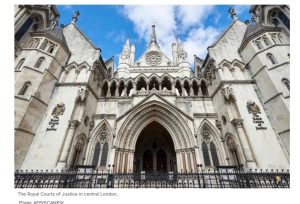
The High Court of Justice, Business and Property Courts of England and Wales, Commercial Court (KBD) presided over by Mr. Justice Bryan, has granted world freezing order against Alhaji Abdulrahman Musa Bashar and a Nigerian company, Ultimate Oil and Gaz FZCO.

The application was brought by Petrichor Energy FZCO (formerly known as CE Energy DMCC).
This was contained in the court judgement with Neutral Citation Number: [2026] EWHC 914 (Comm) and Case No: CL-2024-000225 / CL-2024-000426, which was made available to journalists on Tuesday but dated 30 March 2026
Petrichor Energy FZCO, a Dubai-headquartered energy trading house founded by took a Nigerian millionaire to court seeking to recover over disputed $30 million worth of oil products it supplied and was said not to have been paid for.
It is Petrichor’s attempt to recover losses dating back three years for shipments of gasoil contracted to Nigeria’s Ultimate Oil & Gas, owned by Nigerian millionaire businessman Alhaji Abdulrahman Musa Bashar.
Bryan in the judgement said: “I am satisfied that it is just and convenient to grant a worldwide freezing order in the present case for the following reasons: (1) The application is made post-judgment in order to assist with enforcing judgment. (2) The judgment debts are for significant sums. (3) I am satisfied that the Respondents have assets which will be caught by the injunction and so the relief will be effective; (4) I bear in mind that the Original WFO did not prevent Ultimate from being able to continue to trade and was able to make payments of millions of dollars to purchase product from third parties. Ultimate made a complaint that the requirement to notify the Applicant’s legal representatives before disposing of assets in the ordinary and proper course of its business was onerous, and that was addressed at the time by a variation to the Original WFO to insert a threshold of $100,000.
“However, such an objection carries far less weight post-judgment where the inclusion of a business expenditure exception is harder to justify (see Emmott v Michael Wilson & Partners Ltd [2019] 4 WLR 53 (CA) at [56], and see Great Station Properties (supra.) at [66]).
“That is a factor which may be relevant on a return date in terms of whether or not such a term should continue; and (5) I am satisfied that the Applicant has come to the court with clean hands, although I bear well in mind the point that has been drawn to my attention about an historic WhatsApp exchange.”
According to the judgement,made on 30 March 2026; Petrichor Energy FZCO (the “Applicant”) applied for a post-judgment worldwide freezing order against the First Respondent Alhaji Abdulrahman Musa Bashar (“Mr Bashar”) and the Second Respondent, Ultimate Oil & Gas FZCO (“Ultimate”).
It explained that the judgments relate to unpaid gasoil, sold by the Applicant to Ultimate and a personal guarantee given by Mr Bashar in support of Ultimate’s debt.
It added that the application is supported by the second affidavit of the Claimant’s solicitor, Mark David Lakin of Stephenson Harwood LLP (“Lakin 2”); and the affidavit of the Claimant’s Managing Director, Christopher Eppinger (“Eppinger 1”).
It explained that the application is made without notice.
Below is the judgement:
A. INTRODUCTION
1. Petrichor Energy FZCO (the “Applicant”) applies for a post-judgment worldwide freezing
order against the First Respondent Alhaji Abdulrahman Musa Bashar (“Mr Bashar”) and
the Second Respondent, Ultimate Oil & Gas FZCO (“Ultimate”). The judgments relate to
unpaid gasoil, sold by the Applicant to Ultimate and a personal guarantee given by Mr
Bashar in support of Ultimate’s debt.
2. The application is supported by the second affidavit of the Claimant’s solicitor, Mark
David Lakin of Stephenson Harwood LLP (“Lakin 2”); and the affidavit of the Claimant’s
managing director, Christopher Eppinger (“Eppinger 1”).
3. The application is made without notice. I was satisfied that it was appropriate for the
hearing to proceed on a without notice basis due to the risk that giving notice would
prompt the Respondents to take steps which would defeat the very purpose of the
injunction, as was supported by the evidence of Mr Lakin (in Lakin 2 at paragraph 237).
4. I was also satisfied that the matter was sufficiently urgent to be heard today on a without
notice basis in circumstances where, as shall appear, there has recently been a
conversation, on 15 March 2026, in the course of which Mr Bashar threatened to dissipate
assets.
5. It is right to note at the outset that the Applicant does not start with a blank canvas in
relation to this application for a post-judgment worldwide freezing order in circumstances
where the Applicant had obtained, on 29 July 2024, a pre-judgment ex parte worldwide
freezing order against the Respondents (“the Original WFO”), which was granted by
Robin Knowles J, but which was subsequently discharged by Mr Charles Hollander KC
(sitting as a Deputy Judge of the High Court), that judgment being reported at [2024]
EWHC 2846 (Comm) (“the Hollander Judgment”). The reason why that injunction was
discharged was because the judge considered that the court was not satisfied that there
was a risk of dissipation within the well-known test. In this regard, Mr Hollander KC
stated at [61] as follows:
“In many WFO cases where the Claimant seeks to show risk of
dissipation, there is some positive evidence which supports risk of
dissipation, and that evidence is bolstered by other evidence which,
although not directly showing risk of dissipation, suggests that the
defendant is the sort of individual or entity which by its conduct may
dissipate assets. In such circumstances the strength of the Claimant’s
case on the merits, the fact there is evidence of fraud by the
defendants, that there is evidence of low standards of morality, or lack
of frankness may provide the necessary material from which the court
can infer risk of dissipation. But it all depends. The problem for the
Claimant in the present case is that there is no primary evidence which
shows risk of dissipation…”
6. As was made clear to me at the outset of this application by counsel Nicola Allsop on
behalf of the Applicant, the Applicant is not seeking to go behind the findings that the
Court made on the material that was before it in October 2024. However, in essence,
Approved Judgment Petrichor Energy FZCO v Bashar and Ultimate Oil & Gas FZCO
what is said is that matters have moved on, and have moved on significantly, in that
regard and that is not limited to the fact that the Applicant has the benefit of significant
judgments now against the Respondents, and yet, the Respondents, who on the disclosure
aspect of the original freezing order disclosed assets of some US$170 million in support
of their application to discharge the Original WFO, have not paid the judgments.
7. More than that, one of the factors which was relied on by the judge in the Hollander
Judgment was the fact that a number of the assets, consisted of some US$17.5 million of
real property in Dubai, and as identified at [56]:
“…much of the value of the assets is real property, and whilst I do not
have evidence as to how easy it is to dispose of property in the UAE,
it is obvious that there would be significant problems in disposing of a
large number of properties.”
8. As I shall come on to, in fact, subsequent to the Hollander Judgment, all those properties
in a particular building in the UAE, as well as another property in the UAE, have indeed
been disposed of.
9. Thirdly, and importantly, and as is addressed in the affidavit of Mr Eppinger, there have
very recently been discussions about amending what was called the “new payment
agreement”, which itself provided for a new payment schedule. That, at least in part, has
involved without prejudice discussions but these were followed by a conversation which
is said not to be on a without prejudice basis on 15 March 2026, The evidence of Mr
Eppinger in relation to this, which is at paragraphs 11 to 13 of his affidavit, is as follows:
“11. On 15 March 2026, I received a call from an unknown Nigerian
telephone number. I answered the call and it was Mr Bashar.
This call was not conducted on a without prejudice basis, with
neither me nor Mr Bashar mentioning that the call should be
conducted on such a basis or in any other confidential manner.
12. Mr Bashar insisted that the offer that had been made at the
meeting on 14 March 2026 should be accepted and requested
that I overrule Mr Humphreys-Davies. I said I was unwilling to
do this, and I demanded that Mr Bashar make a significant
payment in March of the sums that were outstanding.
13. In response, he said that this was not possible and if I insisted on
this he would ‘default on my payment obligations’ and would
start to ‘dispose of my assets’ in order to make pursuing him
impossible.
14. In response to that, I said that if that is the path he chose, we (as
in the Applicant) would take all our legal rights including taking
steps to protect the Applicant.”
10. It is said therefore, by Miss Allsop on behalf of the Claimant, that whatever the position at
the time of the Hollander Judgment, matters have moved on in three material respects
since then: firstly, the fact that judgments have now been obtained; secondly, that there is
now actual evidence of dissipation of assets and notwithstanding the sale of those assets,
outstanding payments have not been made; and thirdly, that there has been a recent direct
Approved Judgment Petrichor Energy FZCO v Bashar and Ultimate Oil & Gas FZCO
threat to dissipate of assets. It is against that backdrop that the Applicant applies for a
post-judgment worldwide freezing order against Mr Bashar and Ultimate.
B. BACKGROUND
11. The Applicant is a UAE based oil trading company. In addition to Mr Eppinger, who is
the managing director of the Applicant, there have been a number of other individuals
involved in the dispute which include: Mr Michael Humphreys-Davies (“Mr Humphreys-
Davies”), who was the Applicant’s distillates head trader at the time of the underlying
transactions; and Mr Robin Biswas (“Mr Biswas”), the Applicant’s former Operations
Executive. It was Mr Humphreys-Davies who was referred to in the recent conversation
mentioned above.
12. On 3 January 2024, Prime Rivers Petroleum (“Prime Rivers”) was incorporated in
Nigeria. It is wholly owned by Petrichor Holding Limited, the group holding company.
13. Mr Bashar is a Nigerian businessman and the chairman and sole shareholder of Ultimate.
He is also the Managing Director and Chief Executive Officer of the Nigerian-based
Rahamaniyya group of companies.
14. Ultimate is a commodities trading company incorporated in the UAE. It is the offshore
trading arm of the Rahamaniyya group.
15. A further company in the Rahamaniyya Group, Rahamaniyya Oil & Gas Limited
(“Rahamaniyya”), incorporated in Nigeria, conducts the onshore trading (i.e. in Nigeria)
of the group. It is the owner of a large oil and gas storage depot at Apapa in Lagos,
Nigeria (the “Rahamaniyya Depot”). Mr Adebowale Aderemi (“Mr Aderemi”) is the
manager of the Rahamaniyya Depot and Rahamaniyya is majority owned by Mr Bashar.
16. Zamson Global Resources Limited (“Zamson”) is a Nigerian incorporated entity, also
engaged in the provision of oil and gas storage at a warehouse near Koko, in Nigeria (the
“Koko Depot”). Mr Ibrahim Sulemain (“Mr Sulemain”) is the manager of the Koko
Depot. The majority of the shares in Zamson are held in the name of Mr Alhaji Zayyanu
Bashir (“Mr A Z Bashir”), who is the brother of Mr Bashar. The Claimant believes that
Mr A Z Bashir holds these shares for Mr Bashar but Mr Bashar and the solicitors for
Zamson have denied this (as is addressed in Lakin 2 at paragraph 17(b)).
17. The following individuals have also been involved in the dispute on the Respondents’
side: Mr Kanwar Ratra is the Chief Executive Officer of Ultimate since its establishment
in 2016; a Ms Jane Millan (“Ms Millan”), one of Ultimate’s operators in Dubai; and a Mr
Peter Rabara (“Mr Rabara”) a former employee of Ultimate.
18. Turning to the underlying contracts which I can deal with more shorty than might
otherwise be the case, given that the Claimant has now obtained judgment. The Applicant
and Ultimate entered into a series of contracts for the sale by the Applicant to Ultimate of
various parcels of gasoil and JetA1 fuel, starting with five spot contracts (the “Spot
Contracts”), followed by a term contract entered into on 25 April 2023 (the “Term
Contract”).
19. Although Ultimate belatedly paid for the product that was delivered under the Spot
Contracts, it failed to pay interest under all 5 spot contracts and did not pay the demurrage
due under the first and fourth spot contracts. On 22 November 2023, the Applicant
Approved Judgment Petrichor Energy FZCO v Bashar and Ultimate Oil & Gas FZCO
commenced DIAC arbitration proceedings against Ultimate under the Spot Contracts
seeking recovery of unpaid interest and demurrage.
20. Two lots of cargo were delivered to Ultimate pursuant to the Term Contract and Ultimate
also defaulted on its obligations under the Term Contract.
21. On 14 January 2024, the Applicant and Ultimate entered into the Payment Agreement,
which provided a mechanism for Ultimate to pay its outstanding debts under the Spot
Contracts and Term Contract and, subject to compliance with the terms of the Payment
Agreement, the Applicant was to supply further cargo to Ultimate. Pursuant to the
Payment Agreement and as security for Ultimate’s obligations thereunder, Ultimate was
required to provide the Applicant with nine undated cheques. Ultimate provided nine
undated cheques all signed by Mr Bashar.
22. Mr Bashar also gave a personal guarantee on 14 January 2024, in support of Ultimate’s
obligations under the Payment Agreement (the “Personal Guarantee”). As Ultimate
complied with its initial obligations under the Payment Agreement, the Applicant agreed
to sell a further cargo of gasoil to Ultimate pursuant to the New Spot Contract dated 24
January 2024.
23. Ultimate then breached its further obligations under the Payment Agreement by failing to
pay additional sums as they became due. On 20 March 2024, the Applicant put Ultimate
on notice that it was in clear breach of the Payment Agreement and that the Applicant was
entitled to exercise all of its rights under the Payment Agreement, the Spot Contracts, the
Term Contract, the New Spot Contract, or at law without any further notice to Ultimate.
By letter dated 21 March 2024, Ultimate denied being in default.
24. On 4 April 2024, the Applicant firstly presented seven of the nine cheques for payment,
and, secondly, demanded payment from Mr Bashar under the Personal Guarantee.
25. Two days later, on 6 April 2024, the Applicant was informed by the bank that all of the
cheques that it had encashed had been returned by the bank due to an “irregular”
signature. The Applicant later lodged a criminal complaint in relation to the dishonoured
cheques which resulted in Mr Bashar being sentenced, in absentia, to one year in prison.
At the parties’ request, this sentence was later revoked. I address this matter further, in
due course, below because it is important to put the timing of this in context, as the
Hollander judgment preceded the findings of the court and Mr Bashar being sentenced to
one year in prison.
B.1 Proceedings
26. As already noted above, on 22 November 2023, the Claimant commenced DIAC
arbitration proceedings against Ultimate under the Spot Contracts seeking recovery of
unpaid interest and demurrage in respect of these cargoes.
27. On 17 April 2024, the Applicant commenced proceedings against Mr Bashar under the
personal guarantee, under claim number CL-2024-000225 (the “PG Proceedings”).
28. On 7 May 2024, the Claimant commenced LCIA proceedings against Ultimate under the
Term Contract for outstanding demurrage and interest due in respect of the first cargo and
the remaining principal and interest in respect of the second cargo (the “LCIA
Proceedings”).
Approved Judgment Petrichor Energy FZCO v Bashar and Ultimate Oil & Gas FZCO
29. On 24 July 2024, the Applicant applied, for and on 29 July 2024 was granted, the Original
WFO (in support of the PG Proceedings, LCIA Proceedings, and the New Spot
Proceedings). Ultimate and Mr Bashar ultimately successfully applied to set aside the
Original WFO on the basis that the Deputy Judge was not satisfied as to the risk of
dissipation.
30. On 25 July 2024, the Applicant commenced proceedings against Ultimate in claim
number CL-2024-000426 in respect of the sums due under the New Spot Contract (the
“New Spot Proceedings”).
31. On 9 August 2024, the Applicant applied for summary judgment or to strike out Mr
Bashar’s defence in the PG Proceedings, and on 21 November 2024, the Applicant
applied for summary judgment or to strike out Ultimate’s defence in the New Spot
Proceedings.
32. Following the hearing of both summary judgment applications on 23 January 2025,
judgment was handed down on 14 February 2025 by Mr Paul Stanley KC (sitting as a
Deputy Judge of the High Court) who awarded summary judgment to the Applicant and
ordered:
(1) Ultimate to pay the Applicant the sum of AED 22,846,944.69 in respect of the
outstanding amount owed for the New Spot Cargo, plus interest and costs; and
(2) Mr Bashar to pay the Applicant the sum of AED 122,189,310, plus interest and
costs, under the Personal Guarantee;
(together, the “Summary Judgments”).
33. The court gave permission to appeal on a single point of law regarding the scope and
operation of s. 49(2) of the Sale of Goods Act 1979, but that appeal was not ultimately
pursued as a consequence of further agreements between the parties.
B.2 Attempts to Enforce the Summary Judgments
34. On 10 March 2025, the Applicant made an application for a third-party debt order against
funds held by the Access Bank UK Limited (“Access Bank”) for Ultimate, which was
granted by the court on 12 March 2025 (the “First ITPDO”). The First ITPDO was
discharged by Master Thornett on 10 April 2025 on the application of the Applicant to
facilitate without prejudice discussions.
35. On 10 October 2025, the Applicant applied for interim third-party debt orders (the
“ITPDO”) against Access Bank in respect of bank accounts held in the name of Mr
Bashar and Ultimate. Access Bank confirmed that at the time of service of the ITPDO
they: (a) did not hold, and had never held, any funds on behalf of Mr Bashar or accounts
in his name; and (b) that they held four accounts with Ultimate with a total credit of
US$1,316.14 and £90. The court discharged the ITPDO in respect of Mr Bashar at the
request of the Applicant on 17 November 2025.
36. Ultimate opposed the making of a final third-party debt order on the basis that this would
apparently have a detrimental impact on its relationship with Access Bank with whom it
alleged it had a US$30 million trade finance facility.
Approved Judgment Petrichor Energy FZCO v Bashar and Ultimate Oil & Gas FZCO
37. On 23 December 2025, Master Davison made the final TPDO requiring Access Bank to
pay the Applicant £90 and US$1,316.14, with the Applicant’s costs of the TPDO
application in the amount of £233.50 to be retained out of those funds. The Applicant has
since received those funds.
38. On 5 December 2025, the Applicant filed proceedings against Mr Bashar and Ultimate
before the DIFC Courts seeking recognition and enforcement of the Summary Judgments
as a judgment of the DIFC Courts (the “DIFC Court Proceedings”). Mr Bashar and
Ultimate have challenged the jurisdiction of the DIFC Court, on what the Applicant
believes to be spurious grounds, one of which was withdrawn on 23 March 2026.
However, during the course of oral submissions before me, Miss Allsop updated me as to
the position as to the points that were actually taken at the hearing last Friday on 27
March 2026, which were, to an extent, different. I bear in mind what I was told by Miss
Allsop in that regard. In the event, judgment was reserved.
B.3 The New Payment Agreement
39. On 24 April 2025, the Applicant, Mr Bashar and Ultimate entered into a further settlement
agreement (the “New Payment Agreement”), providing for payment in several instalments
starting on 25 April 2025.
40. The New Payment Agreement allowed Ultimate three grace periods, permitting it a
further ten UAE banking days to pay any of the instalments. In the event that either (i)
payment was not made within the grace period, or (ii) Ultimate utilised all three grace
periods and then failed to make a further payment on time, the Applicant was then
entitled, amongst other matters, to commence enforcement in relation to the Summary
Judgments, and to pursue the DIAC and LCIA arbitrations, after having given the
necessary notice.
41. Having exhausted all three grace periods, Ultimate failed to pay the fifth instalment which
was initially due on 25 August 2025. Ultimate requested additional time to make
payment, which the Applicant granted. Addendum 1 dated 22 August 2025 extended the
payment deadline to 1 September 2025, and Addendum 2 dated 1 September 2025
extended it to 8 September 2025. Ultimate failed to pay the fifth instalment by the
extended deadline. A part payment of the fifth instalment in the amount of AED
1,745,625.00 was made by Ultimate on 13 September 2025. On 11 October 2025,
Ultimate made a part payment of AED 1,470,000.00 towards the outstanding balance of
the fifth instalment payment, leaving an outstanding balance of AED 461,747.37 in
respect of that instalment.
42. Ultimate did not pay the following on time: (i) the sixth instalment, due on 25 September
2025; (ii) the seventh instalment, due on 27 October 2025; or (iii) the eighth instalment,
due on 25 November 2025. The sum of US$32.7 million remains outstanding under the
PG Summary Judgment and the US$7,460,390.95 (exclusive of costs and interest on
costs) under the New Spot Summary Judgment.
43. On 5 December 2025, the Applicant filed a Request for Arbitration (the “RFA”) dated 5
December 2025 seeking that disputes arising out of or in connection with the New
Payment Agreement be referred to LCIA arbitration. In accordance with clause 24.3 of
the New Payment Agreement, the Applicant sought consolidation of the further arbitration
with the existing LCIA Arbitration relating to the Term Contract. On 25 February 2026,
the LCIA Tribunal confirmed that the arbitral proceedings would be consolidated.
Approved Judgment Petrichor Energy FZCO v Bashar and Ultimate Oil & Gas FZCO
44. By the end of January 2026, Ultimate should have paid 10 instalments under the New
Payment Agreement totalling AED 45,777,172.70 but had only paid AED 8,731,683.56,
leaving a shortfall of AED 37,045,489.14.
45. As a result of without prejudice discussions, four payments were made by Ultimate
between 5 February 2026 and 28 February 2026 totalling AED 12,855,150. In accordance
with an agreement between the Applicant and Ultimate, the Applicant has also agreed to
the corresponding release of product stored in the Koko Depot.
46. On 15 March 2026, and as already foreshadowed, Mr Eppinger received a telephone call
from Mr Bashar, in which Mr Bashar urged Mr Eppinger to accept Ultimate’s payment
terms. Mr Eppinger declined and demanded that Mr Bashar make a significant payment in
March, and Mr Bashar responded in the terms that I have already quoted.
B.4 The Sum Outstanding
47. The sum of AED 120,089,582.69 and £94,025.56 (approximately US$32.7 million) is
owed by Mr Bashar in respect of summary judgment in the PG Proceedings.
48. The sum of AED 27,491,540.66 and £63,859.28 (approximately US$7.5 million) is owed
by Ultimate in respect of summary judgment in the New Spot Proceedings.
C. THE FREEZING ORDER APPLICATION
C.1 The General Principles in relation to Pose-Judgment Applications
49. The court will more readily grant a freezing order as an aid to enforcement of a judgment
than on an interim application (see Babanaft International Co SA v Bassatne [1990] 1 Ch
13) per Kerr LJ at [37]:
“However, as a matter of discretion, such orders will in practice no
doubt be made much more readily after judgment.”
50. The applicable principles were recently considered by Calver J in the case of Griffin
Underwriting Limited v Varouxakis [2021] EWHC 226 (Comm) in which he stated at
[29]-[34] as follows:
“29. I turn to the principles governing the granting of a worldwide freezing order. They are, of course, well known. The applicant must show: one, at least a good arguable case on the merits of its claim; two, that the defendant has assets; three, that there is a risk of dissipation of those assets, such that any judgment obtained by the applicant will go unsatisfied; and four, that it is just and convenient to make the order sought.
30. Before addressing each of those requirements, it is worth recalling the general approach to a freezing order which is sought after judgment has been obtained, such as in this case.
The function of a post-judgment freezing order was restated in Emmott v Michael Wilson & Partners [2019] EWCA Civ 219 at 53, where Lord Justice Gross reviewed the earlier authorities
and stated:
Approved Judgment Petrichor Energy FZCO v Bashar and Ultimate Oil & Gas FZCO
‘…post-judgment Mareva injunctions are granted to
facilitate execution, by guarding against a risk of
dissipation over the period between judgment and the
process of execution taking effect, where the judgment
would remain unsatisfied if injunctive relief was
refused … post-judgment Mareva injunctions can no
longer be described as rare… Whether pre- or post-
judgment, a Mareva injunction is not intended to confer a
preference in insolvency and does not form a part of
execution itself. Secondly, by reason of its nature and as
a matter of realism, a post -judgment Mareva will
increase the pressure on a defendant to honour the
judgment debt. The mere increase in such pressure does
not make it illegitimate or ‘in terrorem’.’
31. In this context, the authorities have repeatedly emphasised that a
freezing order will be granted more readily after judgment than
before, see Masri v Consolidated Contractors [2008] EWCA
Civ 288 at paragraph 134.
32. There are a number of reasons for this. First, this reflects the
policy of the law strongly in favour of the enforcement of
judgments, which is based on the principle that justice requires
that the court should be able to take steps to ensure that its
judgments are not rendered valueless by an unjustified disposal
of assets. Second, the existence of a judgment which has not
been satisfied may make it easier to infer a risk of dissipation;
third, it is sometimes the case that factors which are said to
weigh against the making of a freezing order, for example delay
or the absence of assets within this country and the presence of
related proceedings in another jurisdiction, have less weight
where judgment has already been obtained, see Great Station
Properties v UMS [2017] EWHC 330 at paragraphs 61 and 63.
33. I turn next to the good arguable case on the merits. The first
requirement of a good arguable case is necessarily satisfied
where there is a judgment debt, see Great Station at paragraph
53:
‘It is unnecessary to establish that there is a good
arguable case because the claimants have the benefit of
an arbitration award and judgment in their favour.’
34. Here, Griffin has obtained the unsatisfied judgment, together
with judgment on liability in relation to the remainder of its
claim. So I consider that is easily satisfied.”
51. Whilst this is an area which does not appear to be fully developed in the case law, it
appears that this requirement is more or less similar to the requirement on an interim
application to show a risk of dissipation (see the judgment of Hamblen J (as he then was)
in SPL Private Finance (PF1) IC Limited and 17 Others v ARCH Financial Products LLP
[2015] EWHC 1124 (Comm).
Approved Judgment Petrichor Energy FZCO v Bashar and Ultimate Oil & Gas FZCO
52. Although generally there is no requirement that the Applicant provides specific evidence
as to the existence of the Respondents’ assets and their location in order to obtain a WFO,
a post-judgment injunction must be sought for a legitimate purpose – the ultimate
collection of the debt. Therefore, there must be some prospect that the injunction will aid
the judgment creditor in execution, as opposed to place illegitimate pressure upon him
(see Masri (supra.) at [34]).
C.2 The Requisite Elements
53. As already quoted from the decision of Calver J in Griffin, the requirements are, in this
context:
(1) Legitimate purpose/existence of assets;
(2) Risk of dissipation;
(3) Just and convenient; and
(4) Full and frank disclosure.
C.2.1 Legitimate Purpose/Existence of Assets
54. As already foreshadowed, the Respondents have disclosed US$170 million of assets in
support of the discharge of the Original WFO. Whilst that may no longer be the true value
of Mr Bashar’s assets, not least given that he has disposed of some assets for a lesser
value than that which was identified at the time of the Original WFO, i.e. property in the
UAE, there is no doubt that Mr Bashar is a wealthy man and that evidence, in terms of the
disclosure on the previous Original WFO included moveable property, including a large
and expensive luxury car collection and a significant number of high value watches. I am
satisfied that the freezing order is sought for the legitimate purpose of assisting in the
process of the ultimate collection of the debt.
C.2.2 Risk of Dissipation
55. The applicable principles in relation to risk of dissipation are well known. Two of the
most well-known statements are those of Cockerill J in Petroceltic Resources Limited &
Ors v David Fraser Archer [2018] EWHC 671 (Comm), and that of Popplewell J in
Fundo Soberano de Angola v Jose Filomeno dos Santos [2018] EWHC 2199 (Comm) at
[86]:
56. In the former case Cockerill J stated as follows:
“The principles which I now state can broadly be taken from those
authorities, save where I say otherwise. Those principles are:
• The ultimate question is whether it is just and convenient to grant a
freezing order, bearing in mind that it has ‘the nuclear effect of
prohibiting the affected party from dealing with its assets’ and
carries a reputational stigma.
• It is critical to remember the burden is on the applicant to satisfy
the threshold for granting a freezing order and if an applicant has
not adduced sufficient evidence, the application will fail.
Approved Judgment Petrichor Energy FZCO v Bashar and Ultimate Oil & Gas FZCO
• It follows that unless an applicant has made a prima facie case to
support a freezing order, the claimant is not obliged to provide any
explanation or to answer any questions posed.
• The applicant must prove a real risk supported by solid evidence
that a future judgment will not be met because of unjustifiable
dissipation by a defendant.
• Relevant factors in determining whether there is a real risk of
dissipation include the ease with which any assets may be moved
or disposed of, the defendant’s past or existing credit record or
whether there is a history of default in honouring debts, the running
up of liabilities and not paying them or incurring liabilities beyond
the defendant’s means. Evidence of dishonesty or behaving within
unacceptably low standards of commercial morality giving rise to a
feeling of uneasiness about the defendant. (Bank and Clients Plc v
King [2017] EWHC 3099, paragraph 5).
• Claims or even evidence of dishonesty by the defendant which may
establish a good arguable case so far as the substantive case goes
do not, by themselves, support a freezing order. The court must in
each case ‘scrutinise with care whether what is alleged to have
been dishonesty of a person against whom the order is sought in
itself really justifies the inference that that person has assets which
he is likely to dissipate and unless restricted’.
• If and to the extent the substantive claims cast any light on the risk
of dissipation, the fact that a defendant has respectable defences to
those claims has a bearing on the existence of a real risk of
dissipation. (Linsen International Ltd and Others v Humpuss Sea
Transport PTE Ltd [2010] EWHC 383 Comm at paragraph 71 by
Christopher Clarke J).
• There is nothing implicit in complex off-shore corporate structures
which evidences an unjustifiable risk of dissipation. It is not
uncommon for international businessmen and, indeed, quoted UK
companies to use offshore vehicles for their operations, particularly
for tax reasons.
• The stable door point: that if there has been a real risk of the
defendants unjustifiably dissipating their assets, it would have
materialised by the time of the application is a ‘powerful factor
militating against any conclusion of real risk of dissipation’.
• Even if a real risk of dissipation is established, considerations of
confidentiality and commercial stigma and the impact on the
defendant’s commercial interests can weigh heavily in any
assessment of justice and convenience.”
57. In the latter case Popplewell J stated:
Approved Judgment Petrichor Energy FZCO v Bashar and Ultimate Oil & Gas FZCO
“(1) The claimant must show a real risk, judged objectively, that a
future judgment would not be met because of an unjustified
dissipation of assets. In this context dissipation means putting
the assets out of reach of a judgment whether by concealment or
transfer.
(2) The risk of dissipation must be established by solid evidence;
mere inference or generalised assertion is not sufficient.
(3) The risk of dissipation must be established separately against
each respondent.
(4) It is not enough to establish a sufficient risk of dissipation
merely to establish a good arguable case that the defendant has
been guilty of dishonesty; it is necessary to scrutinise the
evidence to see whether the dishonesty in question points to the
conclusion that assets are likely to be dissipated. It is also
necessary to take account of whether there appear at the
interlocutory stage to be properly arguable answers to the
allegations of dishonesty.
(5) The respondent’s former use of offshore structures is relevant
but does not itself equate to a risk of dissipation. Businesses and
individuals often use offshore structures as part of the normal
and legitimate way in which they deal with their assets. Such
legitimate reasons may properly include tax planning, privacy,
and the use of limited liability structures.
(6) What must be threatened is unjustified dissipation. The purpose
of a freezing order is not to provide the claimant with security; it
is to restrain a defendant from evading justice by disposing of,
or concealing, assets otherwise than in the normal course of
business in a way which will have the effect of making it
judgment proof. A freezing order is not intended to stop a
corporate defendant from dealing with its assets in the normal
course of its business. Similarly, it is not intended to constrain
an individual defendant from conducting his personal affairs in
the way he has always conducted them, providing of course that
such conduct is legitimate. If the defendant is not threatening to
change the existing way of handling their assets, it will not be
sufficient to show that such continued conduct would prejudice
the claimant’s ability to enforce a judgment. That would be
contrary to the purpose of the freezing order jurisdiction because
it would require defendants to change their legitimate behaviour
in order to provide preferential security for the claim which the
claimant would not otherwise enjoy.
(7) Each case is fact specific and relevant factors must be looked at
cumulatively.”
58. An applicant for a freezing order does not need to establish the existence of a risk of
dissipation on the balance of probabilities. It is sufficient for the applicant to prove a
Approved Judgment Petrichor Energy FZCO v Bashar and Ultimate Oil & Gas FZCO
danger of dissipation to the “good arguable case” standard (see Lakatamia Shipping
Company Limited v Toshiko Moritomo [2019] EWCA Civ 2203 at [36]).
59. In this regard, I bear in mind the following points:
(1) The burden is on the Applicant to prove a real risk supported by solid evidence and
judged objectively that the judgment will not be met because of unjustifiable
dissipation by the Respondents.
(2) “In this context dissipation means putting the assets out of reach of a judgment
whether by concealment or transfer.” (see Fundo Soberano (supra.) at [86(1)]).
(3) Unjustified dissipation also covers the dealing with of assets in such a way as to make
enforcement of any award or judgment more difficult, unless those dealings can be
justified for normal and proper business purposes (see the judgment of Flaux J in
Congentra v Sixteen Thirteen Marine SA (The ‘Nicolas M’) [2008] 2 Lloyds Reports
602 at [49], as quoted by Haddon Cave J in AH Baldwin at [30]).
(4) “Evidence of actual dishonesty is not essential to the exercise of the jurisdiction, and
there is no need to show an actual intention to dissipate assets…” (see the judgment of
Haddon Cave J in AH Baldwin and Sons Ltd v Sheikh Saud Bin Mohammed Bin Ali
Al-Thani [2012] EWHC 3156 (QB) at [31(3)]).
(5) “If there is a good arguable case in support of an allegation that the defendant has
acted fraudulently or dishonestly, or with unacceptably low standards of morality
giving rise to a feeling of uneasiness about the defendant (Thane Investments Limited
v Tomlinson [2003] EWCA Civ 1271 at [28]), then it is often unnecessary for there to
be any further specific evidence of dissipation for the court to be entitled to take the
view that there is a sufficient risk to justify granting Mareva relief…” (per Haddon
Cave J in AH Baldwin at [31(4)].
(6) A claimant need not prove that dissipation either has happened or will happen, but
that there are objective facts from which a sufficient risk of it can be inferred (see
Holyoake v Candy [2016] 3 WLR 357 at [20]).
(7) The fact a claimant has a claim which is unanswerable, or virtually incapable of being
defended, may be a powerful fact in favour of granting a freezing injunction, though
not of itself decisive (see AH Baldwin (supra.) at [31(7)] and [41]).
(8) In considering risk of dissipation by a company, the court is entitled to take into
account the conduct of individuals who control the company (see Gee on Injunctions
at paragraph 12-041 citing ArcelorMittal USA LLC v Essar Steel Ltd [2019] 2 All
E.R. (Comm) 414 at [68] per Jacobs J).
C.2.2.1 Discussion in Relation to Risk of Dissipation of Assets
60. I am satisfied that there is solid evidence on which there is, at the very least, a good
arguable case of risk of dissipation. The matters that have been relied upon by Miss
Allsop on behalf of the Claimant apply equally to demonstrating a risk of dissipation in
relation to Mr Bashir and in relation to Ultimate in circumstances where Mr Bshire is the
ultimate decision-maker and controller of Ultimate.
Approved Judgment Petrichor Energy FZCO v Bashar and Ultimate Oil & Gas FZCO
61. Those factors which I am satisfied give rise to such arguable case of a risk of dissipation
fall into a number of categories. Some of those categories were already in existence at the
time of the Hollander Judgment. Others of those categories, which I have already
foreshadowed, have arisen subsequent to the Hollander Judgment. Notwithstanding the
fact there is no challenge to the Hollander Judgment as such, it remains relevant to
consider some of those matters which were before the judge and which gave rise to the
Hollander Judgment because those facts now have to be seen in the light of subsequent
events as well.
C.2.2.2 Asset Dissiptation
62. Since the Hollander Judgment, Mr Bashar has disposed of assets worth many millions of
dollars. In that regard (and following the summary judgment hearing on 23 January 2025
and the summary judgment on 14 February 2025), between January and the end of August
2025 Mr Bashar sold all the Park Lane units in UAE. In March 2025, Ultimate closed its
UK establishment and in April 2025 Mr Bashar sold his villa in Meadows 5, which was
said by him to be worth some US$3,812,117. What it was sold for is not known.
63. Those events are to be set against the backdrop not only of the fact that the summary
judgment had recently been entered on 14 February but also that at around about the same
time as Mr Bashar was selling his villa in Meadows 5, the Court of Appeal rejected the
Respondent’s application for a stay on 4 April, and it was soon thereafter on 24 April that
the new payment agreement instalments were due by 25 April and then subsequently on
26 May, 25 June, and so on until 25 August. Then on 16 July 2025, Mr Bashar sold units
901 to 909, 913, and 915 to 921 for a total price of AED 13,420,000 (approximately
US$3,656,675.75).
64. I am satisfied to the requisite standard, for the purpose of this without notice application,
that the timing of those sales does, indeed, support a risk of dissipation for the following
reasons:
(1) Firstly, it appears that the villa, which has been owned by Mr Bashar since 2007, were
sold very quickly after the entry of the summary judgments. In those circumstances, it
is submitted, I consider with some force, that Mr Bashar was attempting to sell the
property at the same time as negotiating the New Payment Agreement so as to deter
the Applicant from taking enforcement action.
(2) Secondly, although it is not known when Mr Bashar purchased the Park Lane units, as
most of them are on the same floor, that is highly suggestive that they were purchased
at the completion of the building in 2016, although, of course, they could have been
purchased by him as a block subsequently. That then has to be considered, measured
against the fact that they were all then sold in quick succession following the summary
judgments and around the time the New Payment Agreement was entered into.
65. What is more, the sale of those assets, which would have realised a large amount of
money, as I have just identified, do not appear to have been used to pay off the debts to
the Claimants in circumstances where the Respondents were well aware of such debts.
Not only was there a large number of sales in rapid order, it also appears that the sale
price was very significantly below the values disclosed at the time of the Original WFO.
They were estimated then to total, the relevant Park Lane units, some US$9,497,148, but
the total sale price for these units was only approximately US$3,656,675. So very
Approved Judgment Petrichor Energy FZCO v Bashar and Ultimate Oil & Gas FZCO
significantly, indeed almost US$6 million less, than they were said by Mr Bashar on oath
to be worth some months earlier.
66. There are, of course, various permutations as to why that might be the case. Either the
initial valuation was overstated, which itself would suggest a lack of truth as to what was
said at the time of the original disclosure exercise, or conceivably, the market could have
dropped, or equally, the sale could be at an undervalue which would, of course, be
consistent with a fire sale, which itself would be indicative of dissipation of assets to
evade enforcement of a judgment. On any view, the rapid disposal of so many units, in
such factual circumstances, gives rise to a risk of unjustifiable dissipation of assets.
C.2.2.3 Non-payment of the Judgment Debt
67. The very non-payment of the judgment debt itself supports a risk of dissipation for a
number of reasons. Firstly, in response to the Original WFO, the response disclosed,
supported by Mr Bashar’s sworn affidavit, assets in the sum of US$170 million.
Therefore, on their own evidence, the Respondents could pay the judgment debt, but have
chosen not to do so. It therefore appears that the present case is one of ‘will not pay’
rather than ‘cannot pay’.
68. Secondly, the value of the products, which remains in the tanks, is now at an all-time high
due to the ongoing hostilities in the Middle East, and an onward sale by Ultimate would
significantly reduce the judgment debt. Indeed, based on spot market prices, as of today’s
date they would go very closely to discharging the judgment debt, dependent, of course,
on the condition of the cargo.
C.2.2.4 The Respondents’ behaviour
69. I am satisfied the Respondents’ behaviour points towards a risk of dissipation. There is a
considerable history of defaulting and honouring debts, breaching promises, and the
extensive accrual of liabilities. The point that I am going to come on to in relation to the
dishonoured cheques also points to dishonesty as well, and certainly adopting low
standards of commercial morality.
70. This is an important factor where the factual position has moved on since the Hollander
Judgment because in relation to those cheques, Article 675 of the UAE Commercial
Transaction Law Number 50 of 2022 makes it a criminal offence to sign a cheque in a
way which prohibits its honouring, punishable by a prison sentence of between six months
and two years, and a fine of not less than 10% of the cheque value. On 22 April 2024, the
Applicant filed a criminal complaint with the Dubai police regarding the returned
cheques, which was registered on 25 April 2024, and on 23 December 2024, the UAE
Public Prosecutor accepted the criminal complaint and transferred it to the Criminal
Court.
71. Then on 30 January 2025, the Dubai Criminal Court found Mr Bashar guilty and handed
down an in absentia judgment sentencing him to one year in prison despite Mr Bashar’s
legal representative attending the hearing submitting a memo advancing a civil claim
against the Applicant. The Dubai Criminal Court considered the arguments raised by Mr
Bashar to be a tactic to avoid payment. Following entry into the new payment agreement,
the criminal prosecution was closed on 17 June 2025. The UAE Criminal Court closed
the criminal case between the parties due to a reconciliation between the parties.
Approved Judgment Petrichor Energy FZCO v Bashar and Ultimate Oil & Gas FZCO
72. Whilst, therefore, the sentence was discharged by agreement, the position remains that to
provide dishonoured cheques, with the explanation given by Mr Bashir not being accepted
by the court, and the court finding that a criminal offence had been committed and
sentencing him to one year in prison, all strongly support a lack of honesty on the part of
Mr Bashar. That is an important distinction from the position at the time of the Hollander
Judgment.
C.2.2.5 Inadequate/Adequate Disclosure
73. As Miss Allsop demonstrated in her oral submission before me, and as is also addressed
in the evidence of Mr Lakin, the initial disclosure (as required under the Original WFO)
made on 5 August 2024, failed to disclose assets of over US$41 million, including his
own home in Nigeria said to be worth over US$21,300,000, and also to fail to disclose a
number of petrol stations in Nigeria. Both of those are things which Mr Bashar could
hardly have forgotten about. The accompanying affidavit in which Mr Bashar said, “I
apologise these assets were not identified on 5 August 2024” was no more than a bare
apology and no credible explanation could be given. The explanation given by his
solicitors Holman Fenwick Willan (“HFW”) was no more fulsome in that regard.
74. It was also notable, and remains notable, that Mr Bashir, who has got a primary residence
in Nigeria, disclosed only a single bank account in the UAE and no bank account in
Nigeria. In addition, and in a nine-day period before the return date, no less than US$3
million were allegedly paid out in the ordinary course of business, and yet no accounts
were identified through which all those millions of dollars would be passed.
75. In his judgment discharging the Original WFO, Mr Hollander KC stated:
“…the detail given is often more limited than would ideally be the
case, and indeed, in some cases, less than that required under the
terms of the WFO…”
76. Mr Hollander KC did not go on to make any findings about that in circumstances where
he was discharging the injunction. However, on the material before me, I have no doubt,
certainly for the purpose of a without notice of application, that there was a prima facie
case that the terms of that worldwide freezing order were breached in terms of asset
disclosure.
C.2.2.6 Thwarting Enforcement
77. I am satisfied that there have been attempts to obstruct what are rightly characterised as
legitimate attempts to enforce a summary judgment on what can be characterised properly
as spurious grounds. For example, Ultimate sought to delay the determination of a third-
party debt order application in respect of Access Bank by seeking to adjourn the hearing
at the last minute, having instructed counsel and solicitors for the hearing, the result being
that that adjournment probably cost more than the Applicant recovered from Access Bank
instead of simply paying the funds to the Applicant.
78. Another example is that Mr Bashar and Ultimate have opposed recognition and
enforcement of the summary judgment in the DFC Courts on grounds which at least,
according to the Claimants, are unfounded, one of which was withdrawn, albeit they
pursued such objections, and judgment has been reserved.
C.2.2.7 Interference with Unpaid Products
Approved Judgment Petrichor Energy FZCO v Bashar and Ultimate Oil & Gas FZCO
79. The evidence before me, as addressed by Mr Lakin in his second affidavit at paragraph
43(d), is that there has been interference and blocking of the Applicant’s attempts to
sample the unpaid product, which remains in the Rahamaniyya and Koko depot.
C.2.2.8 Ownership and Nature of Assets
80. I have already identified that Mr Bashar owns a number of items of personal property,
including vehicles and watches, which could be easily disposed of. There is also an issue,
which I have already foreshadowed, as to whether or not Mr Bashar actually owns the
shares in Zamson, which are held by his brother on his behalf, although that has been
denied by both Mr Bashar and Mr Zamson.
C.2.2.9 Mr Bashar’s Statement
81. I consider it is an important factor, albeit one which has not been overplayed by the
Claimant, that according to the evidence of Mr Eppinger on oath, which I take at face
value, during the conversation with Mr Bashar on 15 March 2026, Mr Bashar stated that if
Ultimate’s offer as to payment was not accepted, he would start to “dispose of his assets”
and in circumstances where the Applicant has not accepted Ultimate’s offer, I consider
that this does, indeed, provide direct evidence of a risk of dissipation.
82. Of course, it is possible that on the return date, more evidence will be before the court in
that regard, and it does not follow that the Respondents will necessarily accept the
account, or the entirety of the account, that has been given as to what was said.
Nevertheless, I consider it an important further supporting factor when overlayed on top
of the dissipation of the UAE properties and the failure to pay the judgments following
summary judgment.
C.2.2.10 Previous Contempt of Court
83. In separate proceedings brought by Sahara Energy Resource Limited, Mr Bashar was
found to be in contempt of court following the breach of an injunction to deliver up
product (that Ultimate failed to pay for) and by order made on 7 February, was committed
to prison for ten months and fined £500,000, which the Applicant says indicates the
seriousness of Mr Bashar’s contempt (which he in due course purged).
84. Whilst Mr Hollander KC did not attach any real weight to this factor, I consider that that
factor now has to be considered against the backdrop of the fact that the Respondents are
continuing to fail to comply with court orders, and I do consider that it does further
demonstrate a disregard for due legal process, notwithstanding the risk of imprisonment.
So whilst not the most important factor, and whilst it is a factor that no real weight was
previously attached to, that this court has previously not found to attach any real weight
to, I do consider it is a relevant factor as part of the overall picture.
85. Accordingly, and for all those reasons, I am satisfied that there is, at the very least, a good
arguable case of risk of dissipation.
C.2.3 Just and Convenient
86. I then turn to consider whether it is just and convenient to grant the relief that is sought.
Approved Judgment Petrichor Energy FZCO v Bashar and Ultimate Oil & Gas FZCO
87. As is well established, the “just and convenient” requirement is relevant to whether a
freezing order should be granted and on what terms (see Holyoake v Candy [2017] 3
WLR 1131 per Gloster LJ at [45]).
88. Grant and Mumford on Civil Fraud (first edn., paragraph 28-059) identifies a series of
non-exhaustive factors which are relevant to the question of whether it is just and
convenient to grant a freezing order, and with which I agree. They are as follows:
(1) The strength of the underlying claim: the stronger the claim, the less “unjust” the
order is likely to be because the defendant’s assets are more likely to be exposed to
enforcement in due course;
(2) The size of the claim: a small claim is unlikely to justify the full panoply and
substantial cost of a freezing order;
(3) Whether the injunctive relief sought will be effective and whether the cost of
obtaining and enforcing it will be proportionate to the value of what is likely to be
frozen;
(4) The potential disruption to the defendant’s business: it is well known that a freezing
order can have a devastating impact on a company’s business or trade; and
(5) The conduct of the Applicant in relation to the application and the underlying claim:
an applicant for injunctive relief must come to court with “clean hands.”
89. Turning to the application of such factors to the facts of the present case, I am satisfied
that it is just and convenient to grant a worldwide freezing order in the present case for the
following reasons:
(1) The application is made post-judgment in order to assist with enforcing judgment.
(2) The judgment debts are for significant sums.
(3) I am satisfied that the Respondents have assets which will be caught by the injunction
and so the relief will be effective;
(4) I bear in mind that the Original WFO did not prevent Ultimate from being able to
continue to trade and was able to make payments of millions of dollars to purchase
product from third parties. Ultimate made a complaint that the requirement to notify
the Applicant’s legal representatives before disposing of assets in the ordinary and
proper course of its business was onerous, and that was addressed at the time by a
variation to the Original WFO to insert a threshold of US$100,000. However, such
an objection carries far less weight post-judgment where the inclusion of a business
expenditure exception is harder to justify (see Emmott v Michael Wilson & Partners
Ltd [2019] 4 WLR 53 (CA) at [56], and see Great Station Properties (supra.) at [66]).
That is a factor which may be relevant on a return date in terms of whether or not
such a term should continue; and
(5) I am satisfied that the Applicant has come to the court with clean hands, although I
bear well in mind the point that has been drawn to my attention about an historic
WhatsApp exchange.
Approved Judgment Petrichor Energy FZCO v Bashar and Ultimate Oil & Gas FZCO
All those factors point to it being just and convenient to make the order sought pending a
return date.
C.2.4 Full and Frank Disclosure
90. I have been addressed extensively in relation to the obligation of full and frank disclosure
both in the evidence of Mr Lakin, in the skeleton argument in support of the application,
and in the oral submissions of Miss Allsop today. I bear in mind all those points which
have been made. I am satisfied that none of them tell against the granting of the relief
which is sought. I will deal with them briefly in such circumstances.
91. Firstly, it is right that the Original WFO was discharged by Charles Hollander KC for the
reasons given by him in the Hollander Judgment. However, as I have addressed during
the course of this judgment, matters have moved on significantly since then, and there are
now judgments against the Respondents. There is the actual evidence of real property
assets being disposed of, and there is the very recent threat to dispose assets.
92. Secondly, whilst it may be said that there is some security for the judgments (in terms of
the product in the tanks), the reality is that there have been suggested potential bars to any
sale of the same, including it being denied in correspondence that the Applicant is entitled
to resell the product. In this regard, Rahamaniyya and Zamson have not permitted full
access to the product, which has led to proceedings to apply for delivery up. Inevitably,
any future sale is likely to be viewed as a salvage sale in the market. There is evidence
before me that the quality of the product is likely to have deteriorated which would have a
negative impact upon price. Additionally, there is also an issue in relation to the value of
the Nigerian Naira at the moment as compared to the US dollar. Finally, and puzzlingly,
Ultimate does not appear to have been willing to sell the product notwithstanding the fact
that there are currently very favourable market conditions, and that could suggest that the
product is not readily saleable, which would impact upon the security value. In such
circumstances, and whilst the product, if on spec, would offer a considerable amount of
security, possibly even approaching the value of the judgment debt subject to daily
volatility, the other factors lead me to consider that there is a very real risk that the cargo
will be worth significantly less than those amounts.
93. In terms of the property disposals, it may well be that it will be suggested that there is a
legitimate commercial explanation for selling the properties, but if that is so, it is rightly
pointed out to me that it is surprising that the realised sums have not been put to
discharging the debts.
94. It is said that Mr Bashar has apologised to court for his past contempt, and that, in fact, he
gave explanations as to the Sahara payments, he suggested that he was ill-advised by his
lawyers, and that sums were ultimately paid. All that is true so far as it goes. I do not
regard the Sahara contempt as an important aspect of the risk of dissipation, but it does
seem to be the case that history is now repeating itself in terms of the failures to pay set
against the backdrop of the evidence of risk of dissipation that I have identified.
95. I have also considered the question of timing and any delay in seeking relief. Due to the
terms that have been negotiated, it would not have been possible to bring matters before
this court before September or October 2025. There have then been subsequent payments.
I am satisfied that there has been no material delay in bringing this matter forward.
Approved Judgment Petrichor Energy FZCO v Bashar and Ultimate Oil & Gas FZCO
96. I have had drawn to my attention what is often called the “stable door point” which was expressed by Cockerill J in the Petroceltic case, but as was memorably said by Cooke J in Antonio Gramsci Shipping Corp v Recoletos Ltd [2011] EWHC 2242 (QB) at [29], the granting of a worldwide freezing order will at least ensure that such dissipation does not
continue even if the horse has bolted and all that is left is a miniature pony. In fact, on the evidence before me, I consider the likelihood is that something more than a miniature pony will be left, but only time will tell in that regard.
97. I have already addressed that I do not consider that the Claimant has acted in an oppressive manner, and I also do not consider that the fact that a high interest rate applies, impacts upon the position. Such interest is simply compensation for the Claimant being
kept out of the money.
98. Finally, and also foreshadowed, it is possible that the evidence of Mr Eppinger will not be fully accepted on any return date. It may also be said that that conversation was without prejudice, given that it was set against a backdrop of earlier without prejudice negotiations. However, Mr Bashar is well aware of the without prejudice principle and it has been expressed on previous occasions. It was not expressed on that occasion. So if he wished it to be on a without prejudice basis, he could easily have done so. In any event,
without prejudice privilege does not extend to negotiations as to how an admitted debt is to be paid (see Bradford & Bingley v Rashid [2006] 1 WLR 2066 per Lord Brown at [72]-
[73]). In addition, without privilege cannot be used as a cloak for fraud.
99. For all those reasons, I am satisfied that it is appropriate to grant a worldwide freezing order post-judgment in the terms sought.
D. ALTERNATIVE SERVICE
100. There are also before me applications for alternative service in circumstances where such orders were made at the time of the Original WFO was made. It is said that those orders
still apply, but out of an abundance of caution, the Applicant also seeks permission to
serve the application and all relevant documents on the Respondent by alternative means,
namely by email.
101. The court has jurisdiction to permit alternative service out of the jurisdiction by
alternative means “where it appears to the court that there is good reason to do so” pursuant to CPR rule 6.37(5)(b)(i) (application for permission to serve the claim form out of the jurisdiction), CPR rule 6.15 (service of the claim form), and CPR rule 6.27 (applying rule 6.15 to “any document in the proceedings”).
102. I am satisfied that there is good reason in this case to do so. In particular, and as is usually the case in the context of applications for freezing orders, the freezing order needs to be brought to the attention of the Respondents at the earliest possible juncture so that they are aware of the same and are obliged to comply with the same, and to avoid a relevant person unwittingly breaching the terms of the order. I am also satisfied that
service by email in this case has proved effective to date. There is also evidence before me in Lakin 2 at paragraph 259 that there is no specific law that forbids service of legal documents by email in either UAE or Nigeria. Accordingly, I make the orders for alternative service that are sought.