
 By joshua
Tinubu’s Reforms Yielding Results, More Gains Expected — Minister
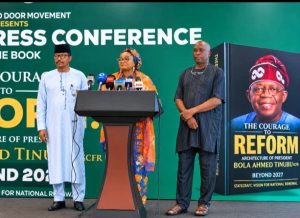
……As PBAT Door-to-Door Movement Set to Unveil Book on Tinubu’s Reform Agenda
Juliet Akoje In Abuja
The Minister of Women Affairs and Social Development, Hajiya Imaan Sulaiman Ibrahim has defended President Bola Ahmed Tinubu’s economic reforms, describing them as necessary and bold decisions that are beginning to deliver results despite the economic difficulties faced by Nigerians.
Sulaiman-Ibrahim stated this on Tuesday at a national press conference organised ahead of the unveiling of a book examining Tinubu’s reform agenda.
She said the President had chosen to confront the country’s longstanding economic problems rather than transfer the burden to future generations.
The book, titled The Courage to Reform: Architecture of President Bola Ahmed Tinubu, GCFR — Beyond 2027: Statecraft, Vision for National Renewal, is being promoted by the PBAT Door-to-Door Movement to showcase the administration’s policies and achievements over the past three years.
According to the minister, Tinubu assumed office on May 29, 2023, amid difficult economic circumstances that demanded decisive action to address structural weaknesses in Nigeria’s economy, revenue collection system and public finances.
She explained that the petrol subsidy was consuming funds that could otherwise have been invested in essential public services, including education, healthcare and road infrastructure.
She also criticised the existing tax system for placing disproportionate pressure on the people it was meant to protect.
“When Mr. President took the oath of office on 29 May 2023, he inherited hard choices that could no longer wait. A petrol subsidy was draining the resources meant for our schools, our hospitals and our roads and our tax system weighed most heavily on the people it should have protected. He could have passed the problem to the next generation. He chose to confront it,” she said.
While acknowledging the economic hardship triggered by the reforms, Sulaiman-Ibrahim said the government recognised the sacrifices Nigerian households had made.
She, however, maintained that the measures were beginning to produce positive outcomes, citing improvements in external reserves, easing inflationary pressures and renewed investor confidence.
The minister said the government did not take the difficulties experienced by citizens lightly, adding that the sacrifices would ultimately prove worthwhile as the results of the reforms became more evident.
“Those decisions came at a cost and Nigerian families have felt it. No one in this government takes that sacrifice lightly, least of all Mr. President. But I say to you today, with conviction, that the sacrifice is not in vain. The results are beginning to show,” she stated.
She identified the Nigerian Education Loan Fund (NELFUND), the new tax laws and financial autonomy for local governments as key policies intended to ensure that the gains from the economic reforms reach ordinary Nigerians.
According to her, the student loan scheme is widening access to higher education for students from disadvantaged backgrounds, while the tax reforms are intended to shield low-income earners and small businesses from excessive taxation.
“Under the new tax laws, low-income earners and small businesses are protected, so that those with the least are asked to carry the least. And with financial autonomy for local governments, resources now flow closer to our communities,” she said.
Addressing the implications of the reforms for women and vulnerable households, the minister said the administration’s Renewed Hope Agenda had placed social protection and the creation of economic opportunities for women and girls among its priorities.
She explained that her evaluation of government policies was based on their practical impact on women engaged in trading, girls attending school and families living on the margins of society.
She added that the administration remained committed to tackling the difficulties confronting vulnerable Nigerians.
“I judge every reform by one test. Does it reach the woman in the market, the girl in the classroom and the family at the margins? On that test, I can say with pride that our leader and father has kept women at the heart of the Renewed Hope Agenda,” the minister said.
On questions concerning the tangible benefits of the reforms and Nigeria’s increasing borrowing needs, Sulaiman-Ibrahim argued that countries required substantial investments in productive sectors and essential infrastructure to achieve sustainable economic growth.
She maintained that public borrowing was not necessarily a sign of economic failure, noting that developed economies also relied on debt to finance their activities.
She cited the United States as an example of a country that continued to borrow despite having one of the world’s largest economies.
“Show me a country that has developed, that has a strong economy, that is not in debt. I think the most indebted country in the world is the United States of America. And they’re still borrowing,” she said.
The minister further stressed that borrowing should be assessed against the economic value and developmental benefits of the projects financed with the funds.
She acknowledged the importance of responsible debt management, insisting that borrowed resources must be directed towards projects and sectors capable of generating measurable economic returns.
According to her, Nigeria still has significant investment gaps in critical infrastructure and essential systems, making additional resources necessary to address longstanding development challenges.
“One thing I can assure you of is Mr. President will take us to the promised land. He means well for the Nigerian people,” she added.
On the reported increase in the number of out-of-school children in Nigeria from 14 million to 20 million, Sulaiman-Ibrahim acknowledged the seriousness of the challenge but said the government was adopting broader interventions beyond conventional classroom education.
She identified science, technology, engineering and mathematics (STEM) education, alongside technical and vocational education and training (TVET), as part of the measures being pursued to expand learning opportunities and equip young people with relevant skills.
The minister also said the administration had increased its attention to early childhood education, skills acquisition and investment in the education sector.
She explained that the government was adopting a coordinated, whole-of-government approach to address educational challenges and improve children’s access to learning.
“Mr. President is a thinking President, so we’re running a thinking government. We’re very deliberate,” she said.
Sulaiman-Ibrahim further urged Nigerians to understand that the benefits of government reforms and policy announcements might not be felt immediately, explaining that implementation often depended on funding arrangements, administrative adjustments and coordination among relevant institutions.
She expressed confidence that the Tinubu administration would fulfil its commitments, while calling on the media to provide citizens with accurate and factual information about the reforms as political activities intensify ahead of the 2027 general elections.
The minister urged journalists to ensure that public discussions about the administration’s policies were guided by verifiable information rather than misinformation as the country approaches the next general election.
“As 2027 approaches, the national debate will grow louder. Let it also grow wiser, and let it rest on facts. I urge you, the press, to carry those facts to every corner of this country,” she said.
The forthcoming book unveiling is expected to feature President Tinubu as the Special Guest of Honour, with Alhaji Aliko Dangote serving as Chief Launcher and Alhaji Abdul Samad Rabiu as Co-Chief Launcher.
High Chief Government Ekpemupolo, popularly known as Tompolo, is listed as the Chief Host, while the Minister of the Federal Capital Territory, Nyesom Wike, will serve as Host.
The Senate President, Speaker of the House of Representatives, Secretary to the Government of the Federation, state governors and other prominent political and business leaders are also expected to attend the event.