
 By joshua
 The Big Ten: Guardians of Nigeria’s Democratic Soul
By Christopher Sunday
In the eternal rhythm of human existence, there are moments when silence becomes betrayal, and action becomes the only honest language of conscience. Democracy, like truth, is never handed down from the heavens—it is wrestled from the grip of tyranny by those willing to stand alone in the dark, holding nothing but conviction and courage, lighting the way for generations yet unborn.
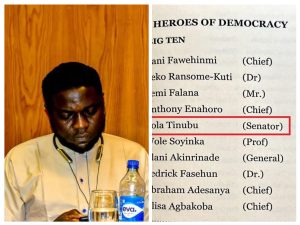
In the moral geography of every nation, there exists a sacred category—those rare individuals who do not bow, who refuse to sell their voices for silver, and whose convictions cannot be detained by handcuffs or silenced by bullets. These are not merely men; they are monuments. Living echoes of thunder in eras defined by fearful whispers. In his timeless book, The Struggle for June 12, the late Frank Kokori inscribed into the chronicles of Nigerian history what he called “The Big Ten” — a fearless circle of patriots who refused to watch their country descend into authoritarian darkness.
At the helm of this distinguished company was Chief Gani Fawehinmi, a man who transformed the courtroom into a battleground for human rights. He was not simply a lawyer—he was the moral spine of Nigeria’s civil resistance. His doggedness, brilliance, and refusal to compromise made him the voice of the voiceless and the conscience of a wounded nation. He suffered arrests, harassment, and detention, yet never wavered. For Gani, law was not a profession—it was a sword of justice against the oppression of the weak.
Dr. Beko Ransome-Kuti, the lion-hearted physician, stood out as a revolutionary healer. While others used medicine to treat the body, Beko used activism to treat the soul of a nation bleeding under military rule. He was a founding member of the Campaign for Democracy (CD), and like his brother Fela, he resisted tyranny with fearless rebellion. His home was raided, his dignity assaulted, yet his spirit remained unbroken. He personified the enduring link between personal sacrifice and public liberation.
Mr. Femi Falana, still a towering figure in Nigerian legal advocacy, was a youthful firebrand during the June 12 struggle. Armed with legal acumen and ideological clarity, he battled the excesses of the military junta from courtrooms to street rallies. In his hands, the Constitution became both shield and sword. Where others compromised or kept silent, Falana rose with audacity, challenging the culture of impunity and inspiring a generation of young human rights defenders.
Chief Anthony Enahoro, whose political activism predates Nigeria’s independence, brought to the June 12 struggle the weight of history and the wisdom of statesmanship. As the man who first moved the motion for Nigeria’s independence in 1953, Enahoro’s involvement in the June 12 saga was not a return to battle—but a continuation of a lifelong mission. He reminded all that democracy is a daily commitment, not a destination.
Among these icons stood Senator Bola Ahmed Tinubu—today the President of Nigeria—whose contributions to the struggle often attract both praise and scrutiny. Yet, facts remain: Tinubu played a strategic, logistical, and financial role in sustaining the pro-democracy movement when many opted for silence or compromise. As a founding member of NADECO, he resisted the military’s venom with resources, voice, and exile. His transition from pro-democracy foot soldier to national leader is both an irony of history and a testimony to the unpredictability of democratic journeys.
Professor Wole Soyinka, Africa’s first Nobel Laureate in Literature, added intellectual thunder to the storm of resistance. Soyinka didn’t merely write poems of protest; he acted them out with his life. Exiled, hunted, and defiant, he symbolized the cultural soul of Nigeria’s democratic quest. With a voice laced in metaphor and fury, he became the nation’s griot—forever unafraid to speak truth to power, even when it meant confronting military swords with literary daggers.
General Alani Akinrinade, a rare breed of principled soldier, was one of the few ex-military men who turned against their former comrades to defend democratic ideals. Retired but not retired from truth, he offered strategic wisdom and leadership to the NADECO movement. In a country where the military often closed ranks, Akinrinade’s courage to dissent proved that even among men of war, there exist warriors of peace.
Dr. Frederick Fasehun, founder of the Oodua People’s Congress (OPC), carried the resistance into the grassroots. A medical doctor by training but an agitator by calling, he gave voice to millions of Yoruba citizens who felt marginalized and endangered by the annulment of June 12. He organized, mobilized, and faced brutal repression, yet remained a stubborn fixture in the democratic push.
Chief Abraham Adesanya, a pillar of the Afenifere political movement, represented wisdom in the trenches. Calm, resolute, and incorruptible, he was the face of Yoruba political resistance during the darkest hours. He led with measured courage, proving that elder statesmanship is not about age but the capacity to channel communal grief into collective action.
Olisa Agbakoba, a Senior Advocate of Nigeria, was one of the youngest on the list but no less impactful. As founder of the Civil Liberties Organization (CLO), Agbakoba brought human rights to the center of public discourse. Arrested, brutalized, and banned from travel, he paid a steep personal price. But he also helped build a human rights architecture that Nigeria still leans on today.
These ten men, each different in background, training, and temperament, became the unlikely orchestra of a democratic symphony that challenged military tyranny. They had no guns, no tanks, and no official titles. Yet they stood, with pen, voice, law, and conviction. And history stood with them.
Today, as Nigeria still navigates the complexities of her democratic experiment, we must remember that the freedom we enjoy was bought with sleepless nights, broken bones, and shattered reputations. Democracy is not inherited; it is sustained through eternal vigilance and principled dissent.
The Big Ten are not just names to be recited on ceremonial days—they are moral compasses in a nation often adrift. To truly honour them is to continue their fight: for justice, equity, free speech, and the dignity of the Nigerian soul.
So, when next we mark June 12, let it not be a mere holiday, but a moment of introspection. Would we have stood when they did? Are we standing now?