
 By joshua
 15th Distinguished Public Lecture
Federal University, Lokoja, Nigeria.
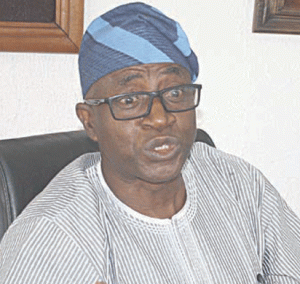
‘Sport has the power to change the world – how true?’. – Ambassador, Dr. Olusegun Odegbami, MON,
I thank you very much for inviting me to deliver the Federal University of Lokoja’s 15th Distinguished Public lecture.
It is, indeed, a great honour.
When I received your invitation, what immediately came to my mind is that the university must know, or must have seen something, that the rest of the world does not. What does an ordinary football player know?
Let me state clearly upfront, therefore, that it will be sheer arrogance for me to come to this citadel of learning and pretend to be who I am not. So, I am here humbly without any airs, without any intention to go on an intellectual expedition drawing from academic library to justify my position on the subject of today’s presentation, one way or the other.
So, having nestled comfortably against that background, I am here only to share my work in Sport (limited as it is) as well as my unique experiences, probably a side of today’s subject matter that may not be found in established academic sports literature.
Once again, little of this my presentation is drawn from a book. It is the product of my personal experiences, significant and, sometimes interesting, events, people and places that will help me to successfully navigate what is truly an intriguing topic for a public lecture.
Beyond that, I am excited to be in the spotlight again. As you all know, as renowned athletes we like to hug the Klieghlights.
My intention, therefore, is to enjoy this moment whilst attempting to take you all on a journey to a place where you may never have been before.
To start with, the title of this presentation is not original to me – “Sport has the power to change the world – how true?”.
It is only the ‘how true’ that I own, and will try to tackle today.
Otherwise, the title is a well-known and well-worn quote by a global political icon, delivered some 20 years ago in Monte Carlo.
As lyrical and beautiful as the words may have sounded to the ears, since then Sport has not changed the world. It has not even impacted the world the way that it should have had the world appreciated its full power, and had been ready to embrace the kind of change that sport can bring upon it.
So, the world took the words of late, former President of South Africa, Nelson Rolihlahla Mandela, as political rhetoric deriving from the emotions at a time in his life that was impacted by sport, a well-documented experience viewed through the lens of sport.
Yet, the Madibba’s speech was epochal, everlasting words expressed before an audience of very famous global athletes at the First Laureus World Sports Awards event in Monte Carlo.
These were his words:
‘Sport has the power to change the world. It has the power to inspire, the power to unite people in a way that little else does. It speaks to the youths in a language they understand. Sport can create hope where there was once despair.
It is more powerful than governments in breaking down racial barriers.
It laughs in the face of all types of discrimination.
The heroes standing with me are examples of that power.
They are valiant not only in the playing field, but also in the community, both local and international. They are champions and they deserve the world’s recognition.
Together, they represent an active vigorous Hall of Fame, a Hall of Fame that goes out into the world spreading help, inspiration and hope.
Their legacy will be an international community where the rules of the game are the same for everyone, and behavior is guided by fair play and good sportsmanship”.
Mandela was not just an ordinary political activist and flippant with his words. He was serious. He was a respected sage, probably the most famous human on earth at the time of his speech, a man that gave his life to protesting against the dehumanization of Black persons in his country under one of the the most oppressive systems of government in history. Apartheid was a satanic White-supremacist system that made Slavery in the 16th to 19th Centuries look like a picnic.
Dr. Mandela was eulogizing the exploits and accomplishments of great athletes, even as those words had a deeper and broader meaning, enough for a person like me to borrow and to promote beyond the cliche of ‘unifying people’.
In 1993, he was released from jail after serving 27 years out of a life sentence.
In 1994, he was elected the first Black President of a new South Africa.
In 1995, South Africa hosted the Rugby World Cup and as President he attended the final match between South Africa and New Zealand. That afternoon of June 24, 1995, Mandela emerged from the underground tunnel of Ellis Park Stadium onto the bright sunlight of an arena with 62,000 spectators packed like Sardines, a rainbow coalition of Black, White and Colored people singing, dancing and drumming together for the first time in a public place. The entire stadium was chanting ‘Nelson’ Nelson, Nelson’, the name of a once-demonized man who became the most loved and first elected Black President of South Africa.
It was a scene viewed on television by over 3 billion humans around the world. It could have been a spectacle straight out of a fictional movie titled ‘the impossible’ because a South Africa of such coloration was considered inconceivable, until that moment.
Even Nelson Mandela must have stared in disbelief at what Sport manifested on that day, a rugby national team that united sworn enemies, birthed a new country and showcased the possibility of a new World Order.
That day, with the broadest of smiles on his face, and waving to the crowd in blissful appreciation, Mandela uttered a few words, a clarion call to his people and to the rest of the world: ‘One Team, One Country’.
So, for such a man to describe Sport as capable of changing the world must be taken seriously. It must be one of the first global public testimonies in recognition of the ‘Power of Sport’ as a tool for global application.
Before then, crisis had either blessed or bedeviled global sport for decades.
The first in my consciousness was the temporary cessation of the brutal, 3-years Nigerian Civil War.
For two separate days in 1968, it is documented in some historic literature that the fighting between the troops of Nigeria and Biafra stopped temporarily to allow the soldiers of both armies to listen to the radio commentaries of the two matches involving visiting Santos FC of Brazil, led by legendary Pele, the most popular athlete in the world at the time, and Bendel Insurance FC in Benin and the national team, the Green Eagles, in Lagos.
Another event, also in my particular experience, almost shattered the myth of the immunity of Sport from the vagaries of Politics.
The Olympic Movement, probably the largest and most powerful organisation in the world, almost broke up. It happened in 1976. I was a part of that story and shall tell it shortly. But before I do, this.
It was former United States Ambassador to the United Nations, Dr. Andrew Young, that put Nelson Mandela’s great speech in Monte Carlo in proper perspective several years later. I don’t recall where the event took place in Nigeria, but it was reported that Ambassador Young connected all the dots of the historic events from 1976 leading to 2000.
He said that but for the sacrifice made by African athletes in 1976, Apartheid would not have ended when it did;
that Nelson Mandela would not have been released from jail when he was;
that South Africa would not have elected a Black President;
and that the Rugby World Cup would not have taken place in South Africa.
All of that because some athletes sacrificed their personal ambition and dreams.
What happened in 1976?
It is very interesting because I was an active participant in the event that he was referring to.
To amplify what happened, two years ago, a ‘Wall of Fame’ was constructed inside the premises of the Nigerian Institute of International Affairs, in Lagos, Nigeria, in reference of the 1976 events.
On the wall are the names of 47 Nigerian athletes that gave up their ambition to become Olympians in order to respond to the call by the Presidents of 27 African countries led by Tanzania’s Julius Nyerere, and Nigeria’s Olusegun Obasanjo.
One day before the start of the Olympic Games of 1976 in Montreal, Canada, the athletes were instructed to boycott the Games if the International Olympic Committee failed to expel New Zealand from the Olympics for disregarding the global isolation of South Africa and for engaging in a rugby match with the Apartheid regime shortly before the Games.
The IOC insisted they would not expel New Zealand because Rugby, which was the sport in question, was not an Olympic event.
Africa, however, stood its ground, and the IOC threw us out, all the athletes from the 27 protesting African countries (plus Iran and Guyana that joined in sympathy) from the Games Village. The devastated African athletes became the pawns in this unprecedented political/diplomacy power-play.
I was one of the young Nigerian athletes that were sent packing from the Games Village that day, left to manage the psychological and physical damage done to our dreams of becoming Olympic gods, only to end up forgotten for 47 years on the tarmac of history.
That 1976 boycott was the start of a series of political interferences in sports. The next two Olympics in Moscow in 1980 and Los Angeles in 1984, also suffered and became pawns of global political chess game between the Super powers at the time.
After 1984, the world realized the unprecedented damage being done to the youths of the world and to the most unifying activity known to man. The world had to reset the buttons of the Olympic spirit in order to bring back sanity to the Olympic movement, to the Olympic Games and to Sport in general.
Since then, every country in the world has avoided tampering with the sanctity of sports as a unifier of the world, a catalyst for dousing tensions, for creating friendships, for peace and conflict-resolution.
Just for the records, our sacrifice of the 1976 Sports boycott, the first in Olympic history, was finally remembered.
The Nigerian athletes were re-United again some 2 years ago after 47 years in Limbo.
We were lavishly celebrated and rewarded on July 28, 2023 by Airpeace Airline and the Nigerian Institute of International Affairs, NIIA.
The names of all the athletes are now written on a special ‘Wall of Fame’ in Lagos, in everlasting testimony to the ‘Power of Sport’ to change the course of history. So, Nelson Mandela was right.
From Monte Carlo in the year 2000, Mandela’s words kept engaging my head. But was the power of Sports restricted to politics only? Can’t it be deployed to impact other sectors? The questions kept running through my head. Remember also that my world view before now was limited to my experiences as a football player for Nigeria.
Some years earlier, but after I ended my sports career, more by accident than by design, I ventured into the world of sports media, sustaining a weekly column in a newspaper, even as an active athlete since 1978. In 1985 I became part owner of Nigeria’s first all-sports newspaper. It was my baptism into a new world in sport beyond that of an active athlete and politics.
Sports and the media are Siamese Twins, inseparable. Within a few years, I expanded into the wider spectrum of sports media (tv and radio). I soon became some sort of an authority by always adding invaluable an athlete’s experience and perspectives to analysis.
Some years later, it was not surprising when the school of African Studies at Harvard University in the USA invited me as a resource person, along with 4 other experts drawn from different countries in Africa, for a discourse on the Sports Business in Africa.
I was the only person from West Africa, a clear demonstration of how far behind Africa lagged in the global sports Industry.
I managed to bluff my way through the program even though I realized after it that, although I was looked on as a ‘guru’ of sports marketing in Nigeria, I actually knew nothing. But the experience was a wake-up call.
I took away useful information and lessons- the Sports media industry, as a part of the global sports entertainment industry, was one of the most flourishing business sectors in the world. Today, it has a conservative estimated value of some $2.5 Trillion Dollars, with Africa still in the doldrums.
The media is another space using the power of sport to thrive outside politics!
The scope of sport in the wider entertainment industry is vast – coverage of events, organisation of competitions, leagues, merchandising, licensing, agencies, trading in athletes and commodities, services in law, medicine, engineering, technology, and so on, a long chain of related and connected activities.
The Sport Business was a window for me into other frontiers of the power of Sport to impact the world.
One day, soon after my Harvard experience, I was invited by the Nigerian Heart Foundation to help raise funds for a golf tournament for the Foundation in their work of creating awareness for a rampaging ‘silent killer’ in Nigeria.
One in every 5 Nigerians walking the streets was suffering from one heart-related disease or the other. Life expectancy amongst the largest Black population on earth had plummeted to below 50 years of age. High Blood Pressure, Diabetes, Obesity, several forms of cancer were ravaging the people. I was shocked to learn about these things happening around me unnoticed.
It was another eye-opening experience for me. The close connection between Sport and Health is a no-brainer. They go together, hand in hand. But I did not think or realize the magnitude of that connection until my work with the NFH.
I soon abandoned trying to raise funds for the Foundation and started working closely to create public awareness about the prevalence of Non-Communicable diseases in Nigeria and by extension the rest of Africa.
I was eventually appointed African Ambassador of Non-Communicable Disease (Nigerian Alliance), followed shortly after as African ‘champion’ for ‘Exercise is Medicine (USA)’ – local responsibilities but of global dimension and significance.
To crown my Sport and Health experience, I was invited as a resource person to the 13th World Public Health Congress in Ethiopia to give a report on my work with the children in a sports school that I established in 2007 in response to another event that took place in 2004. The jigsaw puzzles are falling into place. ( I will tell that story later).
Meanwhile, I was still just scratching the surface of the connection between Sport and Health.
One day, working with some professors of Physical and Health Education from different countries in Africa and Canada on the campus of the Jomo Kenyatta University in Nairobi, Kenya, we were invited to join a group of Town planners, environmentalists and engineers on the campus working on the re-modeling of the city of Mombasa, on the Indian Ocean coastline of Kenya.
What has Sport got to do with Town planning? That was the question I asked myself as we sat down for the meeting.
They needed our contribution in identifying and designing locations within the city for sport and leisure activities, lanes for running and for cycling, recreational parks, no-car zones, sports infrastructure areas, etc, how to make the city a healthier place for the citizens to live, to reduce air pollution and carbon foot prints, block by block.
It was a massive project and another eye-opener of the power of Sport beyond politics to nursing and healing the environment and the world, village by village, city by city.
It screams ‘Sports and Climate Change’ an existential threat to humanity as we speak.
It gets even more interesting.
In the year 2004, I attended the First World Scholar Athletes Games in the University of Rhode Island, USA. It was a friendship games for Students in secondary schools under the age of 17 invited from over 150 countries.
The United Nations organization was involved in the Games. Their representatives were there to introduce and promote the activities of a new special Sports Unit set up in the UN to drive aspects of the Millennium Development Goals Agenda at the time.
The UN’s objectives did not even have the coloration of politics. The unit was to develop programmes that will support the global fight against illiteracy, poverty, hunger, unemployment and diseases (HIV/AIDS) in the world by 2015!
This was taking Sport to absolutely new dimensions, way outside the political struggles between the West and the East, between capitalism and communism, the ideological and cultural wars of civilization between the world’s super powers, and so on.
Sport had become a weapon to save the world in various ways and through programmes been revealed in my personal experiences.
Remember the Genesis of all these – Nelson Mandela’s speech stating that Sport has the Power to change the world. I could already see and experience the expanding scope, dimensions and possibilities for making it a reality.
Now, here was the United Nations getting involved, introducing sport for the first time as a tool beyond the regular unifying, friendship and peace mantras.
At adjacent seminars organised for participants during the Scholar Athletes Games I sat, listened and drank lavishly from the fountains of new knowledge from experts in various fields exploring the potentials of sports as a ‘weapon’, if well deployed, to solve many hitherto intractable societal problems in the world.
I listened to Former President Bill Clinton on the final day. He spoke on sports as part of the globalization of humanity, and ended with a final admonition for everyone of us to be ready to make a difference in the world with our activities if we cannot as individuals change it. It was a great counsel.
By the time I was leaving the USA in 2004, Sport had become to me a serious agent that could take a shot at changing the world for good if well-deployed. I decided to make it my mission for the rest of my life.
Everything I am going to say from now onwards are the consequences of that my decision.
Even this my presentation here today is, only, therefore, my personal testimony of my work along that line.
I returned to Nigeria from my experience at URI in 2004 a different person.
I established a small specialized model sports secondary school in my village. It became my laboratory to research, to teach, to learn, to document the impact of various aspects of Sports on young children.
For example, what are the benefits or effects on children at an early age, of certain foods, of intense physical activity, of outdoor activities as against sitting behind computers for hours, of vigorous running, jumping, kicking or even walking for hours, and so on?
We also set out to build a model to tackle the issue of illiteracy.
The most affected environment in the world, the area with the largest concentration of illiterates (between 13 and 18 million out-of-school children), incidentally, was in some parts of Northern Nigeria, an area that was also facing compounding internal conflicts and crisis. The challenge was in enrolling the children into schools, how to retain them in the schools, a teaching methodology that will make learning easy and interesting for them, curriculum that are not offensive to their religion or culture, and a clear pathway into a future that fulfills their passion and talent, and guarantees their success in life.
Sport ticks all the boxes, a perfect tool, in my estimation, that could drive out illiteracy in such a difficult environment. I needed to test and prove it.
I took my plan to Borno State. I met the Governor, told him my idea. I requested for 2 students that had been deprived of schooling by the Boko Haram insurgency, or for religious or cultural reasons, to be sent to my school as a test case.
He sent 5 young boys. They were all 15 years old and in 3rd year of Junior Secondary School before they stopped schooling due to the crisis.
They could hardly speak any English, had no numeracy or literary skills, but were very passionate about their football and would do anything to play the game, including giving our educational plan a chance despite initial fears of religious and cultural indoctrination.
But the lure of sport swept aside all fears and apprehensions. They came to the special school located in a little village in the heart of Yorubaland for their sport and education.
Wasimi became their home for the next 3 years, as they went through the special sports and academic programs at senior secondary school level, with a teaching methodology from the UK for children with learning difficulty.
They graduated 7 years ago. Since then, 3 of them have become University/ Polytechnic Graduates, completed their national youth service and have become young leaders in their communities. Every single one of them is still involved at various levels of Sport.
Abdullahi Mohammed, Abdulfatai Mohammed and Lawan Bukar, all alive and kicking today, have become ambassadors of the power of Sport to eradicate illiteracy, to empower the youths with education or professional skills, and to become leaders in their communities. And all of these whilst still living their dreams in sport.
That path remains a veritable model for the world to see, to measure and to adopt.
Finally, 21 years ago, I set out on my most ambitious expedition yet. I had studied the impact of Sport in countries that host major international events. I proposed using Sport to catalyse, facilitate, accelerate and enforce the biggest and fastest infrastructural development program for the West African sub-region, by West Africa bidding to host the First World Cup to be held in the African continent.
The idea was simple. More countries in the project would mean more collaboration, reduction in the burden of cost for a single country, and wider spread of the benefits to more countries. The 8 years of preparing to receive and host a visiting global community of at least 1 million sports fans over a one-month period would change that region completely, forever. It was too good to be true. Yet, Sport has the power to achieve that and more. The evidence is all over other parts of the world – in China, in the UAE, in Europe and America. In these places, sport continues to expand its deployment for infrastructural, social and economic development.
West Africa would have fulfilled the over half-a-Century old dream of the founding political fathers at Independence of a powerful, united and flourishing subregion with a superhighway and rail system running from Dakar to Calabar, a single currency for the region, a borderless region with one visa requirement for all, a common security, immigration and customs apparatus across the region, free trade and movement across the region, etc.
That was my dream in 2003/2004. I revived it again in 2024 for Sport to lead in building a new West Africa through hosting the 2030 or 2034 World Cup.
It did not find fulfillment only because understanding and appreciating the Power of Sport to Change the World has still not found ardent followers, particularly amongst the intelligentsia and big business that can drive it. So, it remains on the tarmac, idling away!
Well, It has become my life’s mission to be an ambassador of spreading the message of the Potency of Sport to impact the world and possibly change it for good.
It is not an easy road to travel but I am always encouraged by Bill Clinton’s wise counsel.. ‘If you can’t change the world, ensure you make a difference’.
That’s what I am doing here today. It is up to you to make of it what you will. Sport is connected to every aspect of life – science, technology, business, law, medicine, film, agriculture, tourism, media, health, leisure, hospitality, psychology, entertainment, environment, education, engineering, architecture, climate change, merchandising, manufacturing, and so on and so forth, in a relationship only limited by personal imagination and creativity.
As a university community I urge you to look critically at the stories I have told you today about some of my personal experiences, and be ready also to test them and go where no one has been, and explore the endless possibilities in the power of Sport, the most potent soft-power tool on the planet that is connected to every aspect of our lives.
The Madibba, Dr. Nelson Rohlilahla Mandela was right: ‘Sport has the power to change the world’.
I rest my humble case!
Ambassador, Dr. Olusegun Odegbami, MON, OLY, AFNIIA, FNIS.
April 3, 2025.
Federal University of Lokoja.