
 By joshua
 PROFESSOR SANI RUFAI ABDULLAHI DELIVERS 24TH INAUGURAL LECTURE OF PRINCE ABUBAKAR AUDU UNIVERSITY, ANYIGBA
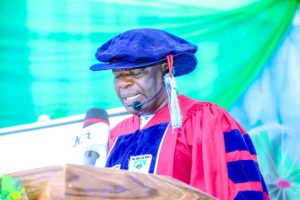
…Calls for Stronger Institutions to Deepen Accountability and Transparency
Professor of Accounting, Professor Sani Rufai Abdullahi, has called for stronger institutions, ethical leadership and value-driven governance as critical requirements for deepening accountability, strengthening public trust, and achieving sustainable national development.
He made the call while delivering the 24th Inaugural Lecture of Prince Abubakar Audu University, Anyigba, titled “Epistemology of Accountability: Societal and Religious Concerns,” on Tuesday, July 28, 2026, at the University Auditorium where he examined the philosophical foundations of accountability and its societal and religious dimensions as indispensable pillars for good governance, ethical conduct and social transformation.
Delivering the lecture, Professor Abdullahi described accountability as a fundamental pillar of moral and social order upon which trust, justice, transparency and responsible leadership are built.
He explained that the epistemology of accountability seeks to understand the nature, origins and justification of knowledge relating to responsibility, answerability and ethical behaviour in both individuals and institutions.
The Inaugural Lecturer noted that while societal accountability is sustained through laws, institutions, and social norms, religious accountability transcends human systems by placing individuals under moral obligations before God.
He maintained that genuine accountability extends beyond compliance with rules and regulations to embrace integrity, stewardship, transparency and ethical consciousness.
Professor Abdullahi identified transparency, answerability and enforcement as the cardinal attributes of accountability, noting that effective accountability operates through vertical, horizontal and social dimensions that collectively promote good governance and institutional effectiveness.
Speaking on the societal dimension of accountability, Professor Abdullahi stated that responsibility to stakeholders, transparency, social justice, corporate social responsibility and good governance remain essential for building public confidence and ensuring sustainable development.
On the religious dimension, the Inaugural Lecturer explained that accountability is regarded across major world religions as a sacred obligation. He noted that Christianity teaches stewardship and responsibility before God, while Islam emphasises hisab (accountability), under which every individual is answerable to Allāh for his or her deeds.
He added that Hinduism and Buddhism reinforce accountability through the doctrine of karma, which teaches that every action has corresponding consequences.
Professor Abdullahi stressed that religious teachings provide a moral compass that inspires honesty, integrity, humility, justice and responsible leadership, even where external supervision is absent.
He also examined the intersection between societal and religious accountability, identifying ethical governance, stewardship, sustainability, peacebuilding, conflict resolution and social cohesion as areas where both dimensions complement each other in promoting responsible leadership and national development.
The Inaugural Lecturer, however, identified corruption, institutional weaknesses, conflicts of interest, ethical dilemmas, globalisation, technological disruptions, cultural relativism and declining moral values as major challenges confronting accountability in contemporary society.
In his words, “Addressing these challenges requires stronger institutions, transparent leadership, active citizen participation, effective legal frameworks and a renewed commitment to ethical values capable of restoring public confidence in governance and public institutions.”
Professor Abdullahi recommended the integration of ethics, civic responsibility, accountability and moral education into primary, secondary, and tertiary education curricula to nurture responsible citizens and future leaders.
He also called for greater autonomy, adequate funding, and stronger enforcement powers for anti-corruption agencies, audit institutions and regulatory bodies to enable them to discharge their responsibilities effectively.
The Inaugural Lecturer further advocated the adoption of digital governance platforms, open-data systems, blockchain-based record management and online audit trails to improve transparency, reduce corruption and strengthen public accountability.
He urged religious organisations to intensify teachings on stewardship, honesty, justice and responsibility while collaborating with governments and civil society organisations to promote ethical behaviour across society.
Professor Abdullahi concluded that accountability is both a societal necessity and a moral imperative, stressing that societies founded on integrity, justice, transparency and responsible leadership are better positioned to achieve peace, equity, institutional stability and sustainable development.
He therefore, urged governments, educational institutions, religious organisations, civil society groups and citizens to work collectively towards building accountable institutions and value-driven communities.
Earlier, the Chairman of the Inaugural Lecture Committee, Professor S.S. Arogba, congratulated the Inaugural Lecturer on attaining the distinguished academic milestone and commended his immense contributions to scholarship in the accounting profession.
In his address, the Vice-Chancellor of Prince Abubakar Audu University, Professor Salisu Ogbo Usman, described the 24th Inaugural Lecture as another remarkable milestone in the University’s academic history, noting that it was the seventh (7th) inaugural lecture delivered since his assumption of office on February 11, 2026.
He noted that the lecture theme was both intellectually profound and socially compelling, stressing that accountability should not be viewed merely as a technical or financial concept but as a body of knowledge deeply rooted in ethical values, societal responsibility, and religious convictions.
Professor Usman noted that the lecture enriched scholarship by demonstrating the interdisciplinary relationship between Accounting, philosophy, sociology, religion, and public ethics.
He added that the lecture reinforced the University’s commitment to producing knowledge that would address societal challenges while promoting innovation, good governance and national development.
The Vice-Chancellor reaffirmed the University’s unwavering commitment to excellence in teaching, research, innovation and character development through sustained support for impactful scholarship and interdisciplinary research.
Professor Usman congratulated Professor Sani Rufai Abdullahi on attaining the distinguished academic milestone and commended him for delivering a lecture that is intellectually stimulating, professionally enriching and socially transformative.
He also appreciated the Chairman and members of the Inaugural Lecture Committee for sustaining the University’s culture of scholarship and academic excellence.
The highlight of the event was the presentation of the inaugural lecture certificate, plaque, and medal to the inaugural lecturer.
The lecture attracted members of the University Governing Council, top government functionaries, members of Management and Senate, academic and non-teaching staff members, students, professional accountants, scholars from other institutions, religious and traditional leaders and distinguished guests from within and outside the University community.
Uredo Omale,
Public Relations Officer,
Prince Abubakar Audu University, Anyigba.