
 By joshua
 ‘Media Must Go Beyond Reporting to Track Money, Protect Whistleblowers’ — Prof. Shehu on Fighting IFFs in Nigeria
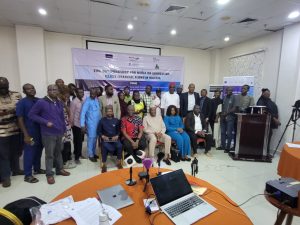
The media has been described as an indispensable partner in combating Illicit Financial Flows, IFFs, in Nigeria, with a call to move beyond routine news reporting to investigative tracking, data analysis, and public accountability.
The position was presented by Prof. Abdullahi Shehu in a paper titled “The Role of the Media in Combating IFFs in Nigeria,”
The ANEEJ Workshop valued at €111,000 under the EU-SecFin Africa Project, outlines multi-layer role for journalists in exposing, deterring, and documenting IFFs.
Prof. Shehu, Secfin Africa Program Representative, said the media should advocate for policy reform by exposing weaknesses in laws, regulations, and enforcement. He also urged reporters to monitor government and corporate activities, including public expenditures, procurement processes, and operations in extractive industries.
By using data journalism, he said, journalists can identify high-risk sectors, produce evidence-based reports on bad practices, and offer policy recommendations.
He noted that the media can promote transparency by scrutinizing public institutions and officials, advocating for disclosure of beneficial ownership, and pushing for open management of public resources. The media he added that should also empower communities to monitor public projects, report corruption and financial misconduct, and participate in governance, including electing credible leaders.
Prof. Shehu urged journalists to support anti-corruption efforts by covering investigations and court proceedings, which he said can create public pressure on oversight bodies like the National Assembly. He called for collaboration with development partners such as the EU-SecFin programme and for the media to track asset recovery and how recovered funds are used. Whistleblower support and protection, he added, should be a priority.
To do the work effectively, he listed key tools: the Freedom of Information Act 2011, government contracts, budget and expenditure tracking, social audits, beneficial ownership databases, and open-data platforms. He also recommended trade data analysis, import/export databases, and investigative methodologies such as money-trail analysis, asset tracing, network mapping, procurement reviews, and forensic accounting. Digital tools for mapping corporate ownership structures and international standards like the UN Convention Against Corruption should also be used, he said.
Prof. Shehu identified major obstacles facing journalists: political intimidation, limited access to information and records, safety risks for investigative reporters, and insufficient funding and technical expertise for complex financial investigations. He urged media houses to form networks, use press conferences and investigative reports, and promote open governance.
“The media must go beyond news reporting. Act independently, serve as a bridge between citizens and government, and use IFFs tools to improve governance,” he said.
The Africa Network for Environment and Economic Justice, ANEEJ, is currently hosting a two-day workshop for media practitioners in Abuja to build capacity for safe and ethical reporting on IFFs, with support from the European Union under the SecFin Africa Project.