
 By joshua
 IFE/OGODU’S EXCLUSION RAISES QUESTIONS AS INEC RESTORES SUPPRESSED CONSTITUENCIES
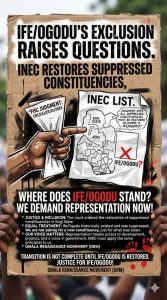
The recent release of the list of restored constituencies by the Independent National Electoral Commission (INEC) has been welcomed across Kogi State as a significant step toward correcting decades of electoral imbalance. However, for the people of Ife/Ogodu, the announcement has generated more concern than celebration.
Their concern is simple: If the Federal High Court ordered the restoration of suppressed constituencies and Ife/Ogodu was among the constituencies historically recognized as suppressed, why was it omitted from the list released by INEC?
This question continues to resonate across communities in Omala Local Government Area, where many believe that the exclusion of Ife/Ogodu contradicts both the spirit and intent of the landmark judgment delivered by Justice Isah A. Danshan in Suit No. FHC/LKJ/CS/01/2026.
In that judgment, the Federal High Court, Lokoja, held that suppressed constituencies in Kogi State deserved restoration and directed INEC to conduct elections in those constituencies. The ruling was celebrated as a victory for constitutional representation and a correction of historical injustice.
For the people of Ife/Ogodu, the judgment rekindled hope that a constituency many believe was unjustly suppressed would finally be restored. It represented the possibility of having a dedicated voice in the Kogi State House of Assembly; a voice that understands the peculiar challenges, aspirations, and developmental needs of the area.
Yet, despite the court’s intervention, the recently published list appears to have left Ife/Ogodu behind.
This development has sparked widespread debate among stakeholders, community leaders, youth groups, and advocates of constituency restoration. Many argue that Ife/Ogodu’s case like others, is unique because it is not a demand for the creation of a new constituency but a call for the restoration of a constituency that historically existed and was recognized before its suppression.
The argument being advanced by supporters of Ife/Ogodu is rooted in fairness and constitutional equity. They contend that if the purpose of the court judgment was to address underrepresentation and restore communities that had lost their political voice, then excluding Ife/Ogodu undermines that objective.
Political representation is more than having a name on a map. It determines access to legislative advocacy, constituency projects, budgetary attention, and direct participation in governance.
For years, residents of Ife/Ogodu have argued that their interests have been diluted under broader political arrangements that fail to adequately reflect their distinct identity and developmental priorities.
Observers note that the Federal High Court judgment was not merely about electoral boundaries. At its core, it was about justice, inclusion, and the constitutional right of communities to be represented.
This is why many believe INEC should revisit the matter and provide clarity on the status of Ife/Ogodu. Transparency is essential, especially where a court judgment has raised legitimate expectations among affected communities.
The people of Ife/Ogodu are not seeking preferential treatment. They are asking for equal treatment. They are asking that the principles applied to other restored constituencies be applied to them as well.
As preparations for the 2027 elections gather momentum, stakeholders are urging INEC to carefully review all relevant records, historical documents, and the implications of the Federal High Court judgment to ensure that no community entitled to representation is left behind.
The restoration of suppressed constituencies was intended to heal old wounds and strengthen democracy. That objective can only be fully achieved when every community that falls within the scope of the court’s decision receives equal consideration.
For the people of Ife/Ogodu, the struggle has never been about politics alone. It is about recognition. It is about representation. Above all, it is about justice.
As the conversation continues, one question remains unanswered: If the court ordered the restoration of suppressed constituencies, where exactly does Ife/Ogodu stand?
Many in the community believe the answer to that question will determine whether the promise of justice has truly been fulfilled. We demand clarifications.
— OMALA RENAISSANCE MOVEMENT (ORM)