
 By joshua
 A Mosque Built by a Christian, Life-Saving Mosque for Xtians; Nigeria’s Test of Faith
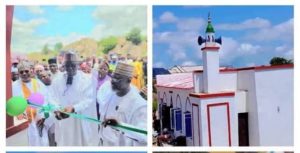
. Peter Gyendyeng and the late Imam Abdullahi Abubakar have given us two powerful lessons: peace must be reciprocal, and humanity must never become the casualty of religious difference_
*By Abdulkarim Abdulmalik*
Nigeria does not lack religious sermons. What the country sometimes lacks is the courage to practise the scriptural values those sermons preach.
That is why the story of Peter Ibrahim Gyendyeng, a Christian in Plateau State who built a Juma’at Mosque for Muslims as a gesture of peace and coexistence, deserves more than a few days of social-media applause.
It deserves reflection. It deserves a national conversation. And, frankly, it deserves to make some of us uncomfortable.
I am happy about Gyendyeng’s gesture. Very happy.
At a time when religious differences can easily become political weapons, when social media arguments can degenerate into religious insults, and when some Nigerians seem determined to interpret every action through the lens of suspicion, a Christian building a mosque for Muslims is a refreshing demonstration of plausible neighbourliness.
Well done, Mr. Gyendyeng.
As we applaud a Christian for helping Muslims practise their religion, intellectual honesty requires us to show comparable respect when a Muslim helps Christians practise theirs.
Nobody is asking Muslims to accept Christianity. Nobody is asking Christians to accept Islam. Nobody is asking anybody to compromise his theology.
The question is simpler: Can we respect one another’s right to live peacefully without requiring one another to surrender our faith?
I believe we can. In fact, Nigeria must.
*Plateau Has Already Shown Us the Way*
There is an extraordinary irony in this conversation.
The same Plateau State has produced another remarkable example of interfaith courage—one that Nigerians should never forget.
In June 2018, during deadly violence in communities around Barkin Ladi, near Jos, Imam Abdullahi Abubakar, then an elderly Islamic cleric, opened his home and mosque to people fleeing the violence. Among those seeking refuge were Christians.
When armed attackers reportedly came looking for the fleeing residents and demanded that the Christians hiding inside be handed over, the Imam refused. He stood between the attackers and those seeking protection. He reportedly told them that those inside were Muslims, thereby shielding the Christians from the attackers. It was an extraordinarily courageous act. According to accounts of the incident, 262 Christians were saved.
In 2019, the United States Department of State honoured Imam Abubakar with its International Religious Freedom Award for his extraordinary courage. The Nigerian government also recognised him with a national honour. He died in Jos in January 2026 at the age of 90.
His death should remind us that Nigeria has produced religious heroes whose greatness was demonstrated not by how loudly they condemned another faith, but by how courageously they protected people of another faith.
Think about that. An Imam protected Christians. Now a Christian has built a mosque for Muslims. Different circumstances. Different individuals. But one very strong message: My faith does not require me to hate you.
That is a message Nigeria desperately needs.
*The Difference Between Faith and Hostility*
One of the mistakes we make in interfaith conversations is assuming that respecting another person’s religious freedom means agreeing with his theology. It does not.
Muslims believe Islam is true. Christians believe Christianity is true. They have every right to hold those convictions.
Religious freedom would be meaningless if people were forbidden from sincerely believing their faith. But conviction and hostility are not the same thing.
A Muslim can believe Islam is true while treating his Christian neighbour with dignity. A Christian can believe Christianity is true while treating his Muslim neighbour with dignity.
The strength of one’s faith should not be measured by the depth of one’s hostility toward another faith.
Indeed, the Qur’an teaches Muslims to act with righteousness and justice toward those who do not fight them because of religion or drive them from their homes (Qur’an 60:8).
It also states clearly: “There is no compulsion in religion” (Qur’an 2:256).
These principles offer a foundation for peaceful coexistence. And Nigeria needs to hear them.
*What Would Reciprocity Look Like?*
Imagine a Nigeria where interfaith kindness becomes normal rather than newsworthy.
A Muslim businessman helps renovate a church destroyed by fire. A Christian businessman supports the renovation of a mosque.
Muslim and Christian organisations establish scholarships together. A church donates food to Muslim families during Ramadan. A mosque supports vulnerable Christian families during Christmas.
Christian and Muslim professionals jointly establish a community health centre. Religious leaders stand together whenever innocent people are attacked. Young Christians and Muslims clean their communities together.
Nobody converts. Nobody loses his identity. Nobody abandons his theology. Yet everybody gains something priceless: trust.
This is what interfaith harmony should mean. Not theological uniformity. Not pretending that Islam and Christianity are identical. Not creating a new religion called “everything is the same.”
Rather, it means recognising that religious diversity does not cancel our common humanity.
*The Dangerous Double Standard*
There is, however, a double standard we must confront.
Sometimes, when a Christian does something generous for Muslims, Muslims praise Christianity’s tolerance.
But when a Muslim does something equally generous for Christians, Christians also praise Islam’s tolerance.
We must stop moving the goalpost according to who is giving and who is receiving.
If an act is genuinely about peace, then peace should remain the principle regardless of the religious identity of the beneficiary.
This is why the hypothetical Muslim who builds a church deserves careful consideration.
There can be legitimate theological discussions about religious participation, intention and boundaries.
But theological disagreement should not automatically become personal abuse, public humiliation or declarations about who is destined for hell. Leave ultimate judgement to God.
Our responsibility as human beings is to act with justice, wisdom and mercy. When a Christian blasphemes Islam, Christian leaders should swiftly rise to condemn the act and demand for the person’s arrest to face the legal consequences.
In the same vein, the Muslim leaders should join hands with their Christian counterparts to ensure the Muslims do not take laws into their hands. And where they do, leaders of the two faiths should collaborate with the Nigeria Inter-Religious Council (NIREC) and support the security agencies to ensure the return of peace while the perpetuators are made to face the law. Faith leaders should stop acting Pontius Pilate.
*Let Plateau Become the Example*
Perhaps Plateau State can become more than a place Nigerians associate with communal violence. Perhaps it can become a laboratory for interfaith reconciliation.
Peter Gyendyeng has given us a mosque. Imam Abdullahi Abubakar gave us a sanctuary. One built a physical place where Muslims could worship. The other turned his mosque and home into a place of refuge for Christians.
What if Plateau deliberately built on these examples? What if Muslim and Christian leaders came together to establish a permanent Plateau Interfaith Peace and Community Service Initiative?
What if young Muslims and Christians were trained together in peace journalism, conflict prevention and community mediation?
What if every major religious celebration became an opportunity for practical acts of kindness rather than merely exchanging greetings?
That would be a legacy worthy of both men.
*The Children Are Watching*
Ultimately, this is about our children. They are watching how we speak about one another.
They are watching whether our religious differences produce hatred or wisdom.
If they hear adults constantly calling followers of another faith enemies, they will inherit suspicion.
If they see us defending one another’s humanity, they will inherit confidence.
The Nigeria we leave behind will be the product of what we teach them today.
So, let us celebrate Peter Gyendyeng. Let us remember Imam Abdullahi Abubakar. But let us do more than celebrate and remember. Let us imitate.
If a Christian can build a mosque for Muslims, let a Muslim be able to help Christians build a church without being treated as though he has abandoned his faith.
If an Imam can risk his safety to protect Christians, Christian leaders should be willing to defend Muslims facing persecution.
If Muslims want Christians to respect Islam, Muslims must demonstrate that they respect Christians as fellow citizens.
If Christians want Muslims to trust them, Christians must demonstrate that trustworthiness is more than a slogan.
This is the essence of reciprocity.
*Peace Must Cross the Road Both Ways*
The greatest test of interfaith harmony is not whether I can tolerate you when you are helping me.
It is whether I can respect you when I am the one being asked to help you.
Peace must cross the road, both ways. Tolerance must be mutual.
Kindness must not have a religious boundary. Human dignity must not carry a denominational label.
And no Nigerian should have to surrender his faith before he can prove that he loves his neighbour.
Mr. Gyendyeng has reminded us of that. The late Imam Abubakar demonstrated it with extraordinary courage. Now the responsibility belongs to all of us.
We should stop building walls in the name of God. Rather, we should build bridges in the name of humanity.
Because when the history of Nigeria is eventually written, perhaps our greatest religious achievement will not be that we defeated one another in theological arguments.
It will be that, despite our differences, we learned how to live together, protect one another and leave our children a more peaceful country than the one we inherited.
That is the Nigeria worth building. That is the Nigeria our faiths should inspire. And that is the Nigeria we must not be afraid to build together.
– Abdulmalik is the Chairman of the Governing Board of the Guild of Interfaith Media Practitioners Nigeria (GIMP-Nigeria). Email contact: info@interfaithmediaguild.org; interfaithmediaguild@gmail.com; nowmalik@gmail.com*