
 By joshua
 When the Qur’an Takes Root in Igboland: The Story Behind 105 Muslim Sisters in Enugu
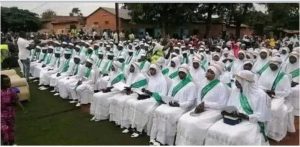
_From a faith once regarded as foreign in the Southeast to a growing community producing Qur’an memorizers, teachers and a new generation of Muslim women_
By Abdulkarim Abdulmalik
There was something deeply symbolic about the sight of 105 Muslim sisters gathering to celebrate the completion of their memorisation of the Qur’an in Enugu, Southeast Nigeria.
The significance went beyond certificates, photographs, congratulatory messages and the joy of parents.
For many Muslims who understand the history of Islam in southeastern Nigeria, the occasion represented something much bigger: the quiet but persistent growth of a religious community that has spent decades negotiating identity, belonging and faith in a region where Christianity has historically been overwhelmingly dominant.
Each of those 105 sisters carried a story.
Some may have begun memorising the Qur’an as children. Others may have struggled with pronunciation, retention and the demands of school and family life. Some depended on parents who insisted that secular education should go hand in hand with religious learning.
But eventually, they reached the finishing line.
And in doing so, they became part of a much longer story — the story of Islam and the Igbo people.
*A Different Picture of Igboland*
For the average Nigerian, the expression “Islam in the Southeast” may initially sound unusual.
Nigeria’s religious geography has often encouraged a simple mental map: Christianity is associated with the South, Islam with the North, while traditional religions occupy the historical background.
Reality, however, has always been more complicated.
Academic research shows that southeastern Nigeria was the part of the country least affected by the nineteenth-century Islamic jihads and political expansion that transformed much of northern Nigeria. Yet Islam eventually established a modest but identifiable presence among Igbo communities.
Historian Egodi Uchendu’s study of Igbo Muslims is particularly important because it challenges the assumption that being Igbo and being Muslim are mutually exclusive identities.
Her research traces conversions among the Igbo particularly from the late 1930s and shows how, over subsequent decades, an indigenous Muslim presence became increasingly visible. She also points to the important role played by Islamic education and the emergence of Igbo Muslim scholars and clerics.
That history is important because religion is never simply about statistics.
It is also about identity.
For generations, the Igbo identity became closely associated with Christianity, particularly as Christian missions expanded their educational and social influence in southeastern Nigeria during the colonial period.
Against this backdrop, an Igbo person embracing Islam could be perceived by some as abandoning not merely one religious tradition for another, but part of a wider cultural identity.
Yet history has repeatedly demonstrated that ethnic identity and religious identity do not always travel together.
A person can be Igbo and Muslim.
A person can be Igbo and Christian.
A person can be Igbo and follow another faith or philosophical tradition.
The emergence of Igbo Muslims is therefore part of the wider complexity of Nigerian identity.
*The First Muslims and the Question of History*
There is some disagreement concerning precisely when Islam first reached different parts of southeastern Nigeria.
Some accounts have suggested earlier commercial and interpersonal contacts, while scholarly investigations have cautioned against turning such claims into established fact without adequate documentary, oral and archaeological evidence.
Rather than emerging from a large Muslim political empire, Islam in Igboland developed largely within a Christian-majority environment, through individual conversion, migration, commercial interaction, marriage, education, preaching and community formation.
Research on the subject describes southeastern Nigeria as a particularly significant case of Muslim minority development. Saheed Ahmad Rufai argues that Islam’s emergence in the region needs to be understood through the initiatives of early Muslims and the mechanisms through which the religion was introduced and sustained among a predominantly Christian population.
The story, therefore, is not simply one of “Islam entering Igboland.”
It is a story of people making choices.
*The Courage of Choosing a Minority Faith*
Imagine being a young Igbo person who becomes Muslim in a community where most of your neighbours, relatives or schoolmates belong to another religion.
The decision may bring questions.
Sometimes it may bring misunderstanding.
There may be family disagreements.
There may also be loneliness.
For some converts, becoming Muslim has meant learning not only a new religious vocabulary but also how to negotiate two important dimensions of identity.
“I am Igbo.”
“I am Muslim.”
Why must one cancel the other?
That question has occupied scholars studying Igbo Muslims.
Uchendu’s research demonstrates that the relationship between ethnic and religious identity among Igbo Muslims has evolved over time. By the 1990s, Islamic education and the emergence of Igbo Muslim scholars helped some Muslims increasingly separate ethnicity from religious identity.
That development may be one of the most important chapters in the story.
*Then came Education*
Religious communities do not survive simply because people believe.
They survive because belief is transmitted.
Children must be taught.
Books must be read.
Teachers must be trained.
Mosques must become places of learning.
Parents must make sacrifices.
And young people must be given reasons to see faith as intellectually and morally meaningful.
This is why Islamic education has been central to the growth of Islam in Igboland.
The story of the 105 sisters in Enugu is therefore significant.
A Qur’an memorisation programme is not simply a religious classroom.
It is an institution of continuity.
A child who memorises the Qur’an today may become tomorrow’s teacher.
A teacher may train another generation.
A graduate may establish a Qur’anic school.
A Muslim woman may raise children who grow up with both Islamic knowledge and a strong Igbo cultural identity.
This way, the Qur’an becomes part of the community’s social memory.
*Why the 105 Sisters Matter*
There is a tendency to look at Muslim minority communities only through the lens of numbers.
How many Muslims are there?
How many mosques?
How many schools?
How many converts/reverts?
These questions matter, but they do not tell the entire story.
The graduation of 105 female Qur’an memorizers offers another measure of community development: human capacity.
It means there are young women who have invested substantial time in religious education.
It means there are teachers capable of transmitting Qur’anic knowledge.
It means families have supported female religious education.
And it means that Islam in Enugu is producing a generation capable of carrying its religious heritage forward.
The achievement is particularly important because women are often the first teachers of children.
A mother who knows the Qur’an can introduce its values into everyday family life.
She can teach her children prayers.
She can explain moral principles.
She can encourage honesty, compassion, patience and service.
In that sense, educating Muslim women is not simply educating individuals.
It is investing in generations.
*Beyond Memorisation*
But there is an important warning.
Memorising the Qur’an should never become merely a certificate-collecting exercise.
The real test begins after graduation.
The Qur’an is not intended merely to occupy memory.
It is intended to transform character.
A person may memorise thousands of verses and still need to learn patience.
Another may know beautiful recitation but struggle with forgiveness.
Someone may have excellent knowledge but poor conduct.
The purpose of Qur’anic education is therefore not only to produce people who can recite the Qur’an but people whose behaviour reflects its ethical teachings.
The Prophet Muhammad (peace and blessings be upon him), according to a well-known hadith recorded by al-Bukhari, said that the best people are those who learn the Qur’an and teach it.
That teaching includes more than pronunciation.
It includes character.
It includes justice.
It includes mercy.
It includes honesty.
It includes service to humanity.
*Islam and Christian-Muslim Relations in the Southeast*
The growth of Islam in Igboland should not be interpreted as a competition between Muslims and Christians.
Nigeria has suffered enough from religious suspicion and misguidance.
The presence of Muslims in a Christian-majority region should instead provide an opportunity for a more mature understanding of religious pluralism, peaceful and harmonious co-existence.
The Qur’an says:
“O mankind, indeed We have created you from a male and a female and made you peoples and tribes that you may know one another.”
The verse presents human diversity as an invitation to knowledge and mutual recognition.
For Muslims in Igboland, that means demonstrating Islamic values through conduct.
It means respecting Christian neighbours.
It means protecting freedom of worship.
It means refusing religious hatred.
It means participating in community development.
It means building relationships with churches, traditional institutions, civil society organisations and the media.
And for Christians, understanding the existence of Igbo Muslims can help challenge stereotypes about what it means to be Muslim in Nigeria.
*The Women are Writing a New Chapter*
There is another message contained in the Enugu graduation.
It is a message about Muslim women.
For too long, public discussions about religious communities have sometimes treated women as passive recipients of religious instruction.
That picture is inadequate.
Muslim women can be scholars, teachers, journalists, professionals, entrepreneurs, community organisers and peacebuilders.
The 105 sisters represent that possibility.
Their achievement should therefore not end with the graduation ceremony.
They should be encouraged to continue their education.
Some should become Qur’an teachers.
Some should study Islamic jurisprudence.
Some should pursue Arabic.
Others should enter medicine, law, journalism, education, science, business and public service.
The Muslim community needs women who understand both their religious heritage and the contemporary world.
*The Future of Islam in Igboland*
What happens next will depend on whether the Muslim community can convert enthusiasm into institutions.
Mosques alone are not enough.
There should be more schools.
Libraries.
Scholarship programmes.
Youth organisations.
Women’s educational programmes.
Interfaith initiatives.
Research centres.
Media platforms.
Community development programmes.
And importantly, structures that preserve peaceful relations with the wider society.
The historical literature suggests that Islamic education has already played an important role in helping Igbo Muslims negotiate identity and strengthen their communities.
The next phase should build upon that foundation.
*A Message from Enugu to Nigeria*
The obvious lesson from the 105 sisters is simple.
Religious growth does not always arrive with noise.
Sometimes it happens quietly.
A mother teaches her daughter a verse.
A teacher corrects a student’s recitation.
A child repeats a passage before going to school.
A family drives to Qur’anic class.
A young woman struggles, perseveres and finally completes her memorisation.
Then one day, 105 sisters stand together.
And people suddenly realise that something has been happening quietly for years.
The Qur’an has been taking root.
Not through coercion.
Not through political power.
But through education, devotion, family commitment and personal conviction.
That is the story worth telling.
The graduation of the 105 sisters in Enugu should therefore be celebrated not merely as a Muslim event but as an important chapter in Nigeria’s continuing story of religious diversity.
It reminds the country that faith can cross ethnic boundaries.
It reminds Igboland that being Igbo and being Muslim are not mutually exclusive.
An importantly, other parts of the country where Christians are in minority should also sleep and wake up with the inspiring Enugu example.
This should also remind Muslims everywhere that the future of Islam depends not merely on numbers, but on knowledge, character and service.
The 105 sisters have memorised the Qur’an.
Now comes the greater responsibility: to live it.
– Abdulkarim Abdulmalik is an Abuja-based Journalist. Email: nowmalik@gmail.com