
 By joshua
 Nkosi Sikelel’ iAfrika: When the Anthem’s Prayer Clashes with Xenophobic Reality
By Alao Adamadamosi Sunday arpa
As South Africa’s national anthem, Nkosi Sikelel’ iAfrika, resonates across stadiums and school assemblies, its opening plea—”Lord, bless Africa”—carries the weight of a continent’s hope. Composed by Enoch Sontonga in 1897 as a hymn of liberation, the song became an anthem of resistance against apartheid, uniting black South Africans and their allies across the globe in a shared dream of freedom, dignity, and African brotherhood.
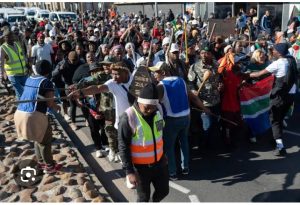
Yet today, that prayer rings hollow. As xenophobic violence once again engulfs parts of South Africa, one cannot help but ask: How can a nation that daily asks God to bless Africa simultaneously permit its citizens to hunt, loot, and kill fellow Africans? How does a country whose struggle for freedom was sustained by the sacrifices of neighbouring nations—Nigeria included—turn around and treat the descendants of those liberators as pariahs?
The full lyrics of the anthem are a testament to unity and hope. The isiXhosa and isiZulu opening calls for God to “raise high her glory” and “hear our prayers”. The Sesotho stanza begs the Lord to “end all wars and tribulations” and “protect our nation”. The Afrikaans verse celebrates the natural beauty of the land—”from our blue heavens”, “from the depth of our seas”, “over our everlasting mountains”. And the English finale declares: “Sounds the call to come together, and united we shall stand, let us live and strive for freedom, in South Africa our land.”
It is a beautiful vision. It is also, in the face of current events, a devastating irony.
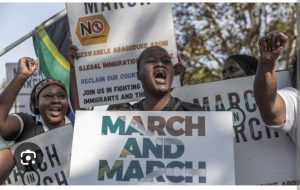
Since late April 2026, South Africa has witnessed a fresh wave of anti-immigrant protests and xenophobic violence, primarily orchestrated by vigilante groups like “Operation Dudula” and “March for March”. These groups have set a 30 June deadline for undocumented migrants to leave the country—a deadline with no legal basis but enormous symbolic power. The consequences have been catastrophic.
In Durban, over 10,000 displaced people are living in dire conditions, having been driven from their homes. Hundreds of documented refugees remain on pavements outside government offices, too terrified to return to their neighbourhoods. In Mossel Bay, two Mozambican migrants were killed, and hundreds more fled into hiding. The Mozambican authorities report a higher death toll, with their citizens killed specifically because of xenophobia. The World Health Organization’s Director-General, Tedros Adhanom Ghebreyesus, called the violence a “tragic betrayal” of the African nations that supported South Africa during the anti-apartheid struggle.
Nigerians have once again found themselves primary targets. Over 1,000 Nigerian citizens have registered for repatriation. The first evacuation flight carrying 268 Nigerians has already landed in Lagos. Many of those fleeing had lived in South Africa for decades—one passenger, Justin, told the BBC he had been there since 1998. He was attacked in a taxi, forced to flee leaving his phone and belongings behind.
Nigeria’s Minister of Foreign Affairs, Bianca Odumegwu-Ojukwu, has not minced words. She described the harassment, looting, and criminal actions against Nigerians, noting that police have done little to intervene. She reminded the world that Nigeria sacrificed funds, resources, and even saw its citizens arrested during protests in support of South Africa’s anti-apartheid struggle. Retaliatory measures, she warned, remain “on the table”.
The attackers’ justification is predictable: migrants are blamed for South Africa’s unemployment rate—which exceeds 30%—and for pressure on public services. Yet as Nigeria’s Consul General in South Africa, Ninikanwa Okey-Uche, pointedly observed, migrants make up less than 10% of the population. “They are not and cannot be the problem,” she said. “Migrants are basically being scapegoated”.
The real drivers are more sinister. Xenophobia does not emerge spontaneously; it is “organised, cultivated and directed”. Political entrepreneurs, seeking support ahead of local elections in November, have found it useful to redirect public anger away from corruption, inequality, and state failure toward vulnerable minorities. Those who benefit from inequality remain untouched while poor communities are encouraged to turn against one another.
South Africa’s motto is “Unity in Diversity”. Its constitutional values enshrine human dignity and the spirit of Ubuntu—the philosophy that “I am because we are”. Yet the government’s response has been tepid. President Cyril Ramaphosa has condemned xenophobia and vigilantism, and announced a “Comprehensive Approach for Migration Management”. But as Okey-Uche noted, words are not enough: “Down on the street, we need to see arrests. We know the people in charge, they’re not hiding. They’ve caused mayhem in people’s lives, but they’re walking free, some of them are running for election”.
The international community is watching—and reacting. South African artists are seeing continental gigs cancelled. South African businesses abroad face backlash. Ghana, Malawi, and Mozambique have already repatriated their citizens. The country’s global brand is suffering.
When South Africans sing Nkosi Sikelel’ iAfrika, they are not merely reciting words. They are making a promise—to God, to Africa, and to themselves. They are declaring that Africa’s children are one family, that its blessings are shared, and that its struggles are collective.
The violent mobs that hunt foreign nationals are not patriots. They are the enemies of everything the anthem stands for. As one editorial poignantly put it: “Xenophobia is not patriotism. Violence against immigrants is not economic policy. Mob attacks do not solve unemployment. They only deepen division, destroy lives and stain national honour”.
The question for South Africa—and for all of us who believe in the promise of a united Africa—is simple: Will the anthem remain a beautiful lie, or will it become a lived truth?
The answer lies not in the words we sing, but in the actions we take. Until every African can walk the streets of Johannesburg, Cape Town, and Durban without fear, until the police protect rather than stand by, until politicians stop using migrants as scapegoats for their own failures—until then, Nkosi Sikelel’ iAfrika will remain not a prayer, but a reproach.
Nigeria and the rest of Africa are watching. And we will not forget.
Alao Adamadamosi Sunday arpa writes from Lokoja.