
 By joshua
 Stakeholders advocates leveraging technology for career path in Agricultural Economies
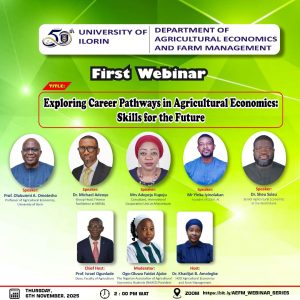
Stakeholders in the agriculture economics sector have urged graduates in the sector to leverage on technology while pursuing a career in the profession, to address global food security challenges.
The stakeholders spoke on Friday during a webinar on Exploring Career Pathways in Agricultural Economics: Skills for the Future.
The webinar was organized by the Department of Agricultural Economics and Farm Management, University of Ilorin.
The Head of Department, Dr Khadijat Amolegbe, said the webinar aimed to provide insights into various career paths available to agricultural economics graduates beyond traditional banking roles.
The Founder CDIAL AI, Mr Yinka Iyinolakan said Artificial Intelligence (AI) when explored, can transform farming through precision agriculture, autonomous robotics, and predictive analytics.
He emphasized that AI is not a replacement but an enabler, adding that different career opportunities in AI and automation can be pursued, and he encouraged continuous learning of digital skills.
A Consultant, International Cooperation Unit at Afreximbank, Mrs Adepeju Ilupeju, while highlighting the projected $1 billion food sector by 2030 said, the importance of regional markets and trade dynamics cannot be over emphasised.
She reiterated the need for strategic approaches, leveraging technology, and considering factors like capital costs, exchange rates, and political environments.
Ilupeju encouraged attendees to seek information, explore grants, and consider value addition in agribusiness.
She added that the shift in financing from commodity to value addition by Afreximbank and various regional organizations should be seen as a growth opportunity.
The Group Head, Finance Facilitation at NIRSAL, Dr Michael Adeoye, highlighted the diverse career opportunities available to agricultural economists, including roles in finance, policy development, research, and agri-tech.
Adeoye stressed the need for skills in agri-value chain analysis, digital tools, data analytics, and communication to succeed in the field.
He also encouraged young agricultural economists to focus on impact-driven projects and leverage platforms like the Association of Agricultural Economists for professional growth.
On his part, a Senior Agricultural Economist at the World Bank, Dr. Sheu Salau, said policy analysis was imperative in addressing global food security challenges.
He emphasized the need for agricultural economists to develop quantitative skills, communication abilities, and technical competencies to advise policymakers effectively.
Dr. Salau discussed various career prospects, including roles in international organizations, the private sector, and agri-tech startups, and encouraged students to pursue internships, fellowships, and additional certifications to enhance their career prospects.
A Nigerian agroeconomist, Prof. Olubunmi Omotesho, shared insights into the history and development of agricultural economics, emphasizing its global impact and relevance in Nigeria.
The Dean of the Faculty of Agriculture, Prof Israel in his admonition, appealed to the Alumni to support the Faculty and bridge the resource gaps limiting its ability to deliver world-class training and research.