
 By joshua
 SENATOR KARIMI’S RECORD OF DELIVERY AND THE CASE FOR MANDATE RENEWAL IN 2027
By Musa Bakare
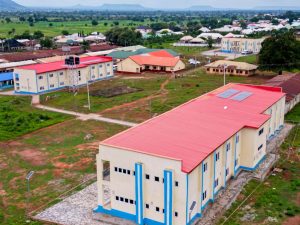
The commissioning of the Government Science Secondary School, Koton-Karfe, Kogi State on September 18, 2026, was far more than an educational ceremony.
It was a vivid demonstration of what purposeful representation can achieve when a political mandate is translated into tangible development, human capital investment and community impact.
For Senator Sunday Steve Karimi, the Koton-Karfe project is not an isolated intervention. It forms part of a broader record spanning education, water, roads, electricity, security, empowerment and human capital development across Kogi West Senatorial District.
His education interventions tell a compelling story. His bursary initiative has supported thousands of students, including 1,000 beneficiaries from Kogi West in 2024 and 3,000 students across Kogi State in 2025, with ₦100,000 awarded to each beneficiary.
A further ₦300 million bursary programme was announced for 2026.
This reflects a simple but important understanding: building schools is essential, but keeping students in school is of utmost important.
On infrastructure, Senator Karimi has facilitated funding for the rehabilitation of the Kabba – Egbe Road, including additional funding aimed at facilitating the contractor’s return to site.
He also personally funded the reconstruction of Pakuta Bridge in Lokoja Local government area, restoring an important link for communities affected by its collapse.
Across Kogi West, his stated interventions in water and electricity include solar-powered boreholes, rehabilitation of water facilities, transformers, electricity infrastructure and solar street lighting.
His empowerment initiatives, including support for cooperative societies, have further extended his intervention agenda into economic development.
Security has also featured in his constituency interventions, including the facilitation of a military forward operating base at Egbe, aimed at strengthening security response within the area.
Taken together, these interventions present a clear picture of a representative seeking to make government presence tangible at community level.
The mandate has not been confined to speeches in Abuja; it has been translated into projects and opportunities across the constituency.
This is where the Koton-Karfe commissioning acquires a broader political significance.
The 2027 election will provide the people of Kogi West with another opportunity to examine the record of their representation, what has been achieved, what remains to be done and whether the direction of development should be sustained.
For beneficiaries of bursaries, roads, bridges, water schemes, electricity projects, educational interventions and empowerment programmes, these are not abstract political promises. They are experiences that can inform how constituents assess representation.
The case being advanced by Senator Karimi’s constituents is therefore fundamentally a case for continuity, consolidation and completion.
If ongoing interventions are creating visible impact, then continuity provides an opportunity to sustain the momentum, expand the reach of existing programmes and pursue unfinished priorities.
For the people of Kogi West, this is why 2027 represents a call to renew confidence in a record they regard as visible, measurable and community-focused.
Kogi West is consequently being asked to look beyond political rhetoric and examine the record.
From classrooms to boreholes; from roads to bridges; from transformers to bursaries; from empowerment to security, the argument for continuity rests on tangible interventions.
The Government Science Secondary School, Koton-Karfe, captures this philosophy perfectly.
A school is more than concrete, classrooms and laboratories. It is a foundation for the next generation of doctors, engineers, scientists, teachers, entrepreneurs and leaders.
Infrastructure becomes human capital when it changes the possibilities available to a child.
Representation becomes meaningful when it creates opportunity.
And a mandate becomes a legacy when its impact continues to serve communities beyond the tenure of the person who secured it.
As Kogi West approaches 2027, Senator Karimi’s constituents are therefore making a straightforward argument for continuity, consolidation and mandate renewal.
Voters have a record before them against which they can make that decision.
2027 is another moment for Kogi West to assess the record, weigh the evidence and decide the direction of its senatorial representation.
For Kogi West, Senator Karimi’s interventions demonstrate purposeful representation and the message is unmistakable.
LET THE WORK CONTINUE