
 By joshua
 OF AUDU, FALEKE AND THE GREAT BETRAYAL OF KOGI’S ROTATIONAL PROMISE.
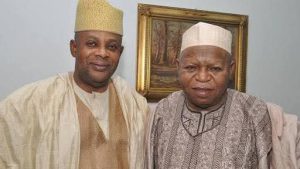
The political journey of the Okun people stands as a poignant chronicle of dreams deferred,a masterclass in the fragility of political covenants and the ruthless calculus of power. This narrative, deeply intertwined with the fate of the Ebira people, has evolved from a story of shared struggle into a tale of divergent fortunes and profound betrayal.
The death of Prince Abubakar Audu in 2015 did more than shatter an immediate Okun ambition,it demolished a principled framework for justice that held the key to lasting stability in Kogi State.
For the decades preceding 2015,the Ebira of Kogi Central and the Okun of Kogi West were bound together by a common political fate,both were perpetual runners up to the enduring hegemony of the Igala of Kogi East, who had governed for 18 successive years since the state’s creation. This shared exclusion from the highest office was the very soil from which Prince Abubakar Audu’s righteous argument grew.
He championed a rotation based on equity and fairness. The Igala,having ruled for 18 years, had had more than a fair share. For Audu, the Okun were the rightful heirs,first in the line of succession.His reasoning was historically grounded and precise,the Ebira,he argued,had already had a shot at executive power in the old Kwara State, with Governor Adamu Attah from 1979 to 1983. Therefore, the Okun quest was not just politically expedient; it was the next logical,fair and necessary step in establishing a lasting rotational legacy.
The supreme irony of 2015 is that the ultimate beneficiary of this disrupted equity was an Ebira man,Alhaji Yahaya Bello. In the wake of the legal tumult that installed him,a fragile hope emerged across Kogi West.The expectation was that Governor Yahaya Bello,a man from a tribe that had also known the sting of exclusion, would understand the imperative of rotation. He was uniquely positioned to institutionalize the very framework Prince Audu had initiated to right the historical wrong and cement his legacy as a statesman who truly united Kogi State by ensuring power moved to Kogi West after his tenure.
This hope was not merely passive,it was actively cultivated and then cruelly shattered. In 2019, while soliciting support for his second term,the then Governor Yahaya Bello stood before prominent Okun elders and made a solemn pledge,his successor would be one of their own.Because the Okun people are virtuous and perhaps politically naive,Okun elders took him at his word. They galvanized crucial support,delivering the needed votes and securing his victory.Yet,when the time came to honour that pledge,it was breached with utter impunity. That history is now a scar, a permanent mark of betrayal that has deepened the grievance from mere disappointment to righteous fury.
To the utter dismay of the Okun people, the man who owed his power to their crucial support has become the most potent obstacle to their aspirations. Far from championing rotational equity, Alhaji Yahaya Bello has systematically dismantled it. He is widely speculated to be the driving force behind the recent political jamboree endorsing Mr. Ododo for a second term,even before his first has properly commenced,a move that has been met with chagrin by Okun leaders and stakeholders across the state. This premature endorsement, strategically tied to President Bola Ahmed Tinubu’s 2027 ambition, represents a calculated reinforcement of the exclusionary politics that has long plagued the state.
This move has attracted condemnation not just from Okun leaders,but from across the political spectrum in both Kogi East and West. The criticism reached a crescendo with Senator Sunday Karimi’s famous outburst,where he boldly declared that “Kogites cannot be intimidated to vote for Asiwaju Bola Ahmed Tinubu come 2027.” This statement, representing significant dissent from within Kogi Central’s own political sphere, attracted wide resentment from members of Alhaji Yahaya Bello’s camp, sparking furious reactions from groups like the Association of Local Government Chairmen and other pro-government factions.
The vehement backlash to Senator Karimi’s statement only underscores the sensitivity of Bello’s political calculations and the breadth of opposition he now faces.
Should this agenda hold,the cumulative stint of Ebira leadership combining Attah’s four years in Kwara and a potential 16 years in Kogi,would stretch to a staggering 20 years of executive power at the state level.
This looming reality hangs over the Okun nation as an undeniable injustice. For a people who have spent zero years in the Lugard House,the mathematical truth of 20 years for Ebira versus 0 years for Okun is a stark, galvanizing indictment. The man who ought to have been a bridge has instead built a fortress,actively blocking the path for the very people who were next in line according to the equitable vision he indirectly inherited and explicitly promised to uphold.
Therefore,a new and resolute spirit is now awakening. The Okun are no longer merely pleading for a turn,they are preparing to wage a decisive political battle for the soul of Lugard House. The current political realignments are fueled by this righteous anger,as speculations that James Abiodun Faleke the living relic of the 2015 mandate,may run again to embody this crusade.
It is a mission to reclaim a stolen future and finally fulfill Prince Audu’s covenant.
The upcoming contest is thus a referendum on rotational equity.It is a demand that Kogi State honours its debt to the Okun people and embraces the principle so eloquently advocated by Prince Abubakar Audu and so brazenly betrayed by his successor. The time for patience is over,the time to arise and claim what is rightfully theirs is now.
Hon Barnabas Ejuku Abiodun,writes from Lokoja, in Kogi State.