
 By joshua
 Nigeria at the Heart of a Global Duel: Trump’s Threat, China’s Stealth Mining
By Christopher Sunday
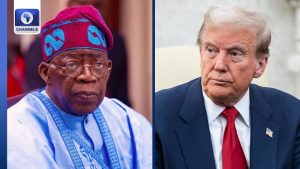
When former United States President Donald Trump issued a blunt warning to the Nigerian government over its alleged complicity with terrorists and poor handling of national resources, global attention shifted once again to Africa’s most populous nation. Beyond the fiery rhetoric lies a deeper struggle that exposes Nigeria as a silent battleground in the ongoing contest between America’s strategic dominance and China’s growing economic expansion.
Trump’s statement, though controversial, has reignited global concern about corruption, insecurity, and the misuse of foreign aid in Nigeria. Yet behind the scenes, his warning also unsettles another global power: China. Beijing has become Nigeria’s most active foreign partner in infrastructure, energy, and mineral extraction. From railways to mining fields, the Chinese government and its affiliated companies have embedded themselves deeply within Nigeria’s economy. Trump’s renewed pressure on Nigeria indirectly threatens this quiet empire and raises serious questions about Beijing’s true interests in the country’s northern and mineral-rich zones.
For more than a decade, China has been on a strategic hunt for the minerals that power the global economy, including lithium, gold, tin, zinc, and ilmenite. These resources are essential for electric vehicles, smartphones, solar panels, and advanced weapon systems. Nigeria, with its vast and largely unregulated deposits, has become an attractive frontier. Investigations by Nigerian and international agencies have revealed a pattern of illegal mining operations involving Chinese nationals, often working in remote areas with the backing of local elites.
In 2025 alone, the Economic and Financial Crimes Commission arrested Chinese nationals in Kwara, Plateau, Lagos, Nasarawa, and Akwa Ibom States for illegal mining and unauthorized export of critical minerals. From lithium to black sand, the scope of their operations shows not just opportunism but a coordinated economic strategy. These incidents are not isolated. They represent a shadow network exploiting weak governance, porous borders, and desperate local economies while draining Nigeria’s mineral wealth.
China officially presents its presence in Nigeria under the Belt and Road Initiative, a global project meant to foster infrastructure development and mutual growth. However, beneath the glossy promises of roads and railways lies a pattern of dependency. Chinese loans often come with opaque terms, and mining deals rarely undergo transparent scrutiny. This economic entanglement makes it difficult for Nigeria to separate legitimate investments from exploitative practices.
Reports by the United States Institute of Peace and the Nigerian Extractive Industries Transparency Initiative warn that these activities not only strip Nigeria of billions in revenue but also fuel insecurity and environmental degradation in mining regions. In some northern communities, illegal mining has been linked to the funding of armed groups, worsening an already fragile security situation.
China’s stake in Nigeria is far greater than many realize. The country’s lithium and gold reserves are vital to China’s technology and energy industries. Nigeria also anchors China’s influence in West Africa and serves as a counterweight to American dominance. The Chinese government views stable access to Nigerian minerals as essential to sustaining its manufacturing base. By maintaining strong ties with Abuja, China also strengthens its diplomatic leverage, pushing the narrative of non-interference while quietly ensuring that Western sanctions or oversight remain minimal.
Beijing’s quiet reaction to Trump’s warning, urging Washington not to interfere in Nigeria’s internal affairs, shows how much it fears losing ground in a country that is central to its African ambitions.
While the United States and China compete for influence, Nigeria stands to lose the most. The uncontrolled mining of its natural resources has deepened poverty, displaced communities, and worsened insecurity. The environmental toll is devastating. Forests have been stripped bare, rivers polluted by toxic chemicals, and farmlands rendered infertile. Yet much of this destruction happens in silence, far from public scrutiny and without real accountability.
Trump’s warning may have caused diplomatic unease, but it has also placed Nigeria under a global microscope. This is a moment that should spark reflection and action. Nigeria cannot afford to remain a pawn in global power games. To reclaim its sovereignty, the government must enforce strict regulation of the mining sector through transparent licensing and modern digital monitoring. Both foreign and local collaborators in illegal mining must be held accountable. The country must also diversify its trade partnerships to avoid over-dependence on any single power and empower investigative journalism to expose the hidden alliances that enable exploitation.
Trump’s warning may appear political, but it has peeled back a deeper truth. Nigeria has become the meeting ground of two empires vying for dominance. As Washington flexes its muscle and Beijing guards its interests, Nigeria’s greatest fight may not be on the battlefield but in the mines, boardrooms, and corridors of power. Until the nation learns to protect its own resources with integrity and courage, others will continue to write its story and steal its wealth.
About the Author
Christopher Sunday is a philosopher, writer, and media consultant. He lectures in Moral Philosophy at Kogi State Polytechnic, Lokoja, and advocates for transparency, justice, and the intellectual independence of African societies.