
 By joshua
 Kugbo Bus Terminal: An Embarrassing Edifice at Abuja’s Gateway—A Test of Planning, Quality and Security
By Comrade Opaluwa Eleojo Simeon (PhD Candidate, Criminology and Security Studies_ )
ABUJA— The Kugbo Bus Terminal, conceived as a solution to public transport challenges at the entrance of the Federal Capital Territory (FCT), has instead become a glaring embarrassment—an unfinished promise of infrastructure that now threatens public confidence and raises security concerns.
What was envisioned by the current FCT administration, alongside the Central Business District (CBD) and Mabushi terminals, as a modern transport gateway has turned into a visibly abandoned structure. Located prominently on the eastern flank of FCT, the terminal’s current state has begun to deface the city and draw sharp criticism from motorists, commuters, and residents alike.
*A Project With Questions From Day One*
From the outset, many citizens questioned the wisdom of the terminal’s siting. Motorists and commuters argued that the facility was built far from the everyday movement patterns of the people it was meant to serve. Instead, they suggested that it could have been placed in a more nodal community—particularly Nyanya—which is more directly connected to dense commuter flows.
These concerns, however, did not prevent the project from being commissioned by officials in government towards the end of 2025. The larger issue, though, emerged after commissioning: the terminal was not put to use, leaving the public to wonder why an expensive transport intervention would be abandoned when its purpose was urgently needed.
*Storm Strikes: The Cover for Poor Oversight Removed*
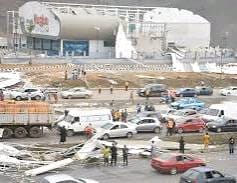
In early 2026, one of the first rainfalls of the year reportedly dealt a heavy blow to the multi-million-naira project. The terminal was damaged, with parts of the structure blown off—an event that would have been catastrophic if the facility had been operational.
While authorities moved to manage the situation, the incident quickly triggered a wider public debate: if the terminal could be so easily affected by ordinary rain and wind, what does that say about construction standards, materials, supervision, and quality assurance?
For critics, the damage was not just about weather conditions. It was about governance—about whether public projects are properly executed, properly inspected, and properly received before being celebrated with government commissioning.
*Abandonment at the City’s Entrance: An Open Security Concern*
Even more troubling than the storm damage is what the terminal represents now: visible neglect at a strategic boundary position into the nation’s capital.
A transport hub is expected to project order, movement, and safety. Instead, the Kugbo Bus Terminal now stands abandoned—physically disrupting the city’s aesthetics and creating conditions that may invite security risks. When infrastructure sits unused in prominent public locations, it can become a gathering point for unlawful activity, a target for vandalism, and a source of ongoing public nuisance.
In a capital city, every structure communicates a message. Right now, Kugbo Bus Terminal is communicating failure: failure of planning, failure of execution, and failure of stewardship after commissioning.
*From “Commissioned” to “Comfortably Useless”*
The story of Kugbe Bus Terminal is particularly humiliating because it was commissioned—meaning government officials publicly declared it ready. Yet the terminal did not serve the public as promised, and before it could even fully begin operations, it was already being defined by damage and abandonment.
This is why many residents describe it as *“an embarrassing edifice”* rather than a developmental landmark. The terminal’s condition suggests that it was not thoroughly tested, not adequately supervised during construction, and not responsibly managed on completion—core duties of public project oversight.
*The Way Forward*
If the FCT administration is serious about transport reform, it must treat Kugbe Bus Terminal not as a publicity success but as a public responsibility requiring urgent attention. That includes:
Transparent assessment of the true state of the structure after storm damage
Independent verification of workmanship, materials, and compliance with construction standards
Public accountability for procurement, supervision, and receiving/commissioning processes
A clear timeline for restoration and eventual operational use—or an honest decision to redesign or relocate if the site remains unsuitable
Abuja is not just a city of monuments; it is a city of systems. Public infrastructure must work safely, efficiently, and consistently. For now, Kugbo Bus Terminal has failed that test.