
 By joshua
Cross River 2027 Budget: Consolidating Growth For Sustainable Prosperity
By Michael Jegede
By any measure, Governor Bassey Edet Otu’s presentation of the N987.8 billion 2027 Appropriation Bill to the Cross River State House of Assembly on October 21, 2026, was more than a fiscal ritual. It was a profound statement of direction.
Christened the “Budget of Consolidation and Renewed Hope,” the proposal represents a modest 2.57% increase over the revised 2026 budget of N963.07 billion. This measured growth reflects fiscal realism, discipline, and a determination to avoid inflated budgeting while sustaining development momentum.
Driven by a strategy of consolidation, the Otu-led administration seeks to complete ongoing roads and bridges, reactivate dormant industries, sustain health and education interventions, and deepen partnerships for growth rather than abandon existing commitments.
Of the total budget, N708.43 billion, representing 71.72%, is earmarked for capital expenditure, while N279.38 billion, representing 28.28%, is for recurrent expenditure. The budget signals a clear shift in intent for Cross River State under Governor Otu, focusing on long-term development rather than just routine governance.
The fiscal plan prioritizes capital projects over administrative overheads, emphasizing direct public benefit over political considerations. The substantial capital expenditure outlay aligns perfectly with the Otu administration’s “People First” agenda, reinforcing its commitment to delivering tangible dividends of democracy to every corner of Cross River State.
Infrastructure remains the engine of Otu’s administration, a priority explicitly reaffirmed in the 2027 fiscal framework. With a huge N246.1 billion dedicated to the sector – the largest single allocation – the Cross River State government is positioned to consolidate its recorded developmental strides.
In the sectoral distribution, education is next to infrastructure with N99.6 billion, followed closely by healthcare at N85.4 billion. The administration also earmarked N28.2 billion for agriculture and N21.8 billion for aviation. Other statutory provisions in the fiscal plan include N20.2 billion for the House of Assembly, N19.1 billion for the judiciary, N16.6 billion for power, and N11.3 billion for tourism.
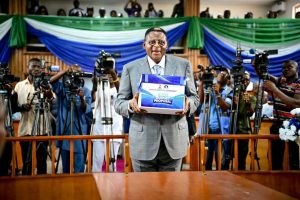
Presenting the fiscal document to lawmakers at the Assembly Complex in Calabar, the Cross River State capital, Otu, popularly known as ‘Sweet Prince’, asserted that the budget transcends a mere aggregation of figures. He characterized it as “a solemn and sacred pact laden with the trust, expectation and aspiration of the people for their improved livelihoods.”
The governor emphasized that successfully executing the budget requires strict accountability, careful resource management, and disciplined spending. Reiterating his administration’s commitment to fulfilling its social contract, he noted that the fiscal blueprint aligns with the United Nations Sustainable Development Goals (SDGs) – prioritizing the completion of existing projects and directing funds toward key state objectives to visibly improve citizens’ lives.
In a review of the state’s 2026 budget performance, Governor Otu cited currency fluctuations, inflation, disrupted supply chains, and inherited debts as major economic constraints. He explained that a collaborative effort with lawmakers resulted in a revised Supplementary Appropriation Law, expanding the state’s 2026 budget framework to N963.07 billion. This budgetary expansion was specifically designed to handle unexpected emergency interventions and secure necessary counterpart funding.
He proudly disclosed that his administration has delivered over 608 kilometres of roads across the three senatorial districts of the state. These include strategic roads such as Nsan-Oban in Akamkpa, Adiabo-Ikoneto in Odukpani, Yahe-Ebo-Wanakade in Yala, and several urban roads in Calabar metropolis.
The 2027 budget is expected to sustain this infrastructure revolution by expanding road and bridge networks, building rural access roads to link farming communities to markets, and funding urban renewal projects. This reflects the belief that robust infrastructure is the foundation upon which economic growth, job creation, and social integration thrive.
In the area of rural development and economic revitalisation, Otu reported significant progress in rural electrification, executed through the installation of solar streetlights, deployment of mini-grids and rehabilitation of power networks. He described these interventions as critical enablers for reopening economic corridors, enhancing mobility and restoring trade and commercial life to underserved localities.
Agriculture stood out in the Governor’s address as a vital pillar of Cross River’s economic makeover. According to him, the government has distributed more than 20,000 bags of fertiliser to 8,000 farmers across the state, and provided over one million improved seedlings of oil-palm, cowpea and cocoa to boost productivity.
Governor Otu also announced the initiation of a 50,000-hectare rice farming project and confirmed targeted assistance for over 5,300 livestock farmers. He added that the administration has provided loans, grants and modern agricultural machinery to both smallholder and large-scale producers to enhance mechanisation and output.
Sweet Prince highlighted a secured N18 billion offtake arrangement designed to fortify market access and sustainability. This commercial safety net anchors an ongoing cash-crop revolution that is systematically elevating the productivity and output of local farmers. The Cross River helmsman reaffirmed his administration’s resolve to make Cross River State Nigeria’s leading cocoa and oil-palm producing state through expanded cultivation, mechanisation, development of agro-allied industries and robust private-sector partnerships.
In the health sector, he spotlighted key structural upgrades, including the renovation of hospitals, the modernization of state-owned Schools of Nursing and Midwifery to achieve full accreditation, and the establishment of medical oxygen plants in Calabar and Ogoja in collaboration with UNICEF. Beyond structural upgrades, the Governor’s scorecard, as indicated in his address, boasts an impressive 95 per cent routine immunisation coverage. This public health victory is matched by concrete welfare interventions, including the implementation of the Consolidated Medical Salary Structure and a strategic policy shift that pushes the retirement age of vital healthcare professionals from 60 to 65 years.
On the educational front, Governor Otu stated that Cross River has achieved a major turnaround through the judicious deployment of over N17 billion in Universal Basic Education Commission (UBEC) intervention funds, which significantly upgraded public school infrastructure across Cross River. He further explained that his administration remains actively committed to protecting the academic aspirations of young citizens, pointing to the state’s full payment of WAEC examination fees for 43,694 indigenous students as clear proof of this commitment.
The number-one citizen of Cross River State also disclosed the promotion of over 14,000 teaching and non-teaching staff, a move aimed at boosting morale, professionalism and quality of service delivery in the education sector. His administration, according to him, is targeting an increase in the state’s literacy rate to 98 per cent from the current estimated 80.7 per cent, while expanding technical and vocational training to provide youth with the job-ready and business skills needed for today’s economy.
The governor likewise announced that the state’s aviation fleet has expanded to five aircraft following the addition of a new Bombardier CRJ regional jet. Construction efforts, he added, have at the same time been ramped up at the Obudu International Passenger and Cargo Airport. He also emphasized the procurement of 730 electric vehicles, including inter-city and urban buses, tricycles, and motorcycles, aimed at lowering transit fares and promoting eco-friendly transportation.
In the maritime sector, Governor Otu revealed a major milestone for the $3.5 billion Bakassi Deep Seaport, noting that it has officially received Federal Government approval and its Certificate of Compliance, which have cleared the way for construction to begin via private investment. Additionally, he noted that FG’s official reinstatement of Cross River as a littoral state marks a critical breakthrough for the state’s coastal and maritime economic goals.
A central message in the Governor’s budget presentation was fiscal responsibility. Otu noted that his administration has not obtained fresh domestic or external loans since assuming office in 2023. To verify this, he cited official data from the National Bureau of Statistics (NBS) and the Debt Management Office (DMO), which highlights Cross River as one of the few states to avoid new debt during this timeframe.
The governor linked the state’s current debt profile to inherited obligations and the impact of naira devaluation on external debt, noting that debt servicing has constrained resources available for development. He avowed that “I cannot, and will never mortgage the future of our children with unsustainable loans.”
To fund the 2027 budget, Governor Otu said his administration will rely on prudent fiscal strategies – including boosting Internally Generated Revenue (IGR), optimizing federal allocations, attracting development assistance and grants, and leveraging private sector investments – aimed at ensuring long-term sustainability, accountability, and intergenerational equity.
Affirming that the proposed budget estimates are built on the foundation of the 2027-2029 Medium Term Expenditure Framework (MTEF) and Fiscal Strategy Paper (FSP), Sweet Prince maintained that “My administration shall continue to be responsive to the yearnings of the citizenry, prudent in the management of the State’s resources and accountable to the people. l will continue to work with the legislature and Judiciary for the betterment of the State.”
He lauded the state lawmakers for their unwavering commitment and diligence, while urging them to grant the budget proposal swift legislative consideration and passage, to ensure the timely execution of government programmes and projects.
The Speaker of the State House of Assembly, Rt. Hon. Elvert Ayambem, assured the Governor and citizens that the 10th Assembly will subject the 2027 estimates to rigorous and expeditious scrutiny.
He said the lawmakers will extensively engage Ministries, Departments, and Agencies (MDAs) to ensure the budget reflects the aspirations of Cross Riverians, promotes even development, and guarantees strict public accountability.
While applauding Governor Otu for his monumental feats in the different sectors of the state’s economy, Speaker Ayambem appealed to the Governor for support in the comprehensive renovation of the Assembly Complex and Quarters and the provision of buses for the Assembly.
The Chairman of the Cross River State House of Assembly Service Commission, Hon. Ntufam Victor Okon, hailed Governor Otu’s timely presentation of the 2027 budget and its substantial provision for capital expenditure.
He emphasized that timely submission is vital to create a structured timeline and clear benchmarks for executing government policies effectively.
Describing the proposal as ambitious and promising, Hon. Okon said: “It’s a clear indication that the Governor is in touch with the people and is poised to take the delivery of good governance to a higher level, which is very good for the state.”
In essence, Governor Otu’s N987.8 billion Budget of Consolidation and Renewed Hope presents a future-oriented roadmap as Cross River steps into the 2027 fiscal year. With 71.72% earmarked for capital expenditure and a stated commitment to avoid fresh borrowing, the fiscal plan aligns disciplined spending with a people-centred vision.
Through strategic, robust allocations for modern infrastructure, human capital, agriculture, and social welfare, Otu’s administration aims to steadily transform the state’s vast potential into tangible, shared prosperity. Far more than an aggregation of figures, the budget is framed as a bridge to a sustainable and secure future – one that positions Cross River as Nigeria’s ultimate destination for tourism, agriculture and investment.
Michael Jegede, a journalist, writes from Abuja