
 By joshua
 COMMUNIQUE ISSUED AT THE END OF THE 2ND BIENNIAL LECTURE OF ADE-BADA FOUNDATION INTERNATIONAL
Theme: United for Ability – Changing the Disability Narrative
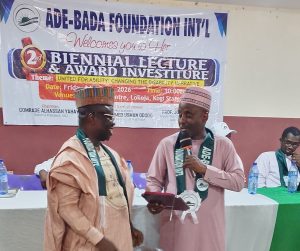
Sub-theme: Reimagining Inclusion and Changing the Paradigm – A Call for Attitudinal Reset
Date: 2026
Venue: NUJ Secretariat, Lokoja, Kogi State
PREAMBLE
The 2nd Biennial Lecture of the Ade-Bada Foundation International was held under the theme “United for Ability Changing the Disability Narrative” with the sub-theme “Reimagining Inclusion and Changing the Paradigm: A Call for Attitudinal Reset.”
The lecture was delivered by Professor J.J. Orugun, Deputy Vice Chancellor – Administration, Prince Abubakar Audu University, Anyigba.
The lecture brought together stakeholders from government, Media, academia, civil society, the private sector, and the disability community to interrogate the persistent barriers facing Persons with Disabilities (PWDs) in Nigeria and to chart a new course for inclusive national development.
After extensive deliberations on the historical, social, economic, and policy dimensions of disability inclusion in Nigeria, participants arrived at the following observations and resolutions:
OBSERVATIONS
1. Scale of the Challenge: Over 27 million Nigerians, about 15% of the population, live with one form of disability or another, yet face systemic exclusion in education, employment, infrastructure, and social participation. Approximately 7 million Nigerian children with disabilities remain out of school, with 95% denied access to formal education.
2. Attitudinal Barrier: While the Discrimination Against Persons with Disabilities (Prohibition) Act of 2018 provides a legal framework, implementation remains weak due to deep-rooted attitudinal biases, cultural stigma, and misconceptions that equate disability with spiritual curse or burden.
3. Economic Cost of Exclusion: Exclusion of PWDs from the workforce and society costs Nigeria up to 7% of GDP annually, according to the International Labour Organization. Only 1.2% of PWDs hold formal employment compared to 40% of the able-bodied population.
4. Strength of Inclusion: Global and local evidence show that inclusive societies record higher productivity, innovation, and economic growth. Nigerian role models such as Grace Alache Jerry and Adeoye Adeola demonstrate that ability transcends physical form and that empowerment yields measurable social and economic returns.
5. Paradigm Shift Needed: The prevailing approach to disability remains charity-based rather than strategy-based. There is an urgent need to move from sympathy to empowerment, from welfare to investment in human capital.
RESOLUTIONS
1. Attitudinal Reset
– Society must reframe disability as a product of environmental and societal barriers rather than an individual flaw.
– Public education campaigns should be launched across schools, religious institutions, and media to promote inclusive language and celebrate the contributions of PWDs.
2. Policy Enforcement and Institutional Action
– Government at all levels must fully enforce the 2018 Discrimination Against Persons with Disabilities Act, including the 5% employment quota in public service, with sanctions for non-compliance and incentives for compliance.
– The National Commission for Persons with Disabilities should be adequately funded, with a recommended annual budget of at least N50 billion, to drive implementation and monitoring.
3. Accessible Infrastructure and Education
– All public buildings and facilities must adopt universal design principles to ensure physical accessibility.
– Inclusive education should be prioritized through provision of braille materials, sign language interpreters, assistive technology, and teacher training to reduce the number of out-of-school children with disabilities.
4. Employment and Economic Empowerment
– The private sector is urged to adopt inclusive hiring practices, provide reasonable accommodations, and partner with disability-focused organizations for skills development.
– Vocational and entrepreneurial training hubs should be established nationwide to equip PWDs with marketable skills for self-reliance and economic contribution.
5. Leveraging Technology for Inclusion
– Government and private sector should invest in assistive technologies such as AI screen readers, digital learning tools, and affordable prosthetics to enhance participation of PWDs in the digital economy.
– Tax incentives should be provided to firms that develop and deploy inclusive technologies.
6. Leadership and Community Engagement
– Leaders in government, academia, and business must model inclusion by implementing accessibility standards and inclusive policies within their institutions.
– Communities should establish support networks that foster empathy, collaboration, and equal participation between persons with and without disabilities.
CALL TO ACTION
Participants call on all Nigerians to abandon exclusion as a tradition and embrace inclusion as a strategic investment in national development. The time has come to recognize ability as a shared human currency and to build a society where every person, regardless of physical condition, has the opportunity to thrive.
CONCLUSION
The lecture reaffirms that disability is not inability, and that Nigeria’s true strength lies in harnessing the diverse talents of all its citizens. Inclusion is not charity but a catalyst for economic growth, social cohesion, and national transformation.
United for Ability – Let Every Nigerian Thrive Unbound.
Signed.
Adeniyi Bada
Convener.