
 By joshua
 CLIMATE RESILIENCE: UNDP, CSDevNet RESTORE HOPE IN KOGI COAL MINING COMMUNITY WITH SUSTAINABLE LIVELIHOOD TOOLS
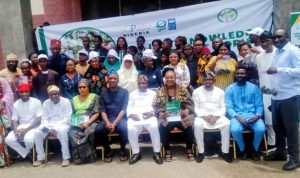
The United Nations Development Programme (UNDP) funded Global Environment Facility Small Grants Programme (GEF-SGP), Nigeria, has empowered coal mining communities in Enjema District, Ankpa Local Government Area of Kogi State with climate resilience tools to restore degraded lands and boost livelihoods.
The project, implemented by the Climate and Sustainable Development Network (CSDevNet), was celebrated on Wednesday in Lokoja at a Project Knowledge Management Forum and official close-out ceremony.
The forum, which doubled as a high-level policy dialogue, brought together government officials, development partners, traditional rulers, civil society organisations and beneficiaries to reflect on lessons learned and chart a sustainability roadmap.
The project is titled: “Addressing Land Degradation and Climate Change through Sustainable Agriculture in Coal Mining Communities in Enjema District, Ankpa LGA, Kogi State.”
In his welcome address, National Network Coordinator of CSDevNet, Mr. Steve Abuh, said the event was not just to close the project, but to reflect on what Enjema has taught about community-led environmental action, sustainable livelihoods and local ownership.
Abuh disclosed that the project, which ran from October 2025 to May 2026, demonstrated that investments in climate-smart agriculture, renewable energy, sustainable aquaculture and community institutions can simultaneously restore degraded landscapes and strengthen rural livelihoods.
He listed key legacies of the project to include demonstration farms, Village Savings and Loan Associations (VSLAs), a solar-powered water system and the Community Green Action Plan (CoGAP), which he said provides a foundation for the community to build on beyond donor funding.
“The work in Enjema shows that environmental challenges are best addressed when communities are not simply beneficiaries, but active partners in identifying problems, implementing solutions and shaping their own priorities. The CoGAP is particularly significant as it provides a platform for sustaining community priorities and strengthening environmental governance,” Abuh stated.
He stressed that scaling successful community initiatives depends on stronger linkages between local experience and public policy, and thanked GEF-SGP, UNDP and the Enjema people for their commitment.
In her remarks, the National Coordinator of UNDP GEF-SGP Nigeria, Dr. Ibironke Favour Olubamise, said the programme was built on the belief that lasting environmental solutions are achieved when communities are empowered to lead.
She described Enjema as a compelling demonstration of that principle, noting that CoGAP offers a practical framework that can be replicated in other mining-affected communities across Nigeria.
Representing Governor Ahmed Usman Ododo, the Kogi State Commissioner for Environment and Ecological Management, Engr. Olusegun Joseph, commended CSDevNet and UNDP for the successful implementation and enumerated the state government’s strides in flood mitigation, climate resilience, erosion control and regulation of mining activities.
Also speaking, the Chairman of Ankpa LGA, Hon. Ademu Yahaya, lauded the partners for choosing Enjema community for the intervention.
Other stakeholders present included the Executive Secretary of the State Emergency Management Agency (SEMA), Mr. Muktar Atima; representatives of the Ministries of Agriculture and Health; the Director-General of the Kogi Climate Change Agency; NGOs, traditional leaders and beneficiaries.
Some beneficiaries – Mr. Yakubu Sule, Mr. Umar Othman, Hajia Habibat Yusuf and Mr. Abubakar Yahaya – said the project has restored hope after years of pollution from coal mining.
Speaking on behalf of the community, Mr. Othman said pollution had contaminated rivers and destroyed farmlands, forcing residents to travel long distances to farm on other people’s land.
“For years we cried out to many organisations without response until God answered through CSDevNet. For the first time in Enjema, we learned that fish can be reared at home. Our rivers are no longer there because pollution from coal mining has contaminated them,” he said.
He noted that fish farming, maize production, sack farming and palm tree planting have created multiplier effects, with children now seeing aquaculture as a viable occupation, while sack farming allows families to plant yams and other crops in their backyards.
Othman appealed to the state government to enforce reclamation of mined lands by mining companies and thanked CSDevNet, UNDP GEF-SGP and the Kogi State Government, describing the Ododo administration as people-oriented.
“This government is a people-oriented government for allowing them to come and give us this programme,” he said.