
 By joshua
 ANEEJ Ignites A New Wave Of Money-trail Journalism As 30 Reporters Vow To Unmask IFFs In Nigeria.
By Abu Micheal
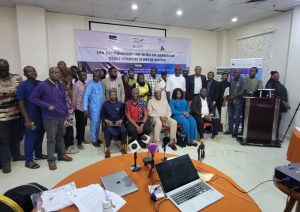
The fight against Illicit Financial Flows in Nigeria has taken a decisive turn, with the Africa Network for Environment and Economic Justice leading a bold push to equip the press for the task. Penultimate week in Abuja, ANEEJ convened more than 30 journalists from across the country for a two-day capacity building workshop at Hawthorn Suites, funded by the European Union through the SecFin Africa Project.
The engagement, held under the theme “Strengthening the Capacity of CSOs and Journalists to Contribute to Addressing IFFs in Nigeria,” has left reporters energized and determined to follow the money and expose the corrupt practices that have kept millions of Nigerians in poverty.
ANEEJ has taken the fight against IFFs further with this training, and the impact was immediate. Participants described the sessions as eye-opening, saying the workshop opened their minds to how to trace illicit flows, verify complex financial data, and report issues around financial crime with courage and accuracy.
Abu Michael and Maryam Awuya, among others, praised ANEEJ, its partners and the European Union for the timely intervention, noting that it could not have come at a better time.
At the heart of the gathering was a simple but powerful idea: journalists must be equipped with knowledge, tools and safe practices so they can cover financial crimes more deeply and consistently, without compromising independence.
Opening the workshop, ANEEJ Deputy Executive Director Leo Atakpu said IFFs deprive the country of resources needed for development through corruption, tax evasion, trade mis-invoicing, money laundering and procurement fraud.
He said the training was designed to build skills in investigative reporting, data analysis, use of the Freedom of Information Act, procurement monitoring, beneficial ownership reporting and ethical handling of sensitive stories.
For ANEEJ, success will be measured by the quality of investigations, the public awareness they create and the policy conversations that follow.
Setting the tone, Prof. Abdullahi Shehu, SecFin Africa Programme Representative and former Director General of GIABA, told participants that the media is an indispensable partner in the battle against IFFs. He urged reporters to move beyond routine headlines, advocate for policy reform, monitor public spending and procurement, use data journalism to identify high-risk sectors, and push for disclosure of beneficial ownership.
He also stressed whistleblower protection as a priority, listing practical tools such as the FOI Act, budget tracking, social audits, trade data, asset tracing, network mapping and forensic accounting. He acknowledged the obstacles of political intimidation, limited access to records and safety risks, and called on media houses to build networks and promote open governance.
The workshop brought seasoned practitioners to the table. Premium Times Editor-in-Chief Musikilu Mojeed urged journalists to dig into CAC records, asset declarations and offshore money trails, warning that Nigeria’s development challenges are tied to illicit financing. He advised reporters to confirm whether politicians hide company ownership, visit project sites, track budgets and contracts, and follow cases in foreign courts where bribery often leaves evidence.
He charged participants to earn public trust and collaborate with CSOs and global networks.
Investigative journalist Taiwo Adebayo framed the media’s role as holding power to account, giving citizens information to ask questions, and offering leads to law enforcement. He urged constant fact-checking, open-source checks and the use of databases such as NG Check, Open Sanctions and the ICIJ Offshore database, while stressing that source protection must never be compromised.
On safety and ethics, Taiwo Hassan of the Institute for Security Studies told reporters to cultivate credible sources responsibly, avoid single-source stories, and apply digital security to protect communication and documents. He said a risk checklist before publication was essential for balance, legal compliance and identity protection, reminding participants that facts remain their strongest defense.
Former EFCC Director Aliu Mohammed Yusuf clarified the distinction between money laundering and IFFs and warned that weak enforcement persists because offenders often outpace the law. He urged journalists to understand legal tools so they can expose flows before suspects escape justice.
Institutional partners backed the effort. Ibrahim Baba Mohammed, Chief GRC Officer of the Nigerian Financial Intelligence Unit who represented the Executive Director, described the workshop as timely and said financial crime reporting must follow the money trail and demand accountability.
Mahmud Isa, speaking for the Special Control Unit Against Money Laundering, noted that millions of dollars are lost annually to IFFs across Africa and stressed the need to end the trend. Resource persons from EFCC, ICPC, NFIU, the Nigeria Revenue Service, Nigeria Customs Service and the Bureau of Public Procurement shared insights on mandates and legal frameworks.
By blending expertise, experience and practical illustrations, ANEEJ made complex financial crime concepts accessible and actionable. The organization has been praised for turning a technical subject into a clear call to action, and for creating a space where journalists could build networks, share leads and leave with concrete story ideas.
The resolve in the room was unmistakable. Reporters left Abuja determined to dig deeper, ask tougher questions and use journalism as a tool for transparency, justice and national development.
In closing, Atakpu said the media must remain a watchdog, a public educator and a platform for accountability, because facts, evidence and responsible reporting matter in the fight against IFFs.
With ANEEJ at the forefront, the message to the public is clear: the money trail will be followed, and the corrupt practices that have impoverished Nigerians will be dragged into the light.