
 By joshua
ABUBAKAR SULEIMAN CALLS FOR PURPOSEFUL, RESULTS-DRIVEN LEADERSHIP
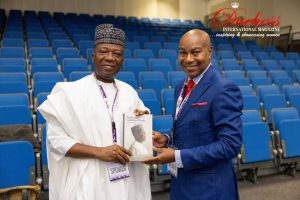
Director-General of the National Institute for Legislative and Democratic Studies, (NILDS), Prof Abubakar Olanrewaju Sulaiman, presenting a copy of his biography to one of the participants at the event in Brighton, United Kingdom
*Brighton, United Kingdom*
The Director-General of National Institute for Legislative and Democratic Studies (NILDS), Professor Abubakar Olanrewaju Sulaiman, has called for purposeful, people-centred and results-driven leadership, declaring that the true measure of leadership lies not in the authority an individual wields, but in the strength of the institutions they leave behind.
He made this assertion while delivering a keynote address titled “Leadership in Practice: Making Decisions, Managing People and Delivering Results” at the International Leadership Summit held at the University of Brighton, United Kingdom, on 16 October 2026.
Addressing an international gathering of leaders, thinkers and changemakers, the Director-General drew on more than three decades of experience spanning academia and public service to highlight the principles that distinguish effective leadership from the mere occupation of public office.
“Leadership is not the privilege of those who occupy high office; it is the discipline of those who accept responsibility for changing the trajectory of institutions and improving the lives of people. Titles confer authority, but only character, competence and vision confer leadership,” he declared.
He identified three enduring pillars of leadership in practice: making sound decisions, managing people with different expectations, and delivering measurable results. According to him, contemporary institutions require leaders who can navigate uncertainty, cultivate human potential and translate vision into tangible public value.
NILDS: A Case Study in Institutional Transformation
Using NILDS as a practical case study, Professor Sulaiman demonstrated how deliberate leadership, institutional resolve and strategic execution can reposition public institutions for greater relevance and impact.
He recounted the Institute’s evolution under his leadership, highlighting its expansion from four operational departments to thirteen professionalised departments, the establishment of new institutional centres and Democracy Radio, and the strengthening of its research, legislative drafting, academic and capacity-building functions.
He also reflected on the completion of NILDS’ permanent complex, describing the milestone as more than an infrastructural achievement. Following years of delay, the Institute moved into its ultra-modern permanent complex on 25 May 2023, marking a significant chapter in its institutional development.
“That relocation was much more than a physical movement. It represented institutional stability, growth, identity and a long-term vision for democratic capacity-building,” he stated.
He emphasised that meaningful institutional transformation requires leaders to confront difficult challenges rather than become accustomed to longstanding limitations. As he put it, “Leadership, at its core, requires the courage to confront what is difficult rather than simply manage what is convenient.”
People-Centred Leadership and Shared Responsibility
On managing people, the NILDS Director-General stressed that sustainable institutional growth depends on recognising the value of human capital, embracing diverse perspectives and creating an environment in which individuals can contribute meaningfully to a shared purpose.
“If decision-making is the heart of leadership, managing people is its soul. No leader achieves anything alone,” he said.
He highlighted the Institute’s commitment to staff welfare, professional development, career progression and inclusive decision-making, noting that institutional effectiveness improves when leaders empower their teams rather than centralise every decision.
The expansion of NILDS’ training programmes from approximately 13 annually to about 60 programmes a year, representing an increase of over 360 per cent, was presented as evidence of the Institute’s growing reach and responsiveness to the needs of legislative and democratic institutions.
The Institute has also strengthened academic and development partnerships, expanded its international engagements across Africa, and pursued initiatives that support women’s political leadership and democratic development.
From Vision to Measurable Impact
Emphasising that leadership must be judged by outcomes rather than intentions, Professor Sulaiman outlined key institutional achievements recorded at NILDS over the past seven years. These include the delivery of more than 200 capacity-building programmes, the training of over 3,000 legislators, parliamentary staff and public officials, the establishment of more than 20 strategic partnerships, and strengthened legislative capacity across Nigeria’s 36 State Houses of Assembly.
He also underscored the importance of youth inclusion, citing the Institute’s internship opportunities for young lawyers in legislative drafting and its annual engagement of over 60 National Youth Service Corps members. These initiatives, he explained, provide practical experience and pathways for young Nigerians to contribute to the governance ecosystem.
“Vision without execution is fantasy. Decisions without outcomes are intentions. Managing people without results is merely activity. Leadership must translate vision into measurable impact,” he declared.
He further observed that the ultimate value of institutional achievements lies in the capacity they create for future generations, positioning NILDS as an emerging African democratic knowledge hub where legislative research, executive education, parliamentary diplomacy and democratic innovation converge.
The Leadership Covenant: Purpose, People and Legacy
Concluding his address, he presented what he described as the Leadership Covenant, urging leaders to anchor decisions in purpose rather than popularity, value people before processes, and measure results by the strength of the institutions they leave behind.
He maintained that leadership in a rapidly changing world requires evidence-based decision-making, people-centred management and results-oriented execution, regardless of geographical or political context.
“Leadership is a practice, not a position,” he affirmed, adding that institutional transformation occurs when leaders develop the courage, vision and resilience to confront challenges, even under unfavourable circumstances.
In one of the defining reflections of his address, he stated: “History rarely remembers those who merely occupied office. It remembers those who expanded the possibilities of institutions, elevated the dignity of people and left society more capable than they found it.”
He concluded by calling for a generation of leaders committed to strengthening democratic institutions, elevating human dignity and bequeathing a more capable society to those who follow.
“That, to me, is the essence of leadership in practice. It is the leadership Africa deserves. It is the leadership democratic institutions require. And it is the leadership this generation must be prepared to bequeath to the next,” he said.
Professor Sulaiman’s participation at the University of Brighton provided an opportunity to share Nigeria’s institutional leadership experience with an international audience and reinforce the importance of accountable governance, institutional capacity-building and leadership anchored in enduring public value.