

Every Day, Kogi Is Getting To Know Ododo Better: Quiet, Without Noise, Without Friction, Yet Things Are Happening Like Never Before
President Bola Ahmed Tinubu on Tuesday flagged off the construction of the Kogi International Cargo Airport in Zariagi, Adavi Local Government Area, describing the project as a major step towards opening the state to global investment, trade and sustainable economic growth.
The President was represented at the groundbreaking ceremony by the Minister of Aviation and Aerospace Development, Festus Keyamo, who commended Governor Ahmed Usman Ododo for his commitment to infrastructure development.
Keyamo said the project would place Zariagi and Kogi State on the global aviation map and serve as a precursor to lasting economic opportunities, noting that once completed, the airport would receive recognition through the International Air Transport Association, IATA, enhancing the state’s visibility and economic relevance, and he projected that the facility would generate between 2,000 and 3,000 direct and indirect jobs for residents, while dismissing criticisms of the project on the ground that strategic infrastructure must be built to attract businesses rather than waiting for investors to arrive first.
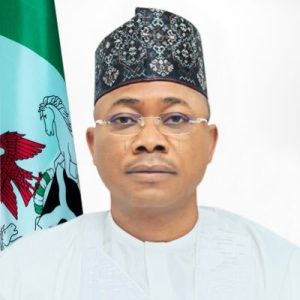
Governor Ododo described the ceremony as a landmark moment in Kogi’s infrastructure and economic history, a signature project that will transform the state into a strategic transportation, aviation, commercial and logistics hub, saying it was a moment of pride and fulfilment and a bold declaration that Kogi is ready to take its rightful place in the emerging economy and the wider world.
Gov. Ododo noted that Kogi is richly endowed with solid minerals and produces significant quantities of cash crops and other agricultural commodities, and that the airport would give farmers and agro-processors improved access to national and international markets, while opening new opportunities in agriculture, mining, manufacturing, tourism and hospitality.
Commissioner for Works, Momoh Salami Ozigi, outlined the scope of the first phase, which includes a 3,600-metre runway, taxiways, aircraft parking apron, drainage systems, perimeter fencing and access roads, with the runway to meet International Civil Aviation Organisation standards and accommodate wide-body aircraft, including the Boeing 747, describing the airport as part of a broader strategy to move Kogi beyond a civil service-based economy towards greater industrial and commercial development, alongside the Lokoja Ultra-Modern Market, the proposed Ajaokuta Free Trade Zone, agro-processing initiatives and road infrastructure projects.
The Managing Director of China Civil Engineering Construction Corporation, CCECC, Henry Shuo, expressed appreciation to the Kogi State Government for the confidence reposed in the company and assured that it would deploy its experience and technical expertise to deliver the project to international standards.
While speaking on behalf of traditional rulers, the Ohinoyi of Ebiraland, Alhaji Ahmed Tijani Anaje, expressed support for the project and reaffirmed the commitment of traditional institutions to initiatives that promote development and improve the welfare of the people, at a ceremony attended by top government officials, political leaders, legislators, technocrats, traditional rulers and other stakeholders, and featured cultural displays by various groups.
To understand what that airport truly means, one must first understand what an airport, and particularly a cargo airport, does to a state. An airport shortens distance. It turns a landlocked advantage into a global advantage. It allows a farmer in Ibaji to imagine his yam, cassava and rice reaching Lagos in hours and reaching foreign markets in a day, rather than rotting on a bad road.
It allows a miner in Ankpa, a processor in Ajaokuta and a trader in Lokoja to move goods quickly, cheaply and safely. It brings investors who will not come to a place they cannot reach, it brings tourists, conferences, hotels, banks, logistics firms, warehouses, cold rooms, packaging plants and maintenance workshops, and it creates jobs not only on the runway but around it, for drivers, caterers, cleaners, security officers, customs officers, freight forwarders, artisans and young graduates who will now find a reason to stay home.
A cargo airport in particular means Kogi will no longer merely produce raw materials for others to profit from, but will export value, earn foreign exchange, reduce post-harvest losses, attract agro-processing industries and become a distribution centre for the whole of North-Central Nigeria, because Kogi sits at the very centre of the country, bordering ten states including the Federal Capital Territory, and what is built in Zariagi can serve Abuja, the North and the South at once.
That is why the airport is not just concrete and tarmac. It is a deliberate act of opening Kogi to the world through strategic management and governance, and it sits within a long list of legacy achievements that are quietly redefining the state. Under Governor Ododo, Kogi has witnessed the flag-off of the historic 37-kilometre Ejule-Ojeba-Unale-Onyedega road linking Idah to Ibaji after more than two decades of neglect, the construction and rehabilitation of township roads in Lokoja, Okene, Kabba and Isanlu, rural feeder roads connecting farmers to markets, the 13-kilometre Odenyi-Oguma-Sheria road in Bassa, the Iyale-Ogane-Enugu road in Dekina, the regulation and formalisation of artisanal mining in Enjema, Ankpa, where legitimate miners are now treated as partners in progress and not criminals, the strengthening of the solid minerals sector, and the steady transformation of the state into a huge construction site where work, not noise, speaks.
Above all, his administration has brought peace and positive reference to the Confluence State. Kogi is no longer in the news for the wrong reasons. One thing no one can take away from his administration is the prudent utilisation of resources, transparency and due process. Contracts are awarded with care, projects are monitored, money is made to follow work, and governance has been returned to procedure rather than impulse. That discipline is what has made it possible for salaries and pensions to be paid regularly, for the state to cease to be one that owes workers, and for the workforce to trust government again.
His fairness and equitable distribution of infrastructure is another aspect needed to govern a multi-ethnic state like Kogi, and it is a feat that has given him a permanent place in the minds of the citizens. Roads are not built only where votes are loudest, schools are not renovated only where power is closest, and appointments and projects are spread in a way that every senatorial district, every local government and every community can see itself in the government. In a state of Ebira, Igala, Okun and many other peoples, that even-handedness is not a small virtue, it is the very foundation of unity.
That inclusive style of administration, which brings on board all segments of society, is perhaps what has made his government most appreciated. For the first time in a long while, the people of the South-South resident in Kogi, the people of Edo, Delta, Cross River, Rivers, Akwa Ibom and Bayelsa, who over the years remained unnoticed, have been seen, heard and given a place at the table through appointments, mobilisation and genuine engagement. They are not strangers in Kogi. They live here, trade here, raise children here and contribute here, and an administration that recognises them has shown that Kogi belongs to all who call it home.
His administration has also brought governance down to the doorstep and to the level of the vulnerable, a feat that was not usually noticed in the governance of the state. In the area of human infrastructure, salaries among other benefits are regularly paid, and in education, the state has moved towards largely free education, with the building and renovation of schools, the payment of school fees, bursary awards, and the payment of JAMB, WAEC and NECO fees as the highpoint of the administration, so that no child is denied an examination or a classroom because the parents are poor. Soon, a massive employment exercise to fill existing vacancies in the service of the state will commence, to cater for the health and education sectors and to fill vacancies in the state civil service, giving thousands of young Kogites a legitimate pathway into productive life.
Yet, for all this, Governor Ododo remains like an onion. Every day, Kogi people peel a new layer and discover a new part of him. He is yet to be fully known, because he does not govern by shouting. His style is non-violent, without friction, less confrontational, yet things are happening like never before. He does not fight his predecessors in public, he does not humiliate opponents, he does not turn governance into theatre, and still, roads are being built, an airport is rising, schools are opening, miners are being organised and the state is being repositioned. It is governance without drama, but with delivery.
That humility is rooted in where he came from. A former labour leader and civil servant before going into partisan politics, raised in a farming family under his grandmother’s care in the small hilly village of Upogoro, Okene, he has often said: “I cannot forget where I came from. I am a man from a humble background who became who I am by the grace of God and will therefore not use my position to oppress anyone but to better the lots of the people.” In the same spirit, he has told workers: “You people generously elected me as your governor, and the resources of the state belong to you all. I am just your chief servant and I will ensure that the resources are allocated to all sectors fairly and equitably.” From his inauguration on January 27, 2024, he has encouraged Kogites to address him as the “Chief Servant” rather than “His Excellency,” reflecting his preference for service over personal status.
In his inaugural address, he reminded citizens that they were his employers because they elected him, emphasising that “the hiree cannot be bigger than the hirer.” In that same address, he said with profound humility: “You are the bosses because you hired me with your votes to serve you. The hiree cannot be bigger than the hirer. I will listen to you, I will serve you.” At his first anniversary, he returned to that same theme: “I was sworn in to be the servant of all Kogites, the servant of those who voted for me and those who didn’t vote for me.” He added: “I grew up with no spoon of any coloration. I understand what it is to struggle through school due to poverty. As your servant, I will ensure I do everything to give education to every Kogi child.”
Those are not mere words. They are visible in a government that pays workers before it celebrates itself, that builds for the poor before it builds monuments to power, and that treats every Kogite, whether from Kogi East, West or Central, whether indigene or resident, as a stakeholder.
It is that disposition that has positioned the Confluence State beyond the minds of political gladiators of other political parties, and that has largely made the state a one-party state, not by force, but by performance, not by intimidation, but by inclusion. When a governor governs quietly, fairly and transparently, opposition finds little to oppose, and the people find much to support.
In the end, the Kogi International Cargo Airport will be remembered as more than an airport. It will be remembered as the day Kogi stopped waiting to be discovered, and decided to open its doors to the world, under a governor who came from a humble background, who governs like a servant, and who, day by day, is still being discovered by his own people.
Abu Micheal,
Special Adviser
South South Mobilization.
