
 By joshua
 Ododo Making Visible, Tangible Progress In Kogi – SA Youth, Oladele Nihi
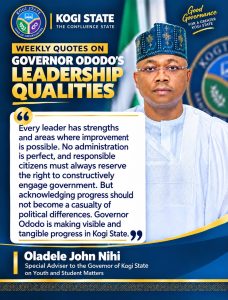
The Special Adviser to the Governor of Kogi State on Youth and Student Matters, Hon. Oladele John Nihi, has said that Governor Ahmed Usman Ododo is making visible and tangible progress across critical sectors of the state, noting that acknowledging progress should not become a casualty of political differences.
In his weekly quote statement issued in Lokoja on Sunday, Nihi said every leader has strengths and areas where improvement is possible, and no administration is perfect, but responsible citizens must always reserve the right to constructively engage government without denying evident achievements.
According to him, Governor Ododo’s administration in less than three years has demonstrated a clear focus on inclusive governance, human capital development and infrastructural renewal that directly touches the lives of the people.
He cited the administration’s sustained investment in education, including the renovation of over 700 public schools, completion of GYB Model Science Secondary Schools, continued investment in the three state-owned universities, payment of over N600 million in WAEC fees for over 18,000 students and disbursement of N646.8 million as bursary to 20,347 tertiary students, with additional support for over 30,000 adolescent schoolgirls to remain in school.
Nihi noted that in healthcare, the ongoing revitalization of more than 150 Primary Healthcare Centres across the 21 local government areas with solar power, water and staff quarters, rehabilitation of over 88 centres with over N7 billion investment, expansion of health insurance coverage to over 255,000 residents including pensioners and students, free medical care for pregnant women, children under five and the elderly, and the N300,000 monthly incentive for doctors, have positioned Kogi as one of the states making bold investments in the health of its people.
He also pointed to youth-focused interventions, including the recent N29.8 million support to 1,490 corps members deployed to the state, skills acquisition programmes, and the administration’s open-door policy to youth and student groups.
On infrastructure and economy, the Governor’s aide listed the policy of at least 10 kilometres of road projects in each of the 21 local government areas, flagship projects such as the 12.5 kilometre Unosi-Odonto-Ogigiri road, township roads in Egbe, Aiyetoro, Idah and Anyigba, the handover of a 25-hectare site for the ultra-modern Lokoja Market, acquisition of 4,000 hectares for free trade zones, commencement of work on the Kogi International Airport at Zariagi and the Kogi-Hunan Special Economic Zone in Ajaokuta.
Nihi added that Governor Ododo has strengthened security through procurement of drones, establishment of forward operating bases and engagement of 1,050 hunters and vigilante operatives, while in agriculture, the revival of the Confluence Rice Mill supporting over 7,000 farmers and protection of cashew farmers from multiple taxation have boosted rural economy.
“Governor Ododo is consolidating on security, ensuring regular payment of salaries and pensions, maintaining religious and ethnic harmony and running an administration that listens. He prefers to be called Chief Servant rather than Your Excellency, and that philosophy is reflected in his decision to pardon 101 inmates including a 91-year-old on compassionate grounds, send doctors with AI-powered X-ray machines into Koton-Karfe Correctional Centre, and embrace South-South communities who have lived in Kogi for decades,” Nihi stated.
He urged Kogi youths and students to continue to constructively engage the government, but not to play politics with verifiable progress.
“Every leader has strengths and areas where improvement is possible. No administration is perfect, and responsible citizens must always reserve the right to constructively engage government. But acknowledging progress should not become a casualty of political differences. Governor Ododo is making visible and tangible progress in Kogi State and the evidence is everywhere,” he concluded.