
 By joshua
 PROFESSOR ABUBAKAR SALISU ABDULLAHI DELIVERS THE 29TH INAUGURAL LECTURE OF PRINCE ABUBAKAR AUDU UNIVERSITY, ANYIGBA
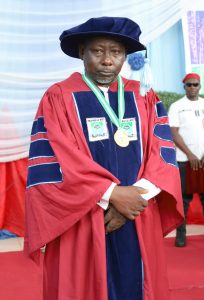
….Traces the Growth, Spread and Literary Contributions of Arabic in the Confluence Area
Professor of Arabic Language and Literature, Professor Abubakar Salisu Abdullahi, has traced the historical development, growth, spread and literary contributions of the Arabic language in the Confluence Area of Nigeria, highlighting the roles of trade, Islam, education, Islamic institutions and scholarly activities in its preservation and advancement.
Prof. Abdullahi made the presentation while delivering the 29th Inaugural Lecture of Prince Abubakar Audu University, Anyigba, on Tuesday, 6th October, 2026 on the topic: “Developmental Tracks of Arabic Language in the Confluence Area of Nigeria (1960–2008).”
The Inaugural Lecturer explained that Arabic occupies a prominent position among the world’s major languages, with significant cultural, historical, religious, intellectual and diplomatic importance.
He noted that Arabic was adopted by the United Nations in 1974 as one of its six (6) official languages, while its central position in Islam has sustained its use as the language of the Qur’an and a major medium of religious and scholarly communication across the world.
Prof. Abdullahi also stressed the historical importance of Arabic in documentation, noting that Arabic has been used for record-keeping in Nigeria since at least the eleventh century.
In his words, Arabic manuscripts and writings in Arabic script constitute important sources for reconstructing the intellectual, religious, political and cultural history of Sub-Saharan Africa.
Tracing the emergence of Arabic in West Africa, the Professor of Arabic Language and Literature explained that commercial relations between North and West Africa created important channels for the movement of people, ideas, languages and cultures long before the widespread expansion of Islam.
He identified commercial links between North African merchants and the Hausa states and Kanem-Borno Empire as significant factors that facilitated the gradual spread of Arabic influence across the region.
He further highlighted the Tripoli-Borno, Tunisia-Kano and Morocco-Kano routes through Timbuktu as important trans-Saharan channels through which Arabic and Islam expanded into West Africa.
Prof. Abdullahi stated that early commercial contacts contributed to the introduction of Arabic loanwords into local languages, including Hausa and Igala, while the spread of Islam subsequently gave Arabic a more structured role in religious, educational and cultural life.
On the development of Arabic in Kogi State, Prof. Abdullahi explained that the Confluence Area maintained commercial relations with major northern centres including Kano, Katsina, Zaria and Kanem-Borno.
He noted that North African traders frequented markets in Lokoja, Itobe, Gbagana and Afor Gam Gam, thereby facilitating contact among Hausa, Kanuri, Arabic and indigenous communities.
The Inaugural Lecturer observed that Arabic and Islam became established in different parts of Kogi State at different periods, with the spread of Islam providing a stronger foundation for Arabic education and scholarship.
He disclosed that between 1980 and 2003, Arabic experienced notable growth in Kogi State, driven by commercial activities, Muslim scholars and preachers, the establishment of mosques and Qur’anic schools, Sufi organisations, educational mobility, modern Islamic schools, Islamic associations, government schools and technological advancement.
Prof. Abdullahi explained that scholars and preachers established traditional schools where Qur’anic recitation, Arabic grammar and Islamic studies were taught, while mosques also served as early centres of learning.
He noted that Madrasahs produced students who later became teachers, thereby contributing to the continued transmission of Arabic knowledge in the region.
He further highlighted the contributions of the Tijaniyyah and other Islamic organisations through schools, seminars, scholarly activities and writings on Islamic teachings.
On educational mobility, Prof. Abdullahi noted that parents sent their children to institutions in Sokoto, Kano, Maiduguri, Saudi Arabia and other locations to acquire Islamic and Arabic education, with many graduates returning to the region to teach and contribute to the development of Arabic scholarship.
He identified the establishment of Kogi State University, now Prince Abubakar Audu University, in 1999 as a major milestone in the formal academic development of Arabic and Islamic Studies in the state.
The Inaugural Lecturer also acknowledged the contributions of organisations such as Jama’atu Nasril Islam (JNI) and Izala to Arabic learning through schools, seminars and other educational activities.
He explained that technological developments, including typewriters, computers, the Internet, radio, television and improved transportation, further enhanced the growth and dissemination of Arabic language and scholarship in Kogi State.
On literary production in the Confluence Area, Prof. Abdullahi noted that Arabic literary activities grew considerably between 1960 and 2008, largely as a result of the expansion of educational and religious institutions.
He explained that before 1960, Arabic literary production was relatively limited but scholars and traditional rulers who were relocated to Lokoja during the colonial period contributed to Qur’anic teaching and Arabic literary activities.
Among those associated with the early development of Arabic literary activities, he mentioned Muhammad Kwaso, Emir of Zaria; Emir Abubakar of Bida; Muhammad Bashir; and Ali Dan Sayed.
Prof. Abdullahi added that Arabic poetry flourished as Arabic schools produced scholars who became proficient in reading and writing poetry, while the study of classical Arabic works further strengthened their mastery of the language.
He identified major themes in Arabic poetry in Kogi State as praise, lamentation, satire, preaching and guidance, supplication, social occasions and expressions of pride.
He explained that educational poetry was also used to communicate Islamic knowledge and facilitate memorisation, with scholars employing poetry as a means of teaching religious concepts and linguistic knowledge.
On Arabic prose, the Inaugural Lecturer noted that its development in the region was reflected particularly in religious sermons and correspondence, demonstrating the growing ability of local scholars to use Arabic for religious instruction, communication and intellectual expression.
Prof. Abdullahi stressed the need to preserve Arabic manuscripts and document the works of scholars from Lokoja, Ankpa, Idah, Dekina, Okene and other parts of the Confluence Area, describing them as valuable records of the region’s intellectual and religious history.
He maintained that the history of Arabic in Kogi State demonstrates the close relationship between Islam, education, commerce, scholarship and literary production.
He added that the development of Arabic was not merely a linguistic phenomenon but also a reflection of the religious, educational, cultural and intellectual transformation that occurred across the region.
In his recommendations, Prof. Abdullahi called for the promotion of Arabic education at all levels, increased support for research, the establishment of more schools and printing presses, the formation of Arabic-speaking associations and the employment of qualified Arabic teachers.
He also urged Islamic societies and educators to remain committed to the continued development and preservation of the Arabic language in Kogi State.
Prof. Abdullahi is the first son of Igala land in eastern Kogi State to become a Professor of Arabic Language and Literature.
Earlier, the Chairman of the Inaugural Lecture Committee, Prof. S. S Arogba congratulated the inaugural lecturer on attaining this significant academic milestone.
In his address, the Vice-Chancellor of Prince Abubakar Audu University, Anyigba, Professor Salisu Ogbo Usman, represented by the Deputy Vice-Chancellor (Administration), Professor Sani Rufai Abdullahi, described the 29th Inaugural Lecture as a reaffirmation of the University’s commitment to rigorous scholarship, intellectual engagement, knowledge preservation and the application of knowledge to societal development.
Prof. Usman described the topic as timely and significant, noting that Arabic is among the oldest languages of literacy and learning in the region and has, over the centuries, served as a language of faith, scholarship, trade, correspondence, record-keeping and literary expression among Nigerian communities.
He noted that the historical development of Arabic therefore forms an important part of the intellectual, cultural and social history of the Nigerian people.
The Vice-Chancellor added that the Confluence Area, deriving its name from the meeting of the Niger and Benue Rivers, has historically served as a meeting point of peoples, cultures, languages, faiths and commercial activities.
Prof. Usman stressed that scholarship on the history of Arabic in the Confluence Area extends beyond language and literature, noting that it provides useful material for curriculum development, educational planning, language policy and the preservation of knowledge that might otherwise be lost.
He also emphasised the role of universities as centres for the production, preservation, transmission and application of knowledge, describing Prof. Abdullahi’s scholarship as an example of locally grounded academic inquiry with enduring relevance.
The Vice-Chancellor noted that in a plural society such as Nigeria, greater knowledge of the languages, histories and intellectual traditions of different communities can promote mutual understanding, cultural appreciation and national cohesion.
He congratulated Prof. Abdullahi on the academic milestone and commended his choice of subject, connecting Arabic language and literature with the history, culture and heritage of the Confluence Area.
Prof. Usman also expressed appreciation to members of the Inaugural Lecture Committee, distinguished guests, members of the University community, friends of the University and members of the public for contributing to the success of the academic occasion.
The lecture attracted members of the University Governing Council, Management and Senate, academic and non-teaching staff, students, traditional and religious leaders, friends of the University and other distinguished guests from within and outside the University community.
Uredo Omale,
Director, Public Affairs,
Prince Abubakar Audu University, Anyigba.