
 By joshua
 Nigeria’s Insecurity: Christian Graduates Seek Moral Renewal, Stronger Institutions As Way Out
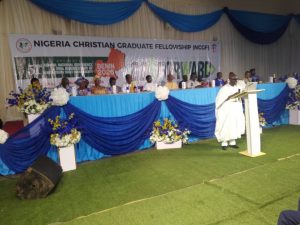
By Ikhili Ebalu, Benin city
Nigeria’s worsening insecurity can only be sustainably tackled when the country confronts the corruption, weak accountability, injustice and institutional failures that create fertile ground for violence, a speaker at the annual convention of the Nigeria Christian Graduate Fellowship has said.
Delivering a keynote address titled, “Rising Above the Storm of Insecurity in Nigeria: God’s Blueprint for National Renewal and Greatness” at the conference in Benin City, the Keynote Speaker, Venerable Osazee David Egbenusi of All Saints’ Chapel, University of Benin, argued that the country’s security crisis goes beyond the activities of terrorists, bandits, kidnappers and other armed criminals.
He said while Nigeria urgently needs effective policing, intelligence gathering, military capability, border control and modern security technology, those measures alone cannot guarantee lasting peace without addressing the deeper moral and institutional problems that sustain insecurity.
“Every enduring security crisis is first a moral crisis before it becomes a military crisis,” Egbenusi declared.
According to him, Nigeria must move beyond asking how to defeat insecurity to confront the more fundamental question of what kind of society continually produces conditions in which insecurity can thrive.
He said farmers abandoned their fields, parents fearing for their children’s safety, travellers worrying about reaching their destinations alive and businesses being crippled by ransom payments were symptoms of a crisis that required both security and national renewal.
Ven. Egbenusi warned that a nation could become heavily armed without becoming genuinely secure, stressing that soldiers could defend borders but could not manufacture public trust, while intelligence agencies could expose conspiracies but could not create integrity.
“Police can arrest criminals, but they cannot build character. Courts can punish offenders, but they cannot create a culture of righteousness,” he said.
Drawing lessons from the histories of Rome, Poland-Lithuania and pre-revolutionary France, the speaker said the collapse or weakening of nations was often preceded by internal decay, corruption, inequality, institutional paralysis and loss of public confidence.
He, therefore, urged Nigerians to pay greater attention to the moral and institutional foundations of the state.
The guest lecturer identified what he described as three major moral fractures that make Nigeria vulnerable to insecurity.
The first, he said, was the loss of accountability in the exercise of power, arguing that democratic institutions, including the judiciary and legislature, must be strong and independent enough to restrain abuses of power.
“When courts can be pressured and legislatures become echo chambers, institutions designed to restrain evil can become instruments that protect it,” he warned.
His second concern was the weakening of legitimate voices capable of holding those in authority accountable.
Using biblical examples including Nathan’s confrontation of King David, Elijah’s challenge to Ahab, John the Baptist’s rebuke of Herod and Daniel’s steadfastness under successive empires, Ven. Egbenusi said societies needed courageous individuals willing to speak truth to power.
“A healthy nation needs its Nathans—people willing to say, ‘You are the man,’ not because they hate those in power, but because they love the nation more than they fear power,” he said.
He warned that suppressing legitimate political, judicial, journalistic and civic opposition could deepen rather than resolve insecurity.
“It becomes blind. And its citizens become resentful,” he said, adding that grievances denied legitimate avenues of expression could eventually find expression through violence.
“What cannot be expressed in parliament may eventually be expressed in the forest,” he cautioned.
He consequently described strong democratic institutions as not only instruments of governance but also instruments of national security.
While naming corruption and the erosion of the value of honesty as the third fracture, the cleric stressed that corruption should not be viewed merely as an economic offence because its consequences extend to public trust and the moral outlook of citizens.
“When citizens repeatedly see the dishonest prosper while the honest struggle, corruption begins to reshape the moral imagination of society,” he said.
Venerable Egbenusi noted that the disappearance of funds meant for hospitals, roads, schools and other public infrastructure does more than deprive citizens of services; it teaches them that the system cannot be trusted.
He said the resulting question in the minds of citizens—“Why should I obey the rules when those who break them are the ones who prosper?”—could gradually undermine respect for law and order.
The keynote speaker also drew from the Biblical concept of Shalom, which he said represented more than the absence of physical violence.
He described true national security as encompassing justice, social harmony, right relationships, human flourishing and responsible governance.
“Righteousness precedes peace. Justice strengthens security. The character strengthens stability,” he said.
Using the Biblical account of Judah, Egbenusi argued that the nation’s military fortifications could not save it when its internal moral foundations had deteriorated.
He said the lesson for Nigeria was that external enemies could exploit internal weaknesses, but those enemies did not necessarily create the weaknesses.
“Walls cannot permanently protect a nation whose moral foundations are collapsing,” he said.
He called for a national culture built around justice, integrity, accountability, responsible citizenship and concern for vulnerable members of society.
In his welcome address, the National President, Professor Ashong C.Ashong urged the members to understand that whatever intimidating circumstances they may be facing as individuals or nations they need to pray to God.
He urged all to turn to God in faith and receive directives on how we may proceed in the face of all our challenges. As God has prepared many vessels to help sharpen our focus and vision so that we may press on to victory without sustaining casualties or material losses.
Adding that the concert promises to equip us with all that we need to make progress politically, economically and above all spiritually in a turbulent world.
Earlier, the Chairman of the Local Organising Committee, Rev. G.O.Chime, also drew attention to the severity of Nigeria’s security challenges, urging Christians to turn to God while contributing to the restoration of peace and stability in the country.
Rev. Chime described the situation as an existential threat and lamented the continuing loss of innocent lives to violence.
“We are facing existential threat to our Nigeria,” he said, stressing the need for fervent prayer at a time when violence had devastated communities and disrupted the natural rhythm of life.
In an emotional appeal, the LOC chairman prayed: “Lord, you are our only hope, let the fire fall again.”
He also commended the Local Organising Committee for its efforts in providing hospitality and ensuring a conducive environment for the convention.
The speakers’ interventions placed the responsibility for national renewal beyond government security agencies alone, pointing instead to a combination of effective security measures, accountable leadership, institutional independence, justice, integrity and a renewed moral consciousness among citizens.
The central message of the NCGF National Conference was that Nigeria’s path out of insecurity must involve both fighting the immediate perpetrators of violence and removing the conditions that enable violence, corruption and distrust to flourish.
For the Christian Graduate community, the proposed blueprint for national greatness therefore begins not merely with more weapons or security personnel, but with a restoration of justice, integrity, accountability and responsible citizenship.
Ven Egbenusi put it, the question Nigeria must ultimately answer is not simply “How do we make Nigeria secure?” but also “How do we make Nigeria righteous?”
The Nigeria Christian Graduate Fellowship ( NCGF) National Conference is an annual massive prophetic gathering designed for Spiritual impartation and answered prayers.
This year’s convention marks the 51st annual conference of the fellowship and 29th anniversary of the Africa Vision Tract House Society, the missionary arm of the Fellowship.