
 By joshua
 KOGI 2027: “THE SUN MUST ALWAYS RISE IN THE EAST, TO SET IN THE WEST, THE SUN WILL NEVER REMAIN IN THE ‘CENTRAL’ OR MIDDLE.” — (SOCRATES)
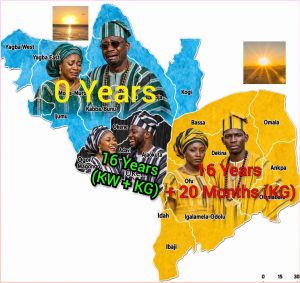
“A MARGINALIZED SYSTEM CANNOT BE USED TO JUSTIFY EQUITY AGAINST THE PEOPLE; EVIL CANNOT CURE EVIL.”
The 2027 Kogi State governorship election is gradually becoming much more than another contest for political power. It is increasingly shaping up as a defining moment in the state’s political history—a moment that will force Kogi people to confront questions of equity, inclusion, political rotation, democratic choice and the right of every major section of the state to aspire to the highest office.
At the centre of that conversation is the growing agitation for Kogi West, particularly the Okun people, to produce the next governor of the state in 2027.
The metaphor contained in the headline is simple but politically powerful. The sun rises in the east and sets in the west. It does not remain permanently in the middle. In a plural society such as Kogi, political power should similarly not be regarded as the permanent possession of any geographical, ethnic or political bloc.
The quotation attributed to Socrates in the headline should, however, be understood as a political metaphor rather than presented as a verified quotation from the ancient Greek philosopher.
The argument for Kogi West in 2027 is not necessarily that an Okun person should become governor merely because he or she is Okun. That would reduce a serious political question to ethnicity. The stronger argument is that, after 35 years of Kogi State’s existence, and after successive political arrangements that have produced governors from other sections of the state, it is reasonable for Kogi West to ask whether its own opportunity has finally arrived.
Kogi State was created on August 27, 1991, from parts of the old Benue and Kwara States. Today, it has 21 local government areas, three senatorial districts and nine federal constituencies. The official structure of the state places seven LGAs in Kogi West, five in Kogi Central and nine in Kogi East.
Kogi West comprises Kogi, Lokoja, Kabba-Bunu, Ijumu, Mopamuro, Yagba East and Yagba West. Central consists of Okene, Adavi, Okehi, Ajaokuta and Ogori-Magongo, while East comprises Ankpa, Bassa, Dekina, Ibaji, Idah, Igalamela-Odolu, Ofu, Olamaboro and Omala.
That geographical structure is politically significant, but it does not mean that the governorship should be allocated according to the number of local governments. The governor is elected by the electorate across the entire state. Consequently, the question of who should govern Kogi cannot be settled merely by counting LGAs. It must ultimately be decided by voters, political negotiations, party processes, candidate quality and the ability of an aspirant to build a statewide coalition.
Yet democracy is not only about counting votes on election day. It is also about creating a political environment in which citizens believe that they have a fair opportunity to aspire to power.
That is where the question of political rotation becomes important.
Since the return to civilian rule in 1999, Kogi’s elected governors have come from outside Kogi West. Abubakar Audu governed from 1999 to 2003; Ibrahim Idris from 2003 to 2012, apart from the brief period of judicially induced interruption in 2008; Idris Wada governed from 2012 to 2016; Yahaya Bello governed from 2016 to 2024; and Ahmed Usman Ododo assumed office in January 2024.
The historical record therefore supports one important fact: Kogi West has never produced an elected governor of Kogi State since the state’s creation in 1991.
That is not an accusation. It is history.
The political interpretation of that history, however, is where opinions begin to differ.
Supporters of the Kogi West aspiration argue that after decades of supporting political coalitions that produced leadership from other parts of the state, the people of the West should now be allowed to seek the same opportunity for themselves. Opponents may argue that governorship should not be determined by zoning or ethnicity but by competence, popularity and electoral strength.
Both positions contain elements of truth.
The Constitution does not reserve the governorship for any senatorial district or ethnic group. Therefore, nobody can claim a constitutional entitlement to the office simply because of geographical origin. At the same time, nothing prevents political parties and stakeholders from adopting zoning or rotation as a political arrangement designed to promote inclusion and stability.
That distinction is crucial.
Zoning is not a constitutional right. It is a political understanding.
And because it is a political understanding, it can be negotiated, reviewed and challenged through democratic processes.
There is also a need for historical accuracy concerning the Ebira experience.
Before Kogi State was created, an Ebira politician, Alhaji Adamu Atta, served as the civilian governor of the old Kwara State from 1979 to 1983. Historical records identify Atta as an Ebira from the area that is now part of Kogi State, and he won the 1979 Kwara governorship election on the platform of the NPN.
That historical fact is relevant to the present debate, but it should not be stretched beyond what the evidence can support. It would be difficult to establish as an empirical fact that the entire Okun population formally “gave” Adamu Atta his mandate or that every Okun political actor subsequently supported every Ebira-led political arrangement.
The more defensible political argument is that communities within Kogi have historically entered political alliances across ethnic and geographical lines. If one group can benefit from such alliances over time, it is not unreasonable for another group that has participated in those alliances to ask for reciprocity.
That is not a demand for political indebtedness. It is a demand for political balance.
There is also an important correction to the argument that Kogi Central has already governed Kogi State for 12 years since 2016. Yahaya Bello served for eight years, from January 2016 to January 2024, while Ahmed Usman Ododo has been governor since January 27, 2024.
Therefore, as of August 2026, the continuous period of Ebira-led administration since 2016 is about ten and a half years. If Ododo completes his current four-year term in January 2028, the combined period will amount to approximately 12 years.
That distinction may appear technical, but political arguments become more credible when they are built on accurate facts.
The real question for Kogi West is therefore not whether Central has already completed 12 years. The more fundamental question is this:
If 2027 is not the time for Kogi West, when is its time?
If the answer is 2032, then Kogi West is effectively being asked to defer its aspiration for another electoral cycle.
There may be strategic reasons for such a proposal. Political alliances may make it attractive. Party calculations may make it convenient. Individual politicians may have their own interests. But convenience should not automatically be confused with equity.
There is a difference between an alliance and political subordination.
Kogi West can choose to work with Kogi Central. It can support a Central candidate. It can negotiate with Central. It can even decide that another section of the state has a more compelling candidate. But such a decision should come from a position of political negotiation, not from the assumption that Kogi West must permanently wait.
That is the heart of the 2027 argument.
The debate should therefore not be reduced to “Central versus West” or “Ebira versus Okun.” Such framing can only deepen division.
The better question is whether Kogi can develop a political culture where every major section of the state believes that it has a realistic opportunity to produce leadership.
That is what political rotation should ideally accomplish.
The 2023 governorship election also provides an important lesson. Ahmed Usman Ododo won the election with 446,237 votes, followed by Murtala Ajaka of the SDP with 259,052 votes and Dino Melaye of the PDP with 46,362 votes. The Supreme Court subsequently upheld Ododo’s victory.
But beyond the statewide figures, the election demonstrated that Kogi politics is highly competitive and that no serious governorship candidate can afford to rely exclusively on one geographical bloc.
That lesson should guide the Okun aspiration in 2027.
If an Okun candidate genuinely wants to become governor of Kogi, the candidate cannot approach the election merely as an Okun project. The candidate must build a Kogi project.
That means reaching out to the Igala in the East, the Ebira in Central, the Oworo, Bassa, Gwari, Hausa, Igbo, Yoruba and other communities living in the state, as well as professionals, farmers, traders, women, youths, workers, traditional institutions, religious communities and business interests across the 21 LGAs.
The most powerful message an Okun candidate could communicate should therefore not be, “It is our turn to dominate.”
It should be:
“It is our turn to serve, and we are ready to serve everybody.”
That distinction is critical.
Kogi West cannot win by West alone.
Kogi Central cannot win by Central alone.
Kogi East cannot win by East alone.
The mathematics of a governorship election requires a statewide coalition.
This is also why the argument that the majority of Kogi West is already prepared to support an Okun candidate should be treated as a political claim that must be tested through credible evidence rather than assumed as an established fact. The 2023 results showed that political loyalties in Kogi West were not completely uniform. Different parties demonstrated strength in different parts of the district.
That does not invalidate the aspiration for an Okun governor. Instead, it demonstrates what an Okun candidate must do: convince voters beyond the traditional political base.
The candidate must earn support.
The candidate must build trust.
The candidate must present a programme.
The candidate must demonstrate competence.
And above all, the candidate must make voters in other parts of Kogi feel that an Okun governor would be their governor, not merely the governor of Okun people.
The same standard should apply to every other candidate.
An Ebira candidate should not be supported simply because he is Ebira.
An Igala candidate should not be supported simply because he is Igala.
An Okun candidate should not be supported simply because he is Okun.
Identity may determine where a politician comes from, but it should never be allowed to determine the quality of leadership expected from that politician.
This is where the debate about governance becomes important.
It is perfectly legitimate to question the performance of previous administrations. But statements that a particular ethnic bloc has produced “no good governance” are political judgements that should be tested against measurable indicators rather than presented as unquestionable facts.
The real assessment should include infrastructure, education, healthcare, employment, agricultural productivity, internally generated revenue, debt management, transparency, investment, civil-service welfare, rural development, poverty reduction and the quality of public institutions.
Kogi’s own development planning documents acknowledge significant socioeconomic challenges while identifying opportunities in infrastructure, agriculture, transportation and other sectors.
Therefore, the 2027 debate should not be about replacing one ethnic dominance with another. It should be about whether Kogi is prepared to move from politics of ownership to politics of inclusion.
That is why the phrase “A marginalized system cannot be used to justify equity against the people; evil cannot cure evil” deserves serious reflection.
If Kogi West has never produced a governor since 1991, asking its people to continue waiting indefinitely without a clear political understanding of rotation cannot reasonably be described as the highest expression of equity.
But neither should Kogi West seek to correct perceived marginalisation by marginalising somebody else.
Political justice cannot be achieved by reproducing political injustice.
The objective should not be revenge.
It should be renewal.
The objective should not be domination.
It should be participation.
The objective should not be to remove one ethnic bloc merely to replace it with another.
It should be to create a Kogi where political power can circulate fairly while competence, character and performance remain the ultimate standards.
That is why the 2027 election is particularly important.
It provides Kogi with an opportunity to decide whether political succession will continue to be determined largely by established power structures or whether the electorate will demand a broader and more inclusive arrangement.
If the people believe that the time has come for Kogi West to produce the governor, they have the democratic right to pursue that objective.
They should pursue it through political organisation, credible candidates, negotiation, coalition-building, transparent party primaries, voter mobilisation and a convincing manifesto.
They should not pursue it through hatred of another ethnic group.
They should not portray every person from another district as an enemy.
They should not make ethnicity a weapon.
And they should not assume that geographical origin automatically translates into competence.
The same responsibility belongs to Kogi Central and Kogi East.
If Central believes it has a candidate who deserves another opportunity, let that candidate present a record and a programme before the people.
If East believes it deserves consideration, let its aspirants build a coalition capable of convincing the state.
If West believes 2027 is its moment, let it produce candidates capable of persuading not only Okun voters but the entire state.
That is democracy.
The final decision should not belong to a handful of political leaders, self-appointed kingmakers, party financiers or alleged cabals. It should ultimately belong to the people through the ballot.
The 2027 contest should therefore become a test of political maturity.
Can Kogi negotiate power without destroying its unity?
Can the people demand equity without promoting hatred?
Can political leaders accept that no part of the state owns the governorship permanently?
Can an Okun candidate present himself or herself not as the candidate of Kogi West alone, but as a potential governor for all Kogites?
Can the people distinguish between political propaganda and measurable performance?
Those are the questions that should define the coming election.
The sun rises.
The sun moves.
The sun reaches its height.
The sun eventually sets.
Then another morning comes.
That is the natural order.
Perhaps there is also a political lesson in that order.
No section of Kogi should consider political power its permanent inheritance. The governorship is not the property of Central, West or East. It belongs constitutionally to the state and politically to the people.
If the political will of the people of Kogi West in 2027 is genuinely that an Okun candidate should emerge, that aspiration deserves to be heard, debated and tested at the ballot box.
But the strongest case for an Okun governor will not be built merely on the argument that “it is our turn.”
It will be built on the promise that when our turn comes, we will govern everybody.
That is the kind of message capable of transforming a sectional aspiration into a statewide movement.
Kogi West should therefore seek the governorship in 2027—not as an act of revenge against Central, not as a rejection of East, and not as an ethnic declaration of superiority, but as a legitimate democratic claim for inclusion after a long period without occupying the highest elected office in the state.
And if that aspiration is rejected, the question should remain: when will the political sun finally move?
Because political equity cannot mean asking one section to wait forever.
The sun must rise.
The sun must move.
And no political middle should mistake its temporary position for permanent ownership of the sky.
Isaiah 59:19
“So shall they fear the name of the LORD from the west, and his glory from the rising of the sun. When the enemy shall come in like a flood, the Spirit of the LORD shall lift up a standard against him.”
Isaiah 45:6
“That they may know from the rising of the sun, and from the west, that there is none beside me. I am the LORD, and there is none else.”