
 By joshua
 KABBA ANGLICAN DIOCESE BISHOP ENDORSES POWER ROTATION AS OMOLUABI BODE ADEYEMI-LED ONE KOGI AGENDA ADVOCACY TEAM INTENSIFIES STAKEHOLDER ENGAGEMENT FOR IMMEDIATE SUMMIT ON EQUITABLE POWER SHARING
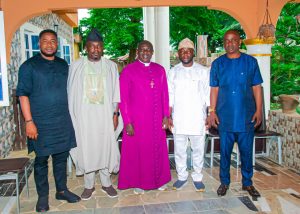
The growing campaign for equitable power sharing in Kogi State received a significant boost as the Bishop of the Anglican Diocese of Kabba declared his support for the principle of rotational leadership during a courtesy visit by the ONE KOGI AGENDA Advocacy Group. The delegation was led by Omoluabi Bode Adeyemi, Chairman of the Kogi State Special Advisers’ Forum and Special Adviser to the Governor on Energy Matters.
The visit formed part of the advocacy group’s ongoing statewide consultation with critical stakeholders, aimed at mobilizing support for an immediate summit on equitable power sharing among the three senatorial districts of Kogi State. The initiative seeks to foster broad-based dialogue capable of strengthening unity, promoting justice, and ensuring fairness in the distribution of political leadership across the state.
Speaking during the engagement, Hon. Omoluabi Bode Adeyemi explained that the campaign for power rotation is not driven by partisan interests or personal ambition but by the collective desire to build a more united, peaceful, and inclusive Kogi State where every senatorial district has a genuine opportunity to produce the state’s governor.
According to him, equity remains the strongest foundation for sustainable peace, political stability, and democratic development.
To illustrate his point, Omoluabi referenced the National Association of Kogi State Students (NAKOSS), where leadership has consistently rotated among the three senatorial districts. He noted that the arrangement has continued to foster peaceful coexistence, mutual respect, healthy competition, and unity among Kogi students.
He stressed that if power can successfully rotate among Kogi State students and continue to strengthen harmony within the association, then the same principle can equally be embraced in the wider society and the political leadership of Kogi State.
According to him, the success of the rotational arrangement within NAKOSS demonstrates that fairness promotes trust, reduces unnecessary rivalry, and gives every group a sense of belonging. He maintained that adopting a similar model in the governance of Kogi State would deepen inclusiveness, encourage political stability, and strengthen confidence in democratic institutions.
Hon. Omoluabi further emphasized that political power should never be acquired through opportunism but through justice, equity, and equal opportunity.
“Power should not be taken through opportunism but attained through equity and fairness. When we embrace equitable power sharing, every son and daughter of nobody can become somebody. That is the true essence of justice and democracy.”
He further observed that the campaign for equitable power sharing goes beyond party politics and should be regarded as a people’s movement anchored on fairness and collective progress.
“This issue goes beyond politics because politicians are merely actors whose actions are often influenced by personal interests. But when an issue concerns the people, it becomes part of their culture, identity, and collective aspiration. Political parties may rise and fall, but the will and interests of the people will always endure.”
He acknowledged that various opinions have been expressed regarding the issue of power rotation, with many stakeholders presenting arguments to support their respective positions. Nevertheless, he urged all Kogites to rise above personal interests and embrace a solution that guarantees justice, fairness, unity, and peaceful coexistence for present and future generations.
Speaking on the growing agitation from Kogi West, Hon. Omoluabi maintained that the demand for the governorship is both legitimate and historically justified, considering that the district has remained without producing a democratically elected Governor since the creation of the state over three decades ago.
“If someone from Kogi West is asking for the governorship, there is every reason to do so because, for 36 years, no one from Kogi West has occupied the office of Governor. Instead of questioning why they seek power, we should be discussing how to make it possible. In 1999, we all agreed on the principle of power sharing, and our son emerged as the candidate of the ruling party, although he did not win the election.”
He further pointed out that the political evolution of Kogi State has always depended on strategic collaboration among the three senatorial districts, insisting that no district has ever produce Governor without another district.
According to him, every successful governorship election in the state has been built on alliances, mutual understanding, and cooperation across regional and ethnic lines.
“Kogi has been structured in such a way that no district can succeed alone. Alliances have always been part of our political journey. Former Governor Ibrahim Idris relied significantly on the support of Kogi West to secure victory, just as the alliance between Kogi Central and Kogi West contributed to the emergence of Governor Ahmed Usman Ododo.”
Responding to the presentation, the Bishop of the Anglican Diocese of Kabba commended the advocacy group for promoting peaceful dialogue on a sensitive political issue. He described the campaign for equitable power rotation as a commendable initiative capable of strengthening unity, justice, peaceful coexistence, and inclusive governance across Kogi State.
The Bishop noted that every society thrives when fairness becomes the foundation of its political system, adding that equal opportunities for all sections of the state would reinforce confidence in democratic governance and strengthen the bonds of brotherhood among the people.
He also offered special prayers for the administration of Governor Ahmed Usman Ododo, asking God to grant the Governor wisdom, divine guidance, sound health, strength, and greater capacity to continue providing purposeful leadership and delivering democratic dividends to the people of Kogi State.
The ONE KOGI AGENDA Advocacy Group reaffirmed its commitment to sustaining consultations with traditional rulers, religious leaders, political stakeholders, youth organizations, women groups, professional bodies, civil society organizations, and community leaders across the state.
The group stated that these engagements are aimed at building statewide consensus ahead of an immediate summit on equitable power sharing, where stakeholders from all parts of Kogi State will deliberate on practical pathways toward institutionalizing fairness, inclusion, and balanced political representation.
The advocacy group concluded that its mission is driven by a sincere commitment to strengthening unity, preserving peace, promoting justice, and ensuring that every senatorial district enjoys a genuine sense of belonging in the governance and political future of Kogi State.
Signed:
Omoluabi Media Network