
 By joshua
 FROM YAGBA TO ANKPA: HOW ILLEGAL MINING IS BANKROLLING INSECURITY IN NIGERIA
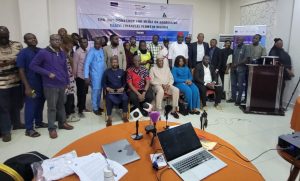
Participants at ANEEJ Abuja Workshop.
…As Kogi Suspends Operations in Ankpa and ANEEJ Trains Journalists to Track Illicit Financial Flows
Beneath Nigeria’s soil lies wealth capable of redefining the nation’s economy. From gold in Zamfara and Osun, to lead-zinc in Ebonyi, tin in Plateau, coal in Enugu, and iron ore in Kogi, the mining sector has the propensity to overtake the gains made in the oil sector and make Nigeria’s economy truly diversified. But instead of prosperity, what is playing out in many communities is violence, poverty, environmental destruction, and a growing security threat.
The reason is simple: inconsistency and weak regulation have allowed artisanal and illegal mining to become the order of the day. Security experts now warn that these unregulated activities have become a major pipeline for Illicit Financial Flows, IFFs, used to fund terrorism and banditry across the country.
The crisis is no longer confined to the North West or North Central alone. In Kogi State, illegal mining has taken root and is making communities increasingly vulnerable. In parts of Yagba land in Kogi West, unlicensed miners have invaded farmlands and forests, digging pits without government approval. The activities have led to land degradation, polluted streams, and clashes between locals and armed groups who now control some of the sites. Residents complain that young people are being lured into the trade, while proceeds from the minerals are moved out of the state in cash, with no records and no benefit to host communities.
The story is the same in Ankpa and other parts of Kogi East, where coal and other solid minerals have been extracted illegally for years. Traditional rulers and community leaders have raised alarm that the influx of illegal miners has brought in strangers, increased crime, and exposed villages to attacks. Because there is no oversight, revenues that should go to government coffers disappear, while the environment is left devastated with abandoned pits that have become death traps for children and livestock.
It is this devastation that the Kogi State Government is now addressing. In a public notice issued on Tuesday and signed by Muhammed Jamiu, Special Assistant on Media and Publicity to the Commissioner, Engr. Bashiru Gegu, the Kogi State Ministry of Solid Minerals and Natural Resources announced a temporary suspension of all mining activities in Ankpa Local Government Area to allow for an ongoing rehabilitation exercise.
The exercise is being carried out in collaboration with the Mining Association, Ankpa Local Government Council, and the Ministry. The Ministry urged all stakeholders to comply “until further notice” and said the suspension is part of the Ododo administration’s commitment to promoting sustainable mining practices and ensuring environmental safety across Kogi State.
Nationally, the pattern is repeating. Unregulated mining pits collapse on workers. Rivers are poisoned with mercury and cyanide. Farmlands are destroyed. Children are pulled out of school to dig. And because most transactions happen outside government channels, the money is moved through informal networks that security agencies cannot track. Analysts warn that this opacity makes it easy for armed groups to access financing for weapons, logistics, and recruitment. In effect, every smuggled bag of solid minerals could be translating into bullets on Nigerian streets.
It was against this backdrop that the Africa Network for Environment and Economic Justice, ANEEJ, with funding from the European Union through the SecFin Africa Project, held a two-day capacity building workshop for 30 journalists from across the country in Abuja from 25th–26th June 2026. The workshop, themed “Strengthening the Capacity of CSOs and Journalists to Contribute to Addressing IFFs in Nigeria,” focused on reporting Illicit Financial Flows and their link to insecurity in the mining sector.
In his welcome address, ANEEJ Deputy Executive Director, Mr. Leo Atakpu, said the media is central to exposing corruption and holding power to account.
“Illicit Financial Flows remain one of the greatest threats to Nigeria’s economic development, democratic governance and social justice. They occur through corruption, tax evasion, trade mis-invoicing, money laundering, procurement fraud, profit shifting and other illegal financial practices that deprive the country of resources needed for development,” Atakpu said.
He added that the training was designed to equip journalists with practical skills in investigative reporting, data analysis, use of the Freedom of Information Act, procurement monitoring, beneficial ownership reporting, and ethical handling of sensitive financial crime stories.
Delivering remarks on behalf of the SecFin Africa Project, Prof. Abdullahi Shehu, former Director General of GIABA and SECFIN representative, said the overall objective is to support African countries in the fight against money laundering and terrorism financing.
“The goal for SECFIN is to support and strengthen CSOs and the media in combating terrorism, money laundering and terrorism financing in Nigeria, and to sensitize the media as the voice of society to fight IFFs in the country,” Prof. Shehu stated.
Also speaking, Ibrahim Baba Mohammed, Chief GRC Officer of the Nigerian Financial Intelligence Unit, NFIU, said the workshop came at a critical time.
“IFFs continue to affect the nation’s resources for development. They have negative consequences and call for a societal response. We need financial crime reporting with a unique response that follows the money trail and demands accountability,” Mohammed said.
Mahmud Isah, speaking on behalf of the Special Control Unit Against Money Laundering, SCUML, lamented that millions of dollars are lost annually to IFFs across Africa and stressed that the trend must be stopped.
On policy and regulation, speakers called on the Federal and State Governments to harmonize mining policies and strengthen institutions. “We must strengthen the Nigeria Mining Cadastre Office and the Mines Inspectorate, and ensure that all artisanal miners are properly documented and organized into cooperatives. Without data and regulation, we are simply mining insecurity,” a resource person said.
On security and intelligence, facilitators urged security agencies to reclassify illegal mining sites. “These sites should be treated as potential terrorism financing hubs, not just economic crimes. We need better intelligence sharing between the EFCC, NSCDC Mining Marshals, and the military to track the money, not just the minerals,” another speaker stated.
On community impact, participants stressed that host communities must be at the center of solutions. “We must engage host communities, provide alternative livelihoods, and ensure that mining benefits translate to schools, hospitals, and roads instead of violence. Communities in Yagba and Ankpa are telling us the cost is too high,” a speaker noted.
On transparency, a presenter emphasized global best practices. “The full implementation of the Extractive Industries Transparency Initiative in the solid minerals sector is critical. EITI gives us the tool to track revenues, expose leakages, and name those profiting from the shadows,” she said.
Participants were also taken through sessions on the drivers, trends and development impact of IFFs in Nigeria, as well as the mandates of institutions such as EFCC, ICPC, NFIU, Nigeria Revenue Service, Nigeria Customs Service and the Bureau of Public Procurement.
A major outcome of the engagement was a clear charge to the media to serve as watchdogs. Journalists were urged to move beyond reporting attacks to investigating the money behind them. This includes tracking suspicious mining licenses, exposing smuggling routes, naming complicit officials, and telling the human stories of communities in places like Yagba and Ankpa that are paying the price. Facilitators noted that illicit financial flows thrive in the dark and that consistent, data-driven reporting by the media can cut off the oxygen that funds insecurity.
ANEEJ said the success of the workshop would be measured by the quality of investigative reports, public awareness and policy conversations that emerge after the training. The organisation expressed appreciation to the European Union, the SecFin Africa Project team, resource persons, and partner institutions including GIABA, NFIU and SCUML for their support.
ANEEJ and its funding partners deserve commendation for convening the workshop. At a time when states like Kogi are taking bold steps such as the suspension in Ankpa, and when Nigeria is grappling with insecurity and seeking to diversify the economy, equipping the media to follow the money in the mining sector is both strategic and urgent.
Nigeria does not lack mineral resources. What it lacks is control. Until artisanal and illegal mining is formalized, regulated, and monitored, from Zamfara to Yagba and Ankpa, the sector will continue to undermine rather than uplift the economy. The suspension in Ankpa signals that governments are beginning to act. Securing the mines may well be the difference between a diversified economy and a diversified crisis.