
 By joshua
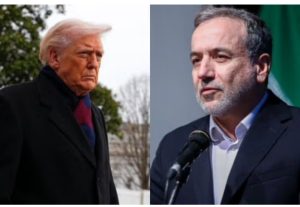
 Trump-Araghchi Altercation: When Agreement Cuts Deeper Than Disagreement
By Abdulkarim Abdulmalik
In a world defined by divisions and rhetoric, two adversarial voices often find themselves in agreement, even briefly. The recent striking exchange between the President of the United States, Donald Trump and Iran’s Foreign Affairs Minister, Abbas Araghchi, brought to the global audience something both ironic and unsettling: a shared statement on nuclear danger that quickly spiraled into a moral indictment.
Trump’s remark was characteristically blunt: “When mad people have nuclear weapons, bad things happen.” It is a statement that literally carries an undeniable truth. Nuclear weapons, by their very existence, amplify the consequences of human error, ego, and miscalculation. They are not merely tools of war. They are instruments of irreversible devastation.
Then came swiftly, Araghchi’s measured, yet piercing response: “Trump is right. The United States is the only country that has used nuclear weapons against civilians twice. That is madness.”
What began as a rare moment of agreement instantly turned into a rhetorical boomerang. Trump’s warning, intended as a critique of perceived adversaries, was redirected back to American history itself; leaving in its wake, the deeper discomfort of this exchange.
*The Weight of History*
Araghchi’s remark invokes the indelible history of Atomic bombings of Hiroshima and Nagasaki; events that remain among the most devastating episodes in human history. For many outside the United States, these bombings are not simply historical facts; they are enduring symbols of the catastrophic potential of nuclear power when wielded without restraint.
Within the United States, however, the narrative is more complex. The bombings are often framed as a grim necessity that hastened the end of World War II and ultimately saved lives that would have been lost in a prolonged conflict. This duality, necessity versus moral cost, continues to shape global perceptions of American power.
Araghchi’s throwback therefore does more than score a diplomatic point. It reopens an unresolved ethical debate, reminding the world that the question of “who is mad” in the nuclear age remain unsettled. Very far from it!
*Rhetoric vs Responsibility*
Trump’s statement fits neatly into a long-standing pattern of political rhetoric: framing nuclear capability as dangerous when held by rivals or controlled by allies. It is a logic that underlines modern geopolitics, where the legitimacy of power often depends less on the weapon itself; but more on who possesses it.
Thus, Araghchi’s reply challenges this selective framing. So, his pointing to historical precedent underscores a critical inconsistency: if the use of nuclear weapons is the ultimate measure of “madness,” then past actions must be part of the present judgment.
This is where the exchange transcends mere political brawling. It exposes a deeper truth about international relations—the tendency of nations to define morality through the lens of their own interests. In such a framework, accountability becomes selective, and memory becomes political.
*The Power of a Punchline*
What makes this moment particularly striking is its structure. It begins with agreement; a rare and almost disarming occurrence in the current climate of U.S.-Iran tensions. But that agreement serves merely as a setup for a devastating upshot.
Araghchi’s response works. It is laced with potency; not because it contradicts Trump, but because it amplifies him. By accepting the premise and then extending it to its logical conclusion, he transforms a general statement into a pointed critique. It is rhetoric at its most effective: concise, ironic, and difficult to dismiss.
In an age dominated by soundbites and viral moments, such exchanges carry significant weight. They shape public perception, influence diplomatic narratives, and often linger longer than carefully crafted policy statements.
*A Mirror to the Nuclear Age*
Beyond the personalities involved, this exchange reflects a broader tension within the nuclear order itself. The world continues to operate under a paradox: nuclear weapons are universally acknowledged as catastrophic, yet they remain central to national security strategies.
Efforts like the Treaty on the Non-Proliferation of Nuclear Weapons aim to limit the spread of these weapons, but they also implicitly legitimize their possession by a select group of states. This imbalance fuels resentment, suspicion, and even defiance.
For countries outside this privileged circle, the message can appear contradictory: nuclear weapons are too dangerous for you while it is necessary for us who possessed them. This brazen and irrational contradiction tmcontinues to challenge the credibility of global non-proliferation efforts. A clear case of oppression. It’s neo-slavery to say the least.
*The Human Cost Behind the Words*
Lost in the intensity of this Trump-Araghchi vituperation is the human reality that underpins it. Nuclear weapons are neither abstract concepts nor rhetorical tools. They are devices capable of destroying entire cities, displacing millions, and leaving scars that last for generations.
The survivors of Hiroshima and Nagasaki- often referred to as _hibakusha_ – have spent decades reminding the world of this very painful reality. Their testimonies cut through political narratives, grounding the nuclear debate in lived experience rather than strategic calculation.
When leaders speak of nuclear weapons, whether in warning or in critique, they are speaking about forces that transcend politics. And yet, as this exchange shows, such discussions are often reduced to moments of point-scoring and historical artfulness.
*A Rare Agreement, A Deeper Divide*
In the end, the brief alignment between Trump and Araghchi reveals less about agreement and more about divergence. Both acknowledge the danger of nuclear weapons, but they differ profoundly over how that danger is understood and who is held accountable for it.
The irony is hard to ignore: a shared statement about the risks of nuclear power becomes a reminder of unresolved historical grievances and enduring geopolitical tensions. Agreement, in this case, does not bridge the divide. It sharpens it!
And perhaps that is the most telling aspect of this exchange. In a world where nuclear weapons remain a central feature of global security, even moments of consensus can carry within them the seeds of deeper conflict.
What begins as a simple truth – that nuclear weapons in the wrong hands are dangerous – quickly evolves into a far more complicated question: who decides which hands are “wrong”?
Until that question is answered with consistency and fairness, such exchanges will continue to resonate; not as signs of progress, but as reflections of a world still struggling to reconcile power with responsibility.
– Abdulkarim Abdulmalik, an Abuja-based Journalist can be reached on Email: nowmalik@gmail.com