
 By joshua
 Opinion: The Press, Power and Nigeria’s Unfinished Democratic Story
By Abdulkarim Abdulmalik
There was something larger than a routine government-media engagement in Enugu on Thursday.
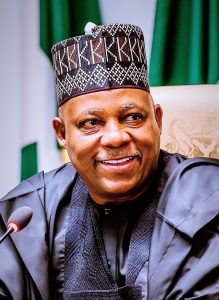
When Vice President Kashim Shettima stood before Nigeria’s editors and spoke about the historic contribution of journalism to the country’s democracy, he was, in effect, speaking about one of the most complicated relationships in any democratic society: the uneasy relationship between power and the people who scrutinise it.
His message was straightforward, but laced with profound its implications.
Nigeria’s democracy, he argued, owes much to journalists and editors who refused to accept silence as an option and insisted, sometimes at considerable personal cost, that citizens deserved to know what those in power were doing.
That history cannot be disputed simply because the contemporary media landscape has become more complicated.
From the struggle against colonial rule to the battles against military dictatorship and the eventual return to democratic government, Nigerian journalism has repeatedly served as a platform for public debate and political accountability.
Journalists have paid prices for that role. Some were detained. Some faced intimidation. Some lost employment. Others worked under conditions in which asking the not-toletated question could carry serious consequences.
It is this history that gives the Nigerian press its description as the “fourth estate of the realm.”
However, history is not merely something to celebrate. It is also something to live up to.
And this may be the more difficult part of Shettima’s message to the editors attending the 22nd All Nigeria Editors’ Conference organised by the Nigerian Guild of Editors at the International Conference Centre in Enugu.
He urged the media to scrutinise government, but also to tell “the full story” of Nigeria, including areas where progress is being made.
That is a reasonable proposition, provided “full story” does not become a euphemism for favourable coverage.
A free press cannot be expected to serve as government’s public relations department.
In the same vein, journalism should not become so deeply trapped in political confrontation that positive developments are ignored simply because they originate from an unpopular or controversial administration.
The newsroom must be bigger than politics. And that is where the real challenge lies.
*Beyond the headline*
Shettima cited economic indicators to make the government’s case. According to figures referenced in his address, Nigeria’s economy grew by 4.43 per cent in the second quarter of 2026, compared with 4.23 per cent in the corresponding quarter of 2025. He said agriculture, manufacturing, oil and gas, and services all recorded growth. He also pointed to a moderation in inflation from earlier levels.
These are important indicators. But they are not the end of the economic story.
Indeed, the Vice President himself acknowledged this when he noted that the real test was what such improvements meant for the cost of living and the purchasing power of ordinary Nigerians.
That admission is important because economic statistics and lived experience could sometimes tell different parts of the same story.
A country’s gross domestic product may expand while households continue to struggle with food, transportation, housing, school fees and other expenses.
Therefore, responsible journalism must do what neither government statistics nor political rhetoric could do alone: connect the numbers to human beings.
What does 4.43 per cent growth mean for the farmer?
What does it mean for the manufacturer struggling with energy costs?
What does it mean for the young Nigerian searching for employment?
What does it mean for the small business owner whose operating costs have increased?
What does inflation moderation mean at the market?
These are the questions that turn economic reporting into journalism. And they are precisely the questions editors should encourage their reporters to pursue.
The government deserves scrutiny; but hyphenated with accuracy
There is another important dimension to Shettima’s intervention. He acknowledged that government and the media “will not always agree, or should we.”
That is perhaps, with a sense of modesty, one of the healthiest statements that could emerge from a government-media engagement.
Democracy was never designed around universal agreement.
A government that expects journalists to agree with every policy proposal would be demanding something incompatible with press freedom. At the same time, a journalist who believes disagreement automatically makes government action illegitimate risks abandoning the discipline of evidence.
The answer lies in professional independence. Criticism should be supported by facts.
Praise should, likewise, be supported with facts while claims should be verified. Government statistics should be interrogated, not automatically accepted or rejected. And on the same strength, opposition claims should receive the same treatment.
That is the difficult but indispensable work of journalism.
*Nigeria needs a fact-based public conversation*
The challenge is particularly urgent because the information environment has changed dramatically. This is because, the traditional newspaper is no longer the only source through which Nigerians encounter news.
Social media platforms have transformed everybody into a citizen Journalist and potential publisher. Against this backdrop, a rumour could become a national controversy before a newsroom has finished investigating it. A manipulated video could gain the attention of millions of views. A misleading headline could travel farther than the correction.
This reality of our time has placed extraordinary responsibility on editors who are no longer decide what deserves publication exclusively.
The editor is now faced with the greater challenge of determining what Nigerians understand to be true. And such responsibility cannot be exercised casually.
To this end, the Nigerian public needs journalism that distinguishes between fact and allegation, evidence and assertion, analysis and propaganda. It needs journalism that can report an official achievement without becoming an official mouthpiece. It needs journalism that can expose government failure without transforming every government action into failure.
Most importantly, it needs journalism that gives citizens enough information to make informed judgments for themselves.
*The Tinubu reforms and the human question*
Shettima’s defence of President Bola Ahmed Tinubu’s economic reforms also illustrates why this balance matters.
The administration has argued that difficult reforms are necessary to establish macroeconomic stability and create the conditions for longer-term growth.
Critics, meanwhile, have focused heavily on the immediate consequences of those policies for households and businesses.
Given this reality, a serious newspaper should give room for both arguments.
The government’s position deserves examination while the experiences of citizens deserve examination too. Hence, neither position should automatically cancel the other. The question therefore, is whether the evidence supports the claims being made.
This is where journalism becomes more than political commentary. It becomes a public service.
If government says businesses are becoming more productive, reporters should investigate. If businesses say operating conditions remain difficult, reporters should investigate. If official figures show economic growth, the figures should be reported. If families say their purchasing power remains under severe pressure, their experiences should also be reported.
The journalist’s task is not to decide which narrative Nigerians must believe. It is to provide the evidence that allows Nigerians to understand the competing narratives.
*The Fourth Estate Must Remain Uncomfortable*
There is an uncomfortable truth at the heart of every democracy: governments rarely enjoy being scrutinised. But journalism was never created to make power comfortable.
The journalist asks the question that an official would rather avoid. The editor publishes the investigation that exposes an institutional weakness. While the newspaper keeps alive a public controversy that authorities would prefer to disappear.
That is not necessarily antagonism. It is accountability. But accountability itself must be accountable to truth.
A Media House that publishes unverified claims merely because they embarrass government is not strengthening democracy. Neither is a press that suppresses legitimate criticism because it wants to maintain cordial relations with those in power. Either case creates professional credibility gap.
The Nigerian media must therefore resist both intimidation and seduction. The government could attempt to influence journalism through access, patronage, advertising, political pressure or official recognition. Opposition politics could, likewise, seek to use the media as an instrument of political warfare. But the professional journalist is obliged to navigate both pressures.
*A Responsibility to the Future*
The most profound part of Shettima’s address was his description of journalists as custodians of Nigeria’s institutional memory.
That responsibility is easily underestimated. Governments come and go. Political parties rise and fall. Presidents leave office. Ministers are replaced. But the records produced by journalists remain.
Tomorrow’s researchers will look at today’s newspapers to understand what Nigeria was thinking, what government promised, what citizens complained about and how institutions responded. The newspaper of today is therefore potentially the historical document of tomorrow.
That makes accuracy more than a professional requirement. It makes it a national responsibility.
Nigeria’s democracy is still a work in progress. Its institutions are evolving. Its citizens are increasingly demanding accountability. Its media is confronting economic, technological and political pressures that previous generations of journalists could hardly have imagined.
In such an environment, the country needs neither a submissive press nor a reckless one. It needs a courageous press.
A questioning press.
An independent press.
But above all, it needs a truthful press.
Shettima’s appearance at the editors’ conference therefore offers an opportunity for something more valuable than applause or political controversy.
It offers a reminder that government and journalism occupy different sides of the democratic equation.
Government exercises authority. The media interrogates that authority. Citizens ultimately judge the results. The three cannot function effectively without credible information.
Nigeria’s democratic future will depend partly on whether these institutions could maintain that delicate relationship without surrendering their independence.
The media must continue to ask uncomfortable questions. Government must continue to tolerate legitimate scrutiny. And journalists must continue to remember that their ultimate constituency is neither the government of the day nor the opposition of the moment.
It is the Nigerian public.
That is why the most powerful meaning of the Vice President’s appeal to tell the “full story” is not that journalists should celebrate government. It is that they should refuse to tell only half the truth.
For a country as complex as Nigeria, anything less would be a disservice to democracy.
– Abdulkarim Abdulmalik is an Abuja-based Journalist. Email: nowmalik@gmail.com