
 By joshua
Rainbow Coalition Hits the Bricks: Wike’s Ambition Collides with APC Governors’ Resolve
By Alao Adamadamosi Sunday, arpa
The political gambit that Nyesom Wike hoped would cement his status as the ultimate kingmaker ahead of 2027 has run into a brick wall—and the wall was built by the very party whose president he claims to be fighting for.
For months, the Minister of the Federal Capital Territory has been assembling what he calls a “Rainbow Coalition,” a cross-party alliance designed to mobilise support for President Bola Tinubu’s re-election while allowing politicians from opposition parties to pursue their own ambitions on separate platforms. It was, in Wike’s telling, a political masterstroke—a way to broaden Tinubu’s base without forcing allies to abandon their parties.
On Monday night, the Progressive Governors’ Forum (PGF) made it clear that the masterstroke would not be tolerated.
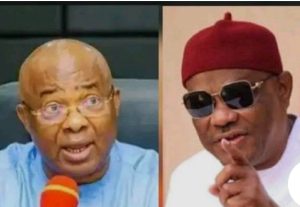
After a closed-door meeting in Abuja, the APC governors, led by Imo State Governor Hope Uzodimma, issued a resolution that left no room for ambiguity. The forum declared it would “not participate in, support or endorse any alliance or political arrangement capable of undermining the re-election of Mr President, weakening the APC or adversely affecting any candidate of the party at all levels”.
Uzodimma was even more direct: “The forum has no intention to support any candidate at any level that is not an APC candidate because our candidates who are contesting the election are being sponsored by our party. The governors’ campaign commitment is exclusively to all APC candidates”.
The message was unmistakable. The party machinery would be deployed exclusively for APC candidates, and any parallel structure—no matter how well-intentioned—would be treated as a threat to party discipline. While the governors did not name Wike directly, the subtext was lost on no one. The Rainbow Coalition, which Wike has been championing since 2025, had been formally rejected by the very governors whose states he needs to deliver.
Wike’s response, delivered through his Senior Special Assistant on Public Communications, Lere Olayinka, was swift and characteristically combative. The Minister challenged the governors to “go and face” their state elections, declaring that his political commitment for 2027 is to President Tinubu’s re-election and “not to candidates of the All Progressives Congress (APC) contesting governorship, National Assembly or State House of Assembly seats”.
He reminded the governors that his support for Tinubu in 2023 was never contingent on an alliance with the APC. “I never met with the APC before myself and other members of the G5 supported the President,” he said, stressing that the Rainbow Coalition is “its own way of mobilising support across political parties for Mr President, who has done well to deserve a second term”.
Wike also fired a pointed rhetorical salvo at Uzodimma, questioning how the APC won two Senate seats in Imo State in 2023 when Tinubu secured less than 15 per cent of the presidential vote. “Was it a rainbow coalition? Were the voters confused?” he asked. The implication was clear: cross-party voting is already a reality in Nigerian politics, and the governors’ fears of divided loyalty are either naive or disingenuous.
The irony of the Rainbow Coalition’s collapse is that it was never entirely clear what it was. Wike described it as a multi-party platform under the “Renewed Hope Family,” with members drawn from both the APC and the PDP. Its primary objective, he insisted, was to mobilise support for Tinubu’s re-election, while members remained free to contest elections under other political parties.
But the ambiguity that Wike saw as flexibility, the APC governors saw as a recipe for confusion. Their concern was practical: if voters are asked to support Tinubu for president while voting for PDP or other party candidates for the National Assembly and state assemblies, the result could be a split ballot that damages APC candidates across the board. A source close to the governors told one of the National dailies that the coalition “could confuse voters and ultimately reduce the votes Tinubu secured”.
The concern is particularly acute in states like Rivers, Kwara, Gombe and Cross River, where political figures associated with the coalition are preparing to contest against candidates backed by the ruling party. In Rivers State, the coalition had already endorsed a consensus governorship candidate, Kingsley Chinda, setting up a direct confrontation with the APC’s own flagbearer.
What the Rainbow Coalition controversy has exposed is not just a personality clash between Wike and the APC governors, but a fundamental disagreement about what the 2027 election is actually about.
For Wike, 2027 is a presidential election first and foremost. His entire political identity since 2023 has been built on his support for Tinubu—a gamble that earned him a ministerial appointment and a reputation as a kingmaker. He has staked his political future on Tinubu’s re-election, declaring that he expects to be “among the first politicians targeted” if Tinubu loses. For him, the Rainbow Coalition is a vehicle to maximise pro-Tinubu mobilisation, regardless of party labels.
For the APC governors, 2027 is a party election. They are fighting to retain control of their states, to secure National Assembly seats, and to ensure that the party’s structure remains intact. They see the Rainbow Coalition as an attempt by an outsider—a PDP member, no less—to build a parallel power structure that could undermine their own candidates. As one analysis put it, the governors’ resolution is “a defence of party integrity—a declaration that the APC will not be used as a vehicle for candidates who refuse to bear its name”.
When the author first examined Wike’s political trajectory, he asked whether his journey represented a genuine conversion—a realisation that Tinubu’s re-election transcended party lines—or a calculated manoeuvre by a master political operator. The events of the past week have provided an answer, though perhaps not the one Wike would have preferred.
The Rainbow Coalition has not converted the APC to Wike’s vision of cross-party politics. It has not persuaded the governors to embrace his brand of transactional alliance-building. Instead, it has united the APC governors in opposition to him, exposed his isolation within the party he claims to serve, and raised questions about whether his influence is as formidable as he believes.
Wike’s defenders might argue that the coalition is still alive, that it continues to mobilise support across states, and that the governors’ opposition is merely a bump in the road. But a coalition that has been formally rejected by the governing party’s governors is not a coalition in any meaningful sense. It is a political vehicle without a road to travel.
The FCT Minister is not a man who retreats easily. His response to the governors’ resolution made clear that he intends to press ahead with the Rainbow Coalition, framing the opposition as a sign of political weakness rather than strength. He has described the governors as “politically lazy” and insisted that he is not answerable to them.
But the math is unforgiving. To deliver Tinubu in 2027, Wike needs the cooperation of the APC governors. Their party machinery, their control of state resources, and their grassroots networks are essential to any presidential campaign. A coalition that operates in opposition to that machinery is not an asset—it is a liability.
The Rainbow Coalition may yet survive in some form. Wike’s allies, including former Deputy Speaker Chibudom Nwuche, insist it will deliver Tinubu in 2027. But the coalition’s ambitions have hit the bricks of political reality. Wike’s road to 2027 now runs through the very governors he has spent the past week attacking. Whether he can rebuild that bridge—or whether he will continue to burn it—may determine whether he remains a kingmaker or becomes a cautionary tale.
“The APC Governors Forum unanimously resolved that its members will not participate in, support or endorse any alliance or political arrangement capable of undermining the re-election of Mr President, weakening the APC or adversely affecting any candidate of the party at all levels.” — Hope Uzodimma, Chairman, Progressive Governors’ Forum
“The forum has no intention to support any candidate at any level that is not an APC candidate because our candidates who are contesting the election are being sponsored by our party.” — Hope Uzodimma
“My support is for Tinubu, not APC. I will mobilise support for the re-election of the President. I never promised anyone that PDP will not field candidates to contest governorship, National Assembly and State House of Assembly elections.” — Nyesom Wike
Alao Adamadamosi Sunday writes from Lokoja.