
 By joshua
 Dr. Hajia Habiba Suleiman, Excels, Doing Well, On A Mission To Sanitize Secondary Education In Kogi
By Abu Micheal
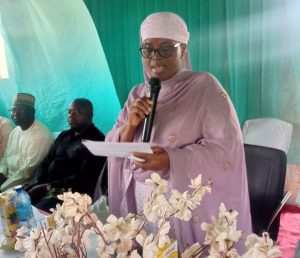
… How one administrator’s reforms, restoring standards, discipline, dignity to Kogi’s Senior Secondary Schools.
Since her assumption of office as Executive Chairman of the Kogi State Senior Secondary Education Board, KGSSEB, Dr. Hajia Habiba Suleiman has been deliberate, visible and unrelenting in her pursuit of a new standard for Secondary Education in the State.
Working in alignment with the vision of Governor Usman Ahmed Ododo to give Secondary Education Schools their pride of place, she has turned a once weakened system into what stakeholders now describe as the envy of the education sector in Kogi.
To many, it is no longer a question of if change will come, but how far it will go. For what Dr. Habiba has done within thus far, observers say, had not been witnessed in the Board, either now or in the past.
The Kogi State Senior Secondary Education Board is charged with regulating, supervising and improving standards in all public and approved private senior secondary schools. Its core functions include policy implementation, quality assurance, staff deployment, curriculum delivery oversight, conduct of examinations, and the promotion of co-curricular and extracurricular development.
Under Dr. Habiba, there is no gainsaying that the purpose for which the Board was established is being realized. Parents now see accountability. Students feel the push for excellence. Government sees results. Teachers are being reminded of their calling, and proprietors of private schools are being carried along rather than regulated out of business.
What makes an effective education administrator is the ability to balance firmness with vision, policy with compassion, and enforcement with encouragement. Dr. Habiba embodies that balance. She has led with integrity, opened the doors of the Board for dialogue, and insisted that discipline is the foundation of learning.
At strategic engagements in Lokoja and zonal meetings in Anyigba, she told principals and proprietors that senior secondary education is the bridge to higher learning, entrepreneurship and the workplace, and that the quality at this stage can make or mar society. She made mock examinations compulsory statewide, prioritized ICT and computer literacy ahead of the Federal Government’s planned CBT for WAEC and NECO, and announced digital training for principals to move schools into computer-based operations.
She also re-centered moral values. From JETS Club to Press Club and Current Affairs programs, she is pushing schools beyond the classroom into leadership, curiosity and critical thinking. At the same time, she has warned against examination malpractice and unethical transfers, insisting that no principal should accept a posting without a proper Board appointment letter.
Dr. Habiba has described herself as being “on a mission to sanitize” the subsector. That mission is visible. She has spoken against laxity, indiscipline and bribery around transfers and promotions. Where misconduct was uncovered, including alleged forgeries and extortion, the Board acted to redeploy and restore accountability. She has maintained that transfers are administrative tools, not punishments, and that every posting must serve students first.
She has also been hands-on. Unannounced visits to schools in Lokoja, Okene, Ohiana, Ahache and other communities have allowed her to assess teachers’ capacity, students’ progress and school environments. She commended clean, orderly schools and urged teachers to model the discipline they expect from students. “Teachers are the heart of development,” she said. “If you are not disciplined, it will be difficult to instil discipline in your students.”
Perhaps her most soothing quality is how she positions herself: a work in progress, not a lone hero. She has consistently called parents, PTAs, proprietors and teachers partners in nation-building. To private school owners, her message has been clear: “Our goal is not to regulate you out of creativity, but to create an enabling environment where private schools can thrive while maintaining standards.” The National Association of Proprietors of Private Schools, NAPPS, has welcomed the approach, describing the engagement as an eye-opener and pledging cooperation.
Board members have reinforced the reform narrative. Hon. Alhassan Ada Hussein has stressed daily supervision, accurate documentation and teamwork, while Hon. Paul P. Jibrin said the meetings are meant to reawaken commitment and chart a new path. Zonal Directors like Mrs. Mary Momoh have pledged total support, noting that the Chairman “hit the ground running.”
Thus far, the support of Governor Ododo and the dedication of the Board have produced visible gains. Quality assurance visits are now routine. ICT and data management are being prioritized. Moral and academic expectations are being reset. Parents say they are seeing a Board that listens, and students are being nudged toward excellence with structure and care.
Dr. Habiba herself remains measured about the journey. She does not pretend that every challenge is gone, but she is clear about the direction: secondary education must be safe, disciplined, digitally ready and academically strong.
In Kogi today, senior secondary education is being repositioned with purpose. With Dr. Hajia Habiba Suleiman at the helm, the Board is no longer just administering schools. It is restoring the confidence of a generation.