
 By joshua
 ‘GOING BEYOND HEADLINES, FOLLOW THE MONEY’: ANEEJ EQUIPS 30 JOURNALISTS TO TRACK ILLICIT FINANCIAL FLOWS IN NIGERIA
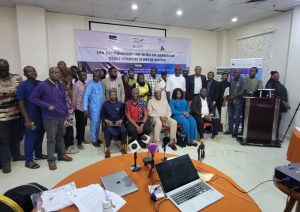
The fight against Illicit Financial Flows, IFFs, gained fresh momentum in Nigeria penultimate week as the Africa Network for Environment and Economic Justice, ANEEJ, assembled over 30 media practitioners for a two-day capacity building workshop in Abuja to sharpen investigative, ethical, and data-driven reporting on financial crimes.
Held at Hawthorn Suites, Abuja, under the theme “Strengthening the Capacity of CSOs and Journalists to Contribute to Addressing IFFs in Nigeria,” the training was funded by the European Union through the SecFin Africa Project.
ANEEJ said the workshop is rooted in a simple goal NGOs pursue when they train journalists: to equip reporters with knowledge, access, and tools so they can cover complex issues more accurately, deeply, and consistently — without dictating the news. For ANEEJ, that means closing knowledge gaps on IFFs, shaping public accountability, improving accuracy, and building long-term partnerships between the media, civil society, and accountability institutions.
Setting the tone, Prof. Abdullahi Shehu, SecFin Africa Programme Representative and former Director General of GIABA, told journalists that the media is an indispensable partner in combating IFFs.
“The media must go beyond news reporting. Act independently, serve as a bridge between citizens and government, and use IFFs tools to improve governance,” he said.
Prof. Shehu urged reporters to advocate for policy reform, monitor public expenditures and procurement, use data journalism to identify high-risk sectors, and push for disclosure of beneficial ownership. He also prioritized whistleblower support and protection.
To do the work, he listed practical tools: the Freedom of Information Act 2011, budget and expenditure tracking, social audits, beneficial ownership databases, trade data, money-trail analysis, asset tracing, network mapping, forensic accounting, and international standards like the UN Convention Against Corruption.
He identified major obstacles — political intimidation, limited access to records, safety risks, and gaps in funding and technical expertise — and urged media houses to form networks and promote open governance.
Taiwo Hassan of the Institute for Security Studies, ISS, charged journalists to build credible source networks, verify competence, avoid single-source stories, and protect identities.
“Your best defense is fact,” Hassan said during his session on Media Ethics, Legal Risks, Protection of Sources, Digital Security and Managing Risks in Investigative Reporting. He listed essentials for digital safety and urged reporters to use a risk checklist before publication to ensure balance, legal compliance, and source protection.
‘Nigeria’s Laws Are Strong, But Citizens Keep Beating Them’
Former EFCC Director, Mr. Aliu Mohammed Yusuf, explained the difference between money laundering and IFFs. “Money laundering focuses on concealment of criminal proceeds while IFF focuses on the movement of illicit funds,” he said.
He listed IFFs to include tax evasion, trade mis-invoicing, bribery, theft, FX racketeering, dubious privatisation, and payments to phantom contractors. Despite multiple laws, he said enforcement remains weak because “citizens have most times beaten the laws until they are apprehended.” He urged journalists to understand legal tools so they can track flows before perpetrators escape justice.
Premium Times Editor-in-Chief, Mr. Musikilu Mojeed, told participants to dig into CAC records, asset declarations, and offshore money trails.
“Nigeria is where we are because of illicit financing,” he said, urging reporters to check if politicians hide company ownership, visit project sites, track budgets and contracts, and follow cases in foreign courts where bribery often leaves evidence.
“Follow offshore money trails. Build yourselves up with information and earn the trust of people so they can share information with you,” Mojeed charged. He also advised collaboration with CSOs, global networks, and the use of leaks databases and investigative dashboards.
Investigative journalist Taiwo Adebayo said the media’s role is threefold: holding the powerful accountable; giving the public information to ask questions; and offering leads to law enforcement.
“ALL JOURNALISTS SHOULD DO THIS!” he said, referring to fact-checking, open-source checks, and seeking reactions. He urged reporters to use tools like CAC search, NG Check, Open Sanctions, Open Corporates, and ICIJ Offshore database, and to focus on procurement, beneficial owners, and illicit contract practices.
Opening the workshop, ANEEJ Deputy Executive Director, Mr. Leo Atakpu, said IFFs “occur through corruption, tax evasion, trade mis-invoicing, money laundering, procurement fraud, profit shifting and other illegal financial practices that deprive the country of resources needed for development.” He said the training would cover investigative reporting, data analysis, FOI use, procurement monitoring, beneficial ownership reporting, and ethical handling of sensitive stories.
Also speaking, Ibrahim Baba Mohammed, Chief GRC Officer of the Nigerian Financial Intelligence Unit, NFIU, who represented the Executive Director, described the workshop as timely.
“IFFs continue to drain resources meant for development. They have serious consequences and demand a collective response. We need financial crime reporting that follows the money trail and demands accountability,” Mohammed said.
Mahmud Isa, speaking for the Special Control Unit Against Money Laundering, SCUML, said millions of dollars are lost annually to IFFs across Africa and stressed the need to end the trend.
Other partners acknowledged for supporting the workshop include the Nigerian Financial Intelligence Unit, NFIU, and the Special Control Unit Against Money Laundering, SCUML. Resource persons from EFCC, ICPC, NFIU, Nigeria Revenue Service, Nigeria Customs Service, and the Bureau of Public Procurement also shared insights on mandates and legal frameworks.
At the close of the workshop, participants said the training had repositioned them for better reporting.
Abu Michael and Maryam Awuya, among others, described it as “eye-opening.”
“It has opened our knowledge on how to follow the money, track illicit financial flows, and placed us in a better position to report issues surrounding IFFs,” they said. They praised ANEEJ, its partners, and the European Union for the timely intervention, saying “it could not have come at a better time.”
ANEEJ said success will be measured by the quality of investigative reports, public awareness, and policy conversations that follow.
“In the fight against illicit financial flows, facts matter, evidence matters, context matters and responsible reporting matters. The media must remain a watchdog, a public educator and a platform for accountability,” Atakpu concluded.