
 By joshua
 PROF. NICHOLAS OKPE: HUMAN DIGNITY MUST GUIDE ARTIFICIAL INTELLIGENCE DEVELOPMENT
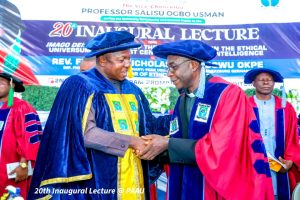
…Delivers 20th Inaugural Lecture at Prince Abubakar Audu University, Anyigba
A Professor of Ethics and Values, Rev. Fr. Prof. Nicholas Ojoajogwu Okpe, has called for human dignity to serve as the ethical compass for the development and deployment of Artificial Intelligence.
Prof. Okpe made the call on Tuesday, June 2, 2026, while delivering the 20th Inaugural Lecture of Prince Abubakar Audu University, Anyigba, at the University Auditorium. The lecture, titled “Imago Dei: The Dignity of the Human Being in the Ethical Universum of 21st Century Artificial Intelligence,” examined the philosophical, theological, and ethical implications of AI on humanity.
He argued that any serious conversation about AI must begin with a proper understanding of the human person. Drawing from the Christian doctrine of Imago Dei — the belief that humans are created in God’s image — Prof. Okpe stressed that this gives every person inherent dignity, worth, and moral responsibility that cannot be reduced to utility or technological efficiency.
“Conscience remains an indispensable moral compass,” he said. “No matter how intelligent machines become, they cannot replace human moral responsibility and accountability.”
The inaugural lecturer traced AI’s evolution from Information AI and Agentic AI to Physical AI and the emerging concept of Conscious AI. He warned that increasingly autonomous systems pose serious threats to human dignity through surveillance, privacy invasion, algorithmic bias, economic displacement, and the erosion of human autonomy.
Prof. Okpe urged developers, policymakers, and institutions to build AI systems within ethical frameworks anchored on justice, transparency, accountability, human rights, and the common good. “Technology must remain the servant of humanity, not its master,” he insisted. “Wherever efficiency conflicts with human dignity, dignity must prevail.”
He advocated for a global ethical and spiritual dialogue involving theologians, philosophers, scientists, technologists, and community leaders to shape a human-centred future for AI. He concluded that AI’s future should enhance human creativity, wisdom, justice, and compassion while preserving the sacred worth of every person.
Earlier, Chairman of the Inaugural Lecture Committee, Prof. Sunday Salifu Arogba, congratulated Prof. Okpe on the academic milestone.
In his remarks, Vice-Chancellor, Prof. Salisu Ogbo Usman, described the lecture as “timely, relevant, and intellectually compelling.” He noted that AI is transforming education, healthcare, governance, security, and research, and said the lecture reinforced universities’ responsibility to provide intellectual leadership on emerging global challenges. He commended Prof. Okpe for his contributions to ethical discourse and character formation, and appreciated the committee for sustaining the university’s culture of scholarship.
Highlights of the event included the presentation of a certificate, plaque, and medal to the inaugural lecturer. The lecture drew members of the University Management, Senate, academic and non-academic staff, students, traditional rulers, religious leaders, and guests from within and outside the university community.