
 By joshua
 A Christian First Lady, a Muslim Qur’anic Champion and a Lesson in the Nigeria We Can Build
By Abdulkarim Abdulmalik
Sometimes, a nation receives an important lesson without sitting in a classroom.
Sometimes, the lesson comes through a simple human encounter: a young girl who has worked tirelessly to master her faith’s sacred text standing before a national figure who recognises her achievement—not because they share the same religion, but because excellence deserves to be celebrated.
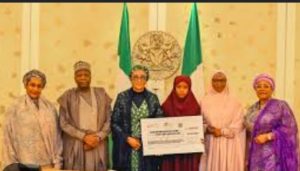
That was the strong symbolism behind First Lady Senator Oluremi Tinubu’s recognition of Maryam Ibrahim Dan’Azumi, the Nigerian Muslim girl who emerged winner of the women’s category at the 46th King Abdulaziz International Qur’anic Competition in Makkah, Saudi Arabia.
The First Lady awarded Maryam N20 million and commended her for bringing honour to Nigeria. She also praised Maryam’s parents, teachers, mentors and the Governor of Gombe State, Inuwa Yahaya, for their roles in nurturing the young woman’s talent.
On the surface, it was an award ceremony.
At a deeper level, it was a lesson in education, parenting, girl-child development, religious tolerance and the possibilities of interfaith harmony in Nigeria.
The encounter between a Christian First Lady and a Muslim Qur’anic scholar-in-the-making deserves to be viewed within this wider national context.
*When Religious Difference Becomes a Bridge*
Nigeria’s religious diversity is sometimes presented almost exclusively through the language of conflict.
News reports frequently remind Nigerians of religious disagreements, communal violence, intolerance and the exploitation of religious identity by individuals and groups pursuing political, social or economic interests.
But Nigeria also has another story. It is the story of Muslims attending Christian celebrations and Christians attending Muslim celebrations. It is the story of neighbours protecting one another’s places of worship. It is the story of parents encouraging children to respect classmates of another faith.
It is also the story of a Christian woman, a Pastor, publicly celebrating the extraordinary accomplishment of a Muslim girl.
The significance of Senator Tinubu’s gesture is therefore not simply that she gave Maryam money. It is that she recognised the value of an achievement rooted in a faith different from her own. That distinction matters!
Interfaith harmony does not require Muslims and Christians to surrender their theological convictions. It requires them to recognise the humanity, dignity and legitimate accomplishments of one another.
Maryam did not have to become a Christian for her achievement to be appreciated by a Christian.
The First Lady did not have to become a Muslim to honour a Qur’anic champion.
That is what mature religious and cultural pluralism should look like.
*The Education of a Child Cannot Be Reduced to a Certificate*
There is a larger educational lesson embedded in Maryam’s accomplishment.
Modern society often measures educational success through examination results, degrees, certificates and professional qualifications. These are important, but they represent only one dimension of education.
The education of a child must also involve character. A child should learn not merely how to pass an examination but how to live responsibly.
Religious education can contribute significantly to this process when it is taught with wisdom and connected to values such as honesty, compassion, justice, humility, self-discipline, respect and service to humanity.
Similarly, academic education equips children with intellectual tools for understanding and transforming their environment. But moral education helps them determine how those tools should be used.
The combination is particularly important in an age in which children are growing up amid enormous technological, social and cultural pressures. This is because, knowledge without values can be misused. Religious devotion without intellectual development can also limit opportunities.
The challenge before parents and educators is therefore to produce young people whose minds are educated, whose characters are developed and whose talents are responsibly deployed.
*Maryam and the Essence of Discipline*
Winning an international Qur’anic competition is not an ordinary accomplishment. Behind the public ceremony is a long story of study, memorisation, correction, repetition and perseverance. It is a story of a young person learning to stay committed to a demanding goal.
Those qualities have significance far beyond Qur’anic competitions.
The same discipline required to memorise the Qur’an can help a student pursue medicine. The same patience required to master a difficult religious text can help another student study engineering.
The same commitment required to compete internationally can help a young woman build a career in science, technology, law, journalism or public administration.
This is why religious education should not automatically be placed in opposition to secular or academic education.
For many families, the two can coexist. A child can study the Qur’an and mathematics. She can learn Islamic ethics and computer science. She can understand her religious heritage while acquiring the skills required to participate effectively in the modern economy.
Indeed, Nigeria needs precisely this kind of balanced education.
*The Girl Child Must Not Be Left Behind*
Maryam’s achievement is also a story about the Nigerian girl child. For decades, Nigeria has discussed the importance of educating girls. Yet the challenge remains substantial in many communities.
Girls must be encouraged to dream beyond traditional expectations. They must be allowed to discover their abilities.
They must have access to education, mentorship and opportunities to demonstrate what they can accomplish.
Maryam and her elder sister, Hajara, provide a remarkable example of what sustained parental encouragement can produce. Hajara reportedly won a similar international competition in Jordan in 2024, while Maryam subsequently achieved success in Saudi Arabia.
The message to parents is unmistakable: when children are supported, disciplined and properly guided, their talents can travel far beyond the communities in which they were born. The two sisters have proved this to be a statement of fact!
The girl child should therefore not be viewed merely as a recipient of protection. She should also be viewed as an intellectual, moral, spiritual and social asset capable of contributing significantly to national development.
*The Family Remains the First University*
Government can build schools. Religious institutions can establish learning centres. Universities can award degrees.
But the family remains the first environment in which a child learns what education means. Thus, Maryam’s parents deserve attention because their role demonstrates that achievement is rarely accidental.
A child may possess natural ability, but ability requires cultivation.
Parents must recognise talent, provide encouragement and make sacrifices.
They must also teach children that success carries responsibility.
Maryam’s parents apparently did not simply tell their daughters to win competitions. They supported a process of learning and development. That is a valuable model for Nigerian families.
Parents should ask not only, “What grade did my child obtain?” but also, “What kind of person is my child becoming?”
That question may ultimately be more important.
*Mentorship Is the Missing Link*
The First Lady’s advice to Maryam to embrace mentorship as she advances in her education is particularly relevant.
Talent without mentorship can easily become stagnant. Therefore, young people need adults who can help them navigate opportunities, avoid pitfalls, develop confidence and make responsible decisions.
Mentorship is especially important for young girls. A talented girl should be able to see examples of women who have successfully combined education, professional accomplishment, moral responsibility and service to society.
Religious communities, schools, government agencies, civil society organisations and private institutions should therefore develop structured mentorship programmes for young Nigerians.
The objective should not simply be to produce competition winners. It should be to produce responsible citizens.
*The National Meaning of a Gombe Girl’s Global Achievement*
Maryam comes from Gombe State, but her accomplishment has moved beyond the boundaries of the state. She represented Nigeria in an international religious competition and emerged victorious.
Her achievement therefore provides another opportunity to challenge the tendency to reduce Nigerian young people to statistics about unemployment, insecurity or social problems.
Nigeria has millions of talented children. They are in Gombe, Kano, Kaduna, Lagos, Enugu, Plateau, Kogi, Rivers, Borno, Abuja and every other part of the federation.
The question is whether the country will identify, nurture and provide platforms for those talents.
A nation cannot build its future merely by managing crises. It must also deliberately cultivate excellence.
*Recognition Should Become Investment*
The N20 million award is significant as recognition, but the First Lady’s willingness to support Maryam’s postgraduate education proves more consequential.
Financial rewards celebrate yesterday’s achievement while education can create tomorrow’s achievement.
Supporting Maryam to advance academically and intellectually will eventually permeate scholarship, education, youth mentorship and community development. This is the ultimate objective of talent recognition. Awards should open these doors.
Scholarships should create opportunities. Mentorship should develop character. And education should multiply impact.
*A Message for Muslim-Christian Relations*
There is also a direct message here for Nigeria’s Muslim-Christian relationship. The country does not need more suspicion between its two largest religious communities.
It needs more opportunities for ordinary Nigerians to encounter one another positively.
A Christian teacher helping a Muslim pupil.
A Muslim neighbour protecting a Christian neighbour’s property.
Christian and Muslim students collaborating on a community project.
Religious leaders jointly encouraging young people to reject hatred.
Government officials recognising citizens based on achievement rather than religious or ethnic identity.
These seemingly small acts can collectively change the atmosphere of the Nigerian communities.
Interfaith harmony is not created only at conferences. It is created in homes, classrooms, neighbourhoods, workplaces and public ceremonies. The Abuja recognition of Maryam is one such moment.
*The Nigeria We Should Bequeath to Our Children*
Ultimately, Maryam’s story should cause Nigerians to think about the kind of country they want to leave behind.
Do we want children to grow up believing that religious differences make friendship impossible?
Or do we want them to understand that one can remain firmly committed to one’s faith while respecting another person’s faith?
Do we want girls to be told that their possibilities are limited?
Or do we want them encouraged to pursue knowledge wherever their talents lead?
Do we want education to be reduced to examinations?
Or do we want it to produce knowledgeable, disciplined, ethical and compassionate citizens?
The encounter between Oluremi Tinubu and Maryam Ibrahim Dan’Azumi offers an answer without requiring a political argument.
A Christian First Lady honoured a Muslim girl.
A Muslim girl accepted the honour with gratitude.
A Nigerian state celebrated one of its daughters.
A national audience witnessed an example of religious respect.
And a young woman used her moment of recognition to encourage other young Nigerians to develop themselves mentally and physically.
Indeed, that is the real prize!
Beyond the N20 million, beyond the international trophy and beyond the headlines, Maryam’s achievement offers Nigeria a simple but profound reminder: children flourish when families nurture them, teachers guide them, faith communities educate them, society encourages them and the nation gives them room to shine.
Therefore, when Nigerians learn to celebrate excellence across religious boundaries, the achievement of one child can become a bridge between communities.
That is the Nigeria worth building—and the Nigeria worth bequeathing to the next generation.
– Abdulkarim Abdulmalik is Chairman, Governing Board, Guild of Interfaith Media Practitioners Nigeria (GIMP-Nigeria). Email: nowmalik@gmail.com; info@interfaithmediaguild.org